

[비즈한국] High-intensity reforms to stabilize the capital market have officially begun. With the new implementation of delisting regulations for penny stocks priced under 1,000 won, the fear of mass delistings among small and mid-sized listed companies is growing throughout the market.
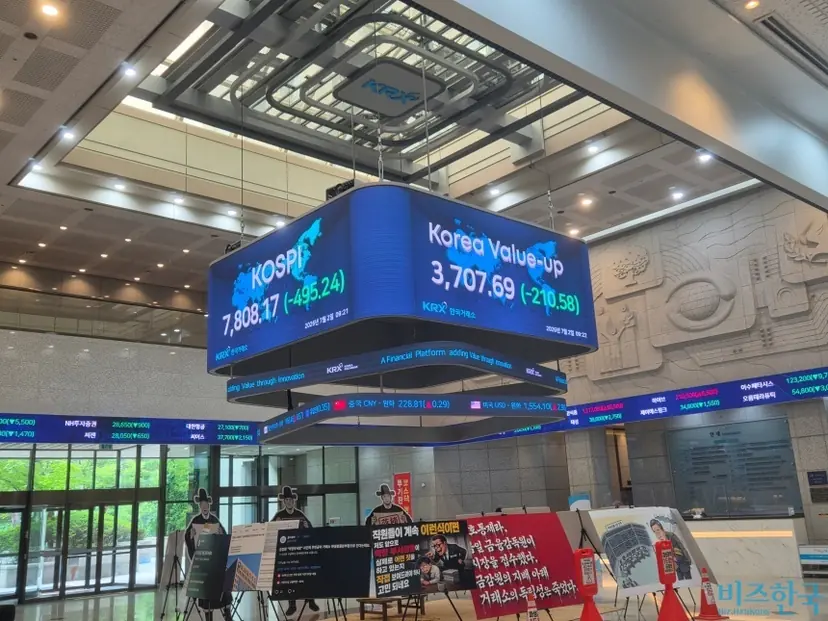
According to the Korea Exchange, as of the closing price on the 1st, there were a total of 224 companies with stock prices below 1,000 won. Among them, 21 are related to pharmaceuticals, biotechnology, and healthcare, including Cho-A Pharm034940, CMG Pharmaceutical058820, and PeopleBio304840.
Following the restructuring of the listing maintenance system that went into effect on the 1st, companies whose closing price remains below 1,000 won for 30 consecutive trading days will be designated as administrative issues. Subsequently, if the closing price does not recover to 1,000 won or higher for 45 consecutive trading days during a 90-trading-day improvement period, grounds for delisting will be triggered. In particular, decisions are based on the daily closing price, not intraday prices, effectively blocking attempts to bypass the rule through means like reverse stock splits or capital reductions.
Given this situation, the pharmaceutical and biotechnology industry, where long-term R&D investment is essential to achieve tangible results, is in a bind. They are facing a double whammy: chronic difficulties in raising capital and the need to defend stock prices and performance for survival.
Jung Yoon-taek, President of the Pharmaceutical Industry Institute, recently criticized the authorities' strengthened delisting requirements as a blanket regulation that ignores the unique nature of the drug development industry, which requires long-term investment. He urged a fundamental reform of the special technology listing system. President Jung emphasized, "Bio companies pressured by short-term financial requirements for maintaining their listing (such as sales and recurring losses) are dispersing their capabilities into immediate profit-generating businesses like cosmetics or health supplements instead of their core business of new drug R&D, which creates a vicious cycle that damages corporate value." He added, "Instead of using simple stock price or market capitalization as a yardstick, there is an urgent need for policy flexibility to introduce practical evaluation metrics tailored to industry characteristics, such as clinical progress achievements or global technology export potential."
"Qualitative Growth vs. Market Contraction": Differing Perspectives
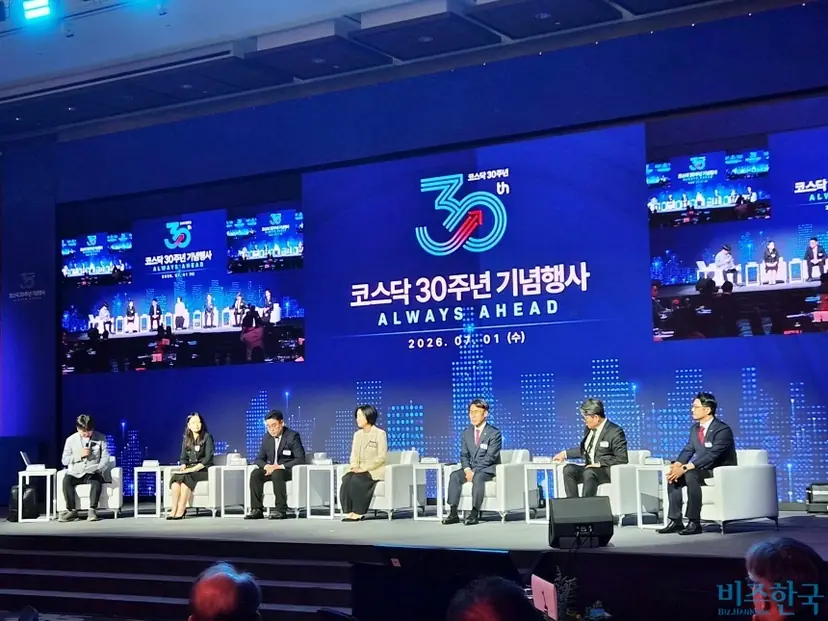
At a seminar marking the 30th anniversary of KOSDAQ held at the Conrad Seoul Hotel in Yeouido on the 1st, experts from various fields held a fierce debate over the delisting of marginal companies. While there was a consensus that the swift liquidation of insolvent companies is necessary for the qualitative leap of the KOSDAQ market, concerns were also raised that it could lead to market contraction. The Korea Exchange repeatedly emphasized that this measure is a necessary step for the virtuous cycle of the capital market. Choi Ji-woo, Managing Director of the KOSDAQ Market Division at the Korea Exchange, emphasized, "Strengthening delisting requirements is not aimed simply at the act of delisting companies," adding, "It is a task to prevent the inefficient allocation of venture capital caused by the meaningless prolongation of insolvent companies and to improve the fundamental constitution of the market."
Conversely, counterarguments were raised that mechanical criteria ignoring a company's life cycle and business model could actually crush the growth engine of promising innovative companies. Kang So-hyun, a researcher at the Korea Capital Market Institute, diagnosed, "In the current KOSDAQ market, which contains about 1,800 companies, it is unreasonable to regulate top-tier and bottom-tier companies under a single system," and suggested, "Appropriate support and a segmented approach reflecting size and characteristics must come first."
Field experts agree that a uniform yardstick that ignores company size and characteristics actually holds back innovation. It is pointed out that companies are experiencing a regulatory paradox where they are pressured by administrative demands rather than their core R&D while trying to cross the same regulatory threshold as large conglomerates. Jin Sung-hoon, Head of the Research & Policy Division at the KOSDAQ Association, advised, "Rather than focusing solely on regulation and delisting, we should create an environment where venture capital and growth capital can continue to flow in on a large scale so that companies can map out long-term visions," adding, "Building infrastructure tailored to innovative or special-category companies is more desirable to help companies grow."
Introduction of Tiering System and Significantly Strengthened Delisting Requirements
The exit of penny stocks is only a part of the cold winds blowing through KOSDAQ. Starting from the 1st, financial authorities and the Korea Exchange fired the signal flare for a major reform aimed at the swift exit of insolvent companies and the fostering of blue-chip companies.
The most notable point is the introduction of a KOSDAQ tiering system (segment separation). This involves strictly reclassifying the nearly 1,800 KOSDAQ-listed companies based on financial and liquidity criteria into a "Select (Premium)" segment centered on blue-chip and representative companies, and a "Management Group" centered on risky companies. This was benchmarked against the NASDAQ Global Select Market to overcome the phenomenon where investors turn away from the entire market because blue-chip and insolvent stocks are mixed together.
To weed out insolvent and marginal companies, measures such as establishing new delisting requirements for penny stocks priced under 1,000 won and raising the market capitalization threshold for maintaining a listing (20 billion won for KOSDAQ, 30 billion won for KOSPI) were also implemented. In addition, the delisting criteria for complete capital impairment under the electronic disclosure system was expanded from annual to semi-annual, and the cumulative disclosure violation points used as a benchmark for delisting were lowered from 15 to 10 points. The exchange also shortened the maximum improvement period granted to insolvent companies during substantive reviews from one year and six months to one year.
Chae Hyun-joo, an advisor at the law firm Yulchon, analyzed, "As the delisting procedure, which was previously operated as a three-instance system, has been reduced to a two-instance system, the practical period for companies to submit improvement plans and demonstrate their implementation ability has been halved, accelerating the pace of delisting," adding, "According to the Korea Exchange's simulation results applying the strengthened standards, it is expected that about 150 companies will be at risk of delisting this year alone."