

[비즈한국] “For the brave sky-travellers, maps of the celestial bodies.”
Kepler wrote this in a letter to the astronomer Galileo in 1610. Kepler believed that someday, in the distant future, ships and sails would be built to navigate between the stars. He envisioned that maps of the moon and Jupiter needed to be prepared before that day arrived. Kepler considered his and Galileo's study of the night sky to be more than just uncovering the mysteries of the universe; it was about drawing maps for a vast human future.
Now, we draw maps of the entire universe, not just Earth or the solar system. It is filled with countless galaxies. And each newly drawn map leads us to unexpected and strange discoveries.
Long ago, humanity believed the Earth was a flat world. But the Earth is a giant sphere. This always causes an annoying problem when drawing maps of the Earth. Trying to project the curved Earth onto a flat sheet of paper always results in unintended distortion.
Interestingly, curvature is a troublesome problem not only for Earth but for the entire universe. First, we need to clarify exactly what "curvature" means in the context of universal space-time.
Curvature refers to the geometry of the universe. The geometry of the universe is a different concept from the shape of the universe. The shape of the universe refers to whether it is spherical, donut-shaped, or something else entirely. One can imagine all sorts of shapes for the universe. It only describes what the universe might look like if viewed from an omniscient observer's perspective outside of it. However, what is more astrophysically meaningful is not the shape of the universe, but its geometry. Unlike the infinite variety of shapes, there are only three possibilities for the geometry of the universe: flat, closed, or open.
To determine the curvature of space-time, one can draw parallel lines. In a flat universe, parallel lines remain parallel forever. They never meet. In a closed universe, parallel lines eventually intersect, and in an open universe, the distance between the two parallel lines gradually widens. Similarly, if we want to know the curvature of our universe, we can draw parallel lines that extend endlessly through space. The best tool for this is light. Light always travels straight. The path of light bends because the space through which it travels is curved. Therefore, by following the path of light through space, we can determine how much the universe's curvature is bent and how flat it is.
If the universe has a very, very slight curvature, it is difficult to detect by drawing parallel lines over just a few kilometers. One must draw them for a long distance to truly know if those parallel lines will eventually meet or never touch. Thus, we must follow beams of light that have traveled the longest distances for a very long time. There is a perfect light for this. In fact, it is the Cosmic Microwave Background (CMB), the oldest light from the farthest reaches, which has been traveling ever since the primordial light began to spread throughout the universe right after the Big Bang.
This light is the primordial glow that began to spread when the hot, dense, and early universe cooled down sufficiently and cleared after the Big Bang's expansion. About 380,000 years after the Big Bang, at the moment the universe's temperature cooled below 3,000 degrees, the first beams of light began to push through the dense soup of primordial particles in the early universe. As a long time has passed since then, the heat has cooled evenly and spread across the entire universe as a faint, low-level temperature.
This light comes from every direction in the sky. It was emitted and spread simultaneously from everywhere in the universe. So at first glance, the CMB appears perfectly uniform. A very faint temperature of 2.7K is distributed quite smoothly. Until the 2000s, it looked that way. However, as space telescopes went up to capture the residual heat of the Big Bang, it was revealed that there are very fine, bumpy fluctuations within the CMB that seemed smooth at first. The scale of those fluctuations is very small—only at the level of one-part-in-100,000. Those small fluctuations appear as large and small smudges on the CMB map.
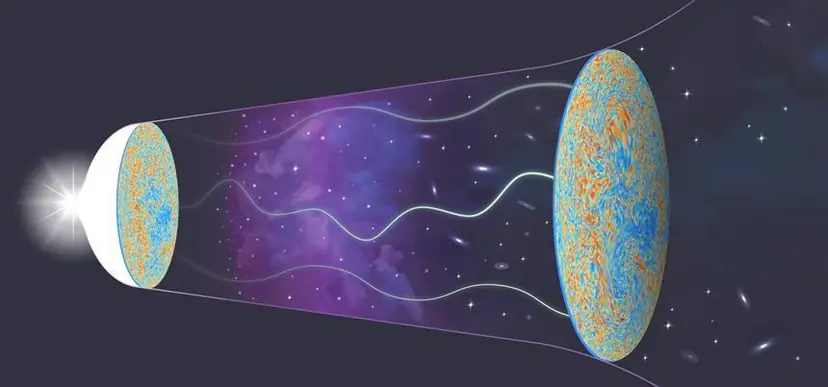
The size of the CMB smudges changes depending on the curvature of the universe. If the universe is flat, the light beams starting from the edge of the universe travel in parallel for 13.8 billion years, and the size of the CMB smudges remains unchanged. If it is a closed universe, the light beams eventually converge and meet. Because we perceive the light by extrapolating it backward, the smudges appear larger than they actually are. Conversely, in an open universe, the two parallel light beams drift further apart. Similarly, because we look at the light by extrapolating it backward, the CMB smudges appear smaller. By using this principle, we can determine whether the universe is flat, open, or closed through the distribution of the CMB smudges.
Starting with WMAP, which was launched into space in the 2000s, the CMB began to yield answers suggesting that the universe is effectively flat. Although observations continued for nine years, the CMB map consistently showed that the universe was flat. However, the Planck satellite, launched in 2009, began to raise controversy about the curvature of the universe. Compared to WMAP, the Planck satellite has nearly three times the resolution. It can see fluctuations on a much smaller scale. As it drew the CMB map with more sensitive eyes, fine effects that did not need to be considered in the past became important.
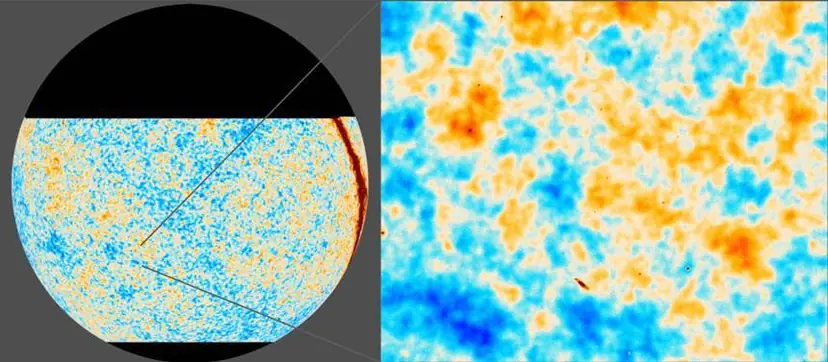
Massive galaxy clusters throughout the universe also bend the surrounding space-time. As the CMB light starting from the edge of the universe travels toward us, it passes through large and small galaxy clusters, causing the path of the light to bend. Local gravitational lensing effects by galaxy clusters occur. Of course, this effect is very small compared to the space-time effects of the entire universe. However, with eyes as sensitive as Planck's, these effects can be detected. Surprisingly, the CMB map drawn by Planck showed more traces of gravitational lensing than expected. There were unexpectedly many traces of distorted space-time throughout the universe that we thought would be perfectly flat. This is called the Planck lensing anomaly.
Some astronomers even thought this might be evidence that the actual universe is not perfectly flat. It could be because the universe is slightly closed. Of course, other observations, such as those by DESI and SDSS, which map the spatial distribution of galaxies across the universe, still show the universe as being perfectly flat. Therefore, it is difficult to be certain whether the universe is truly flat or closed. Perhaps the universe is indeed flat, and there simply happened to be more galaxy clusters creating gravitational lenses than expected.
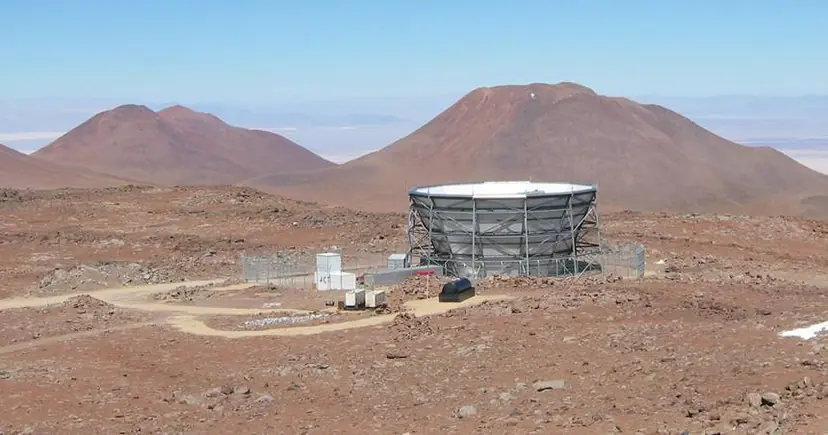
Recently, new results have emerged from using a giant ground-based radio telescope to complete a map of the CMB across the entire universe over six years. They utilized the Atacama Cosmology Telescope (ACT) in Chile. Through this telescope, standing alone at an altitude of 5,000 meters, researchers precisely observed the polarization of the CMB light. Even compared to Planck, it was possible to observe it three times more clearly. Polarization reveals the direction in which light waves oscillate. The curvature of the universe also leaves traces in the polarization of the CMB light. A galaxy cluster's gravitational lens not only bends the path of light but also twists the direction of the light's oscillation. By observing the degree of this twist, we can determine how frequent and strong gravitational lenses are throughout the universe. Subtracting this effect leaves only the effect of the universe's own curvature.
The new ACT observations show that the universe is almost perfectly flat. The traces of gravitational lenses that Planck discovered, which seemed more abundant, all cleanly disappeared. The universe, which appeared to have a more closed curvature in Planck's eyes, looks like a perfectly flat universe in ACT's eyes. Humanity, which long ago agonized over whether the Earth was flat or round and how to draw its map, is still agonizing over whether the universe is flat or round, spreading out a map of the universe that is not yet fully filled in.
This unexpected debate over the universe's curvature and geometry is called "curvature tension" in astronomy. There are various debates in astronomy, such as the Hubble tension and dark energy tension. Curvature tension is one of them. Like other tensions, although we clearly live in one universe, the universe looks slightly closed or perfectly flat depending on the observation method and tools. We do not yet know which of the two might be telling an unintended lie.
However, there is a fact that should not be overlooked here. ACT is a ground-based telescope after all. There is a limit to the scope of the sky that can be seen from a fixed point on the ground. No matter how thoroughly it scans, ACT can only see up to 40% of the total sky area, centered on the Southern Hemisphere. On the other hand, Planck is a telescope launched into space. So, it can constantly rotate its orientation to map the CMB from all directions of the universe.
If so, we can imagine something even more dramatic. It is possible that the curvature of the universe was only flat in the Southern Hemisphere sky that ACT targeted, while the entire universe might have a closed curvature. And this could be another challenge to the isotropy of the universe, which states that the universe is not only flat but also looks the same in every direction. This is because it would be a more shocking statement that the distribution and shape of the universe's large-scale structure, as well as the geometry of the universe itself, could vary depending on which direction you look.
The role of a map does not stop at simply making it easy to look at the scenery of the world we live in. Ultimately, the most important reason for drawing a map is that it serves as a guide on how to reach our intended destination.
References
https://iopscience.iop.org/article/10.1088/1475-7516/2025/11/063
https://iopscience.iop.org/article/10.1088/1475-7516/2025/11/061
Who is author Ji Woong-bae? He loves cats and the universe. After watching 'Galaxy Express 999' as a child, he developed a dream of making the beauty of the universe known. He is currently an assistant professor in the Faculty of Liberal Arts at Sejong University, participating in various science communication activities such as lecturing and writing. He has written books such as 'On the Uselessness of Astronomers', 'We Are All Born Astronomers', and 'Strange Questions That Come to Mind When Looking at the Universe', and translated 'How I Killed Pluto', 'Quantum Life', and 'UFO'.