

[비즈한국] It has been confirmed that Kyobo Book Centre has stepped back from its push to revise its digital content terms of service, which it had initiated under the pretext of ensuring artificial intelligence (AI) transparency, following strong opposition from the publishing industry. While the stated goal of the revision was to increase the transparency of AI-generated books, it also included changes to clauses unrelated to AI, such as strengthening liability for damages, enabling unilateral sales suspension, and designating exclusive jurisdiction for disputes. Following the publishing industry's decision to take joint action against these measures, it has been confirmed that both sides have recently entered into discussions.

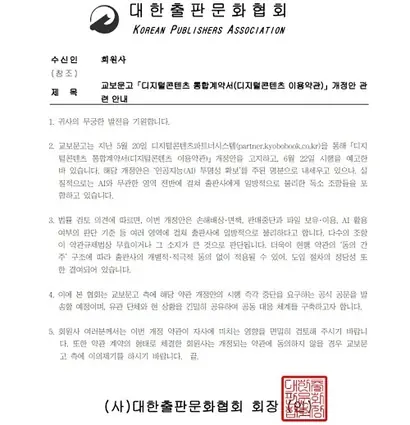
According to the publishing industry, Kyobo Book Centre notified partners on May 20 of a 'Revised Digital Content Integrated Contract (Digital Content Terms of Service)' through its partner system. Kyobo Book Centre explicitly stated that the reason for revising the terms was to secure transparency regarding artificial intelligence (AI). Digital content encompasses e-books converted from print, web content optimized for mobile devices, and audio/video books.
However, the publishing industry protested, claiming the revised terms contained clauses unfairly skewed against publishers. Perceiving that the changes would cause significant damage to the publishing sector, the Korean Publishers Association and the Korean Publishers Society sent an official letter to Kyobo Book Centre on June 10 requesting the suspension of the proposed amendments. Although the changes were scheduled to take effect on June 22 without a separate consent process, Kyobo Book Centre tentatively suspended the implementation after receiving the letter of protest.
According to the Korean Publishers Society, the revised terms included numerous toxic clauses. A legal review conducted by the society identified issues in approximately eight clauses. While two of these (blanket exclusion of AI-generated books and lack of AI labeling standards/control) were related to AI, six were unrelated: increased burden of proof for damages, total exemption of liability/full compensation upon failure to notify of rights expiration, shifting the guarantee of existing purchase services, potential for unilateral sales suspension, changes to exclusive jurisdiction for disputes, and integration clauses.
An official from the Korean Publishers Society stated, "The terms included clauses unfavorable to publishers as a whole, not just AI-related content. Many companies were likely unaware of the details," adding, "We viewed it as problematic that they attempted to revise terms that could harm publishers without any prior consultation."
The revised terms included a clause that would have uniformly excluded AI-generated books from member and B2B rental services. The issue was that the terms failed to specifically define AI-generated books or set concrete criteria for identification. An official from the Korean Publishers Association pointed out, "Modern e-books may contain tables of contents, covers, or illustrations created by AI. In some cases, AI is used for copy-editing or even writing the manuscript itself," noting that, "the scope of AI usage is extremely broad, and it was unclear to what extent these restrictions would apply."
The Korean Publishers Society also highlighted the problem with a clause requiring publishers to bear the burden of proving damages caused by illegal content distribution. While the existing terms required only a 'clarification' of damages, the revision changed this to 'objective proof.' A major incident occurred in 2023 when 720,000 e-books were leaked from Aladin bookstore, and there was significant friction before publishers were compensated even then. The Korean Publishers Society explained, "It is difficult for a publisher whose content has been leaked to secure evidence like logs. The information itself is asymmetrical," adding, "Strengthening the burden of proof for the damaged party could effectively block any compensation claims."
Among the toxic clauses was one changing the venue for disputes from mutual agreement to the exclusive jurisdiction of the Seoul Central District Court, where Kyobo Book Centre's headquarters is located. The industry expressed concern that if implemented, this would increase the burden for small publishers located outside the capital region, making it difficult for them to seek legal recourse.
There was also a clause that would allow Kyobo Book Centre to suspend sales at its discretion when issues related to digital content arise. The publishing industry pointed out that this is problematic because it allows sales to be halted without prior notice, explanation, or an objection process in the event of disputes with consumers, such as refund requests.
It has been confirmed that both sides have recently met to open a dialogue. Kyobo Book Centre and the publishing industry held a meeting on June 25 regarding the direction of the digital content terms revision. Kyobo Book Centre acknowledged the industry's concerns and officially suspended the implementation of the revisions. A Kyobo Book Centre representative stated, "It was a meeting to exchange and review the opinions of both sides," adding, "We have not determined specific revision directions yet, and we intend to coordinate and consult on the matter moving forward."
The publishing industry reportedly agrees with the original intent of the revision to prevent issues caused by AI-generated books. An official from the Korean Publishers Association stated, "Both sides formed a consensus regarding the labeling methods and related issues for AI-produced books. Since the initial purpose of the revision was to secure AI transparency, we agreed to address those points together," adding, "I understand that they are currently collecting industry opinions and re-examining the remaining issues internally."