

[비즈한국] A grand blueprint to transform the future of South Korea's industry was unveiled at the 'National Report on the 3 Major Mega Projects for Korea's Great Leap Forward' held at the Blue House Yeongbingwan on the 29th. President Yoon Suk Yeol officially declared 'Physical AI' alongside semiconductors and AI data centers as one of the three core pillars to drive the nation's great leap forward. Until now, AI technology has focused on software-based virtual exploration, but now, 'Physical AI'—where AI combines with robotics to perceive the physical environment, take action, and verify results—has been elevated to a national strategic task.
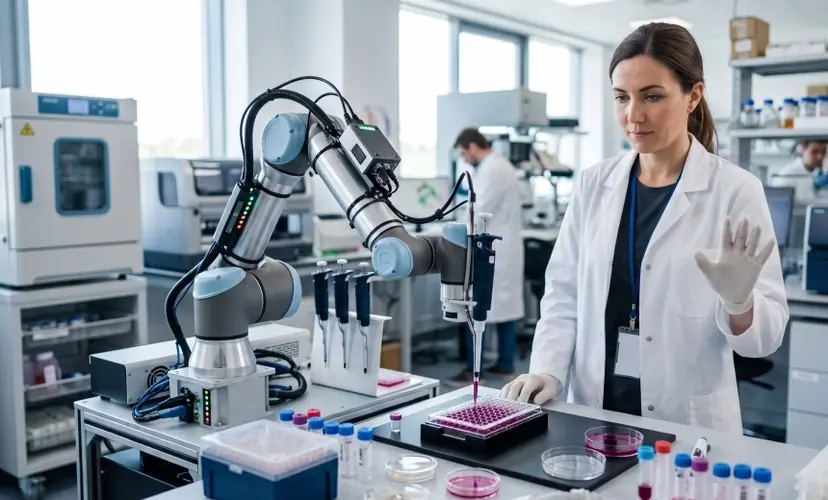
In the pharmaceutical and biotech sector, Physical AI is being noted as a technology that will change the drug development paradigm by increasing the productivity and reproducibility of R&D. Recently, Insilico Medicine became the first to successfully reach Phase 2 clinical trials with a drug designed by generative AI. With its idiopathic pulmonary fibrosis (IPF) treatment demonstrating significant lung function improvement in Phase 2a trials and preparing for subsequent stages, expectations for the commercialization of AI-developed drugs are rising. Beyond these achievements, it is predicted that the transition to Physical AI-based autonomous laboratories—which rapidly verify AI-predicted results in real-world labs and feed measurement data back into AI models—is an inevitable path and a turning point that will determine industrial competitiveness.
Autonomous laboratories are distinguished from simple existing automated equipment like High-Throughput Screening (HTS), which mechanically repeats protocols pre-set by researchers. It is an automated system linked with AI and robot-based systems that minimizes human intervention, connecting hypothesis formulation, experiment execution, data analysis, and model updating into a single closed-loop, allowing it to explore on its own and rapidly derive optimal results.
Leading global nations are expanding autonomous laboratories beyond individual equipment or single-lab levels into platforms linked across multiple institutions. The Acceleration Consortium (AC) in Canada has built a platform that links the entire R&D lifecycle, from medicinal chemistry to human organ mimicry and scale-up, deriving over 21 candidate groups in a short period. The Commonwealth Scientific and Industrial Research Organization (CSIRO) in Australia has also introduced a robot and AI-based Self-Driving Lab (SDL) system, achieving results that shortened the catalyst development period (the entire R&D process from optimal composition/reaction condition exploration to commercialization), which previously took about 5 years, to the 6-month level.
In particular, the performance of XtalPi in China is remarkable. XtalPi has built a large-scale research system that operates over 300 robotic workstations globally to perform experiments 24 hours a day. They combine over 500 proprietary AI models and quantum mechanics algorithms with automated equipment to ultra-rapidly repeat the 'design-synthesis-inspection-analysis' drug discovery cycle.
Based on this technical prowess, XtalPi is jointly conducting an innovative drug discovery research project with global pharmaceutical firm Eli Lilly, valued at up to $250 million (387.3 billion won). They are also conducting joint research with C&C Research Laboratories, a subsidiary of the domestic pharmaceutical company JW Pharmaceutical001060, to optimize lead compounds for a 'STAT6' protein-targeted anti-inflammatory treatment, which has had no successful development cases to date.
In contrast, the domestic ecosystem has a clear gap compared to the global level. Korea is still at the early Proof of Concept (PoC) stage at the individual lab level. While the Korea Institute of Science and Technology (KIST)'s 'OCTOPUS OS' and the practice infrastructure of the Korea Pharmaceutical and Bio-Pharma Manufacturers Association and Yonsei University's K-NIBRT project have begun to be built, it is pointed out that there is still a need for improvement in terms of connectivity between individual equipment and data standardization.
Experts advise that the domestic pharmaceutical and biotech industry should move away from the quantitative strategy of expanding hardware and move toward qualitative advancement centered on an Operating System (OS) that integrates data flow and experimental procedures. The diagnosis is that establishing a structure to integrate data scattered by equipment into a standard format and metadata system, and to enhance the decision-making capabilities of AI models through real-time experimental feedback, is the most urgent task. Kim Min-seok, a senior researcher at the Korea Health Industry Development Institute, emphasized, "Unlike existing automation that simply repeats set protocols, the core of SDL is a closed-loop system that learns from experimental results to explore and adjust the next conditions on its own," adding, "Competitiveness is now determined by data standardization, interoperability, and the maturity of operating software rather than the performance of individual equipment."
For such technical and institutional shifts, suggestions are also being made that the creation of 'open, public autonomous experiment hubs' led by the government and local authorities is essential. This is because, given the high initial construction costs and the complex requirement for expertise in AI, robotics, data, and experimentation, there are inherent limits to pharmaceutical companies or individual labs building these on their own. Researcher Kim added, "Institutional foundations such as research data security, Intellectual Property (IP) management, and public-private partnership operation models also need to be prepared."