

[비즈한국] Using artificial intelligence, we deliver information on the actual transaction prices of apartments and residential real estate in Seoul that occurred over the past week quickly and accurately.
In the Seoul residential real estate market this week, the intrinsic value of a location outweighed price tags once again. Jongno-gu Sinmunno 2-ga D-Palace hit a weekly high of 5 billion won, while major properties in key business and residential zones such as Jamsil, Samseong, Daechi, and Yeouido dominated the top rankings. Notably, this wasn't just a solo run for high-end apartments in the Gangnam area. Luxury new-builds in the downtown area, multi-household villas in the Gangdong area, and anticipated redevelopment projects in Yeouido all made the list, broadening the axes of Seoul's luxury housing market.
According to the Seoul Real Estate Information Plaza, based on residential property transactions from June 22 to June 26, a 9th-floor unit of D-Palace in Sinmunno 2-ga, Jongno-gu, with a dedicated area of 147.551㎡, topped the weekly list at 5 billion won.
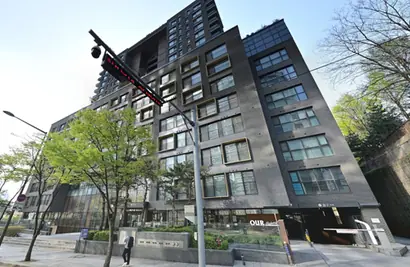
The D-Palace transaction is not merely a high-priced deal in the Jongno area. It represents the value of core downtown residential space located near the Gwanghwamun, Jongno, City Hall, and Seodaemun business districts. While high-end Gangnam apartments build their prices on school districts and an affluent image, D-Palace is defined more by its proximity to work and the scarcity of new residential options in the heart of the city. In the middle of Seoul's central business district, there are few properties that offer a large floor plan, new construction quality, and residential privacy all at once. This 5-billion-won transaction can be seen as a price tag affixed to that scarcity.
Converted to a price per 3.3㎡, the sale price of D-Palace is approximately 112.02 million won. This is significantly higher than the average apartment price per 3.3㎡ in Seoul. However, it differs in character from the price per 3.3㎡ of top-tier redevelopment complexes in Gangnam. While prices in Apgujeong or Daechi-dong were driven by 'future development value and school district premiums,' D-Palace is more driven by the value of 'high-end downtown living that can be utilized immediately.'
The most unusual transaction this week was for Sekyung Housing in Seongnae-dong, Gangdong-gu. A unit with a dedicated area of 58.53㎡ sold for 3.6 billion won, and another unit in the same building (legal dong) with a dedicated area of 59.28㎡ traded for 3.5 billion won. Another 58.53㎡ unit traded for 2.87935 billion won, causing the name to appear repeatedly at the top of the list.
It is uncommon for multi-household villas to occupy the top spots in Seoul's weekly high-price transaction list. The price range is difficult to explain solely by general residential satisfaction. Such transactions are likely to reflect land ownership stakes, expectations for urban renewal projects, bulk purchases, or business feasibility assessments. It is more natural to view this as a transaction evaluating land and property rights rather than a standard price tag for the apartment owner-occupier market. In this week's Seoul real estate market, Sekyung Housing serves as an example of how the boundary between 'a place to live' and 'land awaiting development' has become blurred.
A unit in Jamsil Els, Jamsil-dong, Songpa-gu, with a dedicated area of 84.8㎡, sold for 3.3 billion won. Jamsil Els is a landmark complex in Jamsil, benefiting from its proximity to Jamsil Saenae Station (Line 2), the Jamsil Station lifestyle zone, access to the Han River, and the perks of a large-scale complex. This transaction shows that prices for 84㎡-class units in the Jamsil area are holding firm in the early 3-billion-won range. While middle-tier demand may waver as loan regulations tighten, the pent-up demand for representative Jamsil complexes does not easily evaporate.
A unit in Punglim, Samseong-dong, Gangnam-gu, with a dedicated area of 84.78㎡, sold for 2.85 billion won. Samseong-dong is an area where expectations for the Gangnam business district, COEX, and the International Exchange Complex converge. It is a place where the strength of the location supports the price rather than the brand of the complex itself. The fact that an 84㎡-class unit in the Gangnam area traded in the late 2-billion-won range is a signal that the market is in a phase of re-selecting prices by location rather than in a correction phase.
A unit in Daechi-dong Punglim I-One 2nd (Building 202), Gangnam-gu, with a dedicated area of 156.21㎡, traded for 2.55 billion won. The name 'Daechi-dong' remains powerful. However, considering the price per area, this deal has a different character than key new-build mega-complexes in Daechi-dong. While the regional premium of school districts and living infrastructure remains, it signifies that price differentiation based on property quality and specific location is becoming more pronounced.
A unit in Mokhwa, Yeouido-dong, Yeongdeungpo-gu, with a dedicated area of 67.11㎡, sold for 2.425 billion won. The transaction of the Mokhwa Apartment in Yeouido is a significant scene in this week's top rankings. Yeouido is a financial business district and an area where expectations for redevelopment along the Han River are concentrated. Even though it is an aging complex, the value of the land and expectations for maintenance projects underpin the price. This transaction demonstrates that the narrative of Yeouido redevelopment is still alive in the market.
A unit in Jamsil Raemian I-Park, Sincheon-dong, Songpa-gu, with a dedicated area of 43.73㎡, traded for 2.38 billion won. While it is a small-to-medium size by area, the price exceeds most large apartments in Seoul. It is the result of reflecting the preference and scarcity of new and semi-new products in the Jamsil area. A unit in Dangsan Samsung Raemian 4th, Dangsan-dong 5-ga, Yeongdeungpo-gu, with a dedicated area of 97.27㎡, also traded for the same 2.38 billion won. In other words, a small unit in Jamsil and a large unit in Dangsan traded at the same price. In the Seoul market, prices are now increasingly driven by the combination of location and product quality rather than just area.
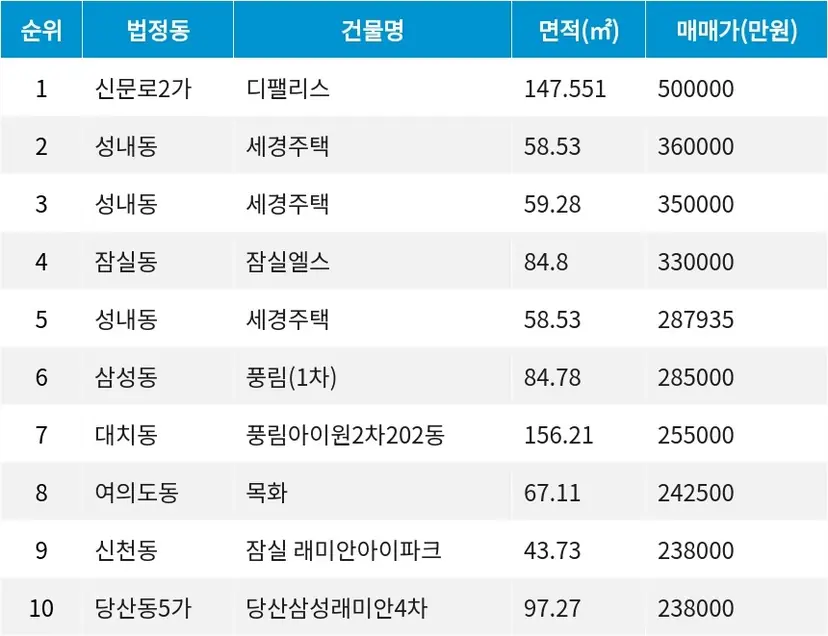
Three keywords penetrate the top 10 transactions this week. First is the re-evaluation of downtown living. The record-high deal for D-Palace showed that even outside of Gangnam, scarce residential properties near Seoul's central business district can form a 5-billion-won market. Second is the expectation of urban renewal projects. Sekyung Housing in Seongnae-dong, Mokhwa in Yeouido, and major Jamsil complexes all have future value mixed into their prices that is difficult to explain by the current value of the buildings alone. Third is the premium of large complexes and living zones. Jamsil Els and Dangsan Samsung Raemian 4th are representative living zone complexes supported by owner-occupier demand.
The policy environment remains tight. Since the June 27 loan regulations last year, limits on mortgage loan amounts in the metropolitan area and requirements for actual residence have acted as significant barriers for buyers of high-priced homes. The stance on managing household debt has continued into this year. The higher the price of a home, the less that can be bought with loans, and the actual purchase depends on equity and the ability to dispose of existing assets.
However, this week's top transactions paradoxically illustrate that very point. When loans are blocked, not all demand disappears. Only demand with low loan dependency remains. Transactions like D-Palace at 5 billion won, Jamsil Els at 3.3 billion won, Punglim Samseong-dong at 2.85 billion won, and Mokhwa Yeouido at 2.425 billion won are transactions that occurred in a market where cash-raising power and location assessment take precedence over loan limits.
The flow of apartment prices in Seoul also supports this. In the fourth week of June, the sales prices of Seoul apartments increased in growth, and the jeonse (charter) prices rose even faster than sales prices. As the supply of jeonse properties shrinks and upward contracts continue to center on school districts, station areas, and large complexes, some tenants are considering switching to purchasing. Jeonse anxiety can ultimately act as pressure to push up sale prices in areas favored by owner-occupiers.
However, it is difficult to see the entire Seoul market rising at the same speed based on this week's transactions alone. The top-tier transactions are the most unique properties in Seoul. D-Palace is a scarce downtown residence, and Sekyung Housing has a strong nature of development expectations that is different from general apartment trades. The transactions in Jamsil, Yeouido, and Samseong-dong also have their own location premiums. The Seoul market has already become a market that is difficult to explain with a single average value.
Interestingly, while regulations such as the land transaction permit system are maintained in the Gangnam 3-gu and Yongsan-gu, the areas inside and outside the regulations are moving simultaneously. Regions where regulations and preferences overlap, such as Jamsil, Samseong, and Daechi, hold out due to scarcity, while regions where the intensity of regulations is perceived differently, such as Jongno, Gangdong, Yeouido, and Dangsan, absorb alternative demand and development expectations. Rather than stopping the market, regulations are playing a role in changing the paths where money flows.
A one-line comment on the Seoul real estate market this week is this: Although the money supply has been tightened, the line toward a good address is still long.
※ This article was written together by Bizhankook and MetaVX's generative AI.