

[비즈한국] This week, the KOSPI experienced extreme fluctuations, severely shaking investor sentiment. The market faced unpredictable movements, with steep drops of around 10% in a single day followed by rebounds and subsequent declines. Experts attribute this unusual volatility to the concentration of funds in specific leading stocks, structural limitations of derivatives, and large-scale position adjustments by institutional and foreign investors ahead of the first-half fiscal closing.
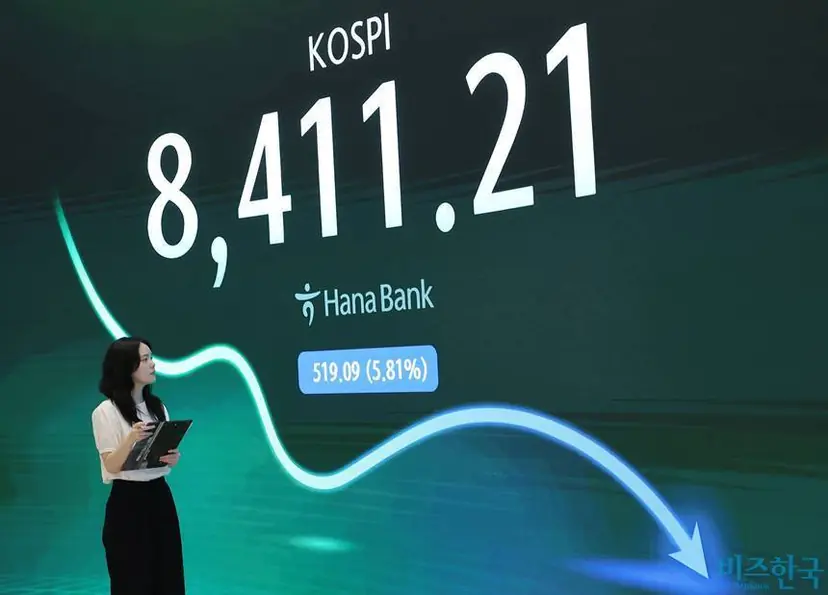
Circuit Breaker Triggered Twice in a Week for the First Time in History
The KOSPI market was in total chaos this week. On Tuesday the 23rd, the index plunged nearly 10%, triggering a circuit breaker (CB) that halted all trading. Although it rebounded by around 3-5% over the next two days, it gave back all those gains on the 26th by sliding another 5.81%.
With sharp declines occurring just three days apart, circuit breakers were triggered twice in one week for the first time since the inception of the domestic stock market. Sidecars, which temporarily suspend the validity of program trading orders, have already been triggered 29 times this year. This has already surpassed the annual record (26 times) set during the 2008 global financial crisis. The KOSPI 200 Volatility Index (VKOSPI) also broke records, spiking as high as 95.09.
Foreigners and Institutions Begin Rebalancing Ahead of First-Half Close
Analysts point to large-scale position adjustments by institutional and foreign investors as the decisive factor behind this week's extreme volatility. With the first-half earnings settlement approaching at the end of June, foreigners and institutions have embarked on major portfolio rebalancing. Those executing large fund mandates cashed out massive amounts of profits, particularly from large-cap semiconductor stocks that had rallied recently, fueling the index's decline. In fact, on the 26th alone, foreigners offloaded 4.3 trillion won worth of shares, and institutions net sold 4.1 trillion won, putting immense pressure on the index.
Hwang Soo-wook, an analyst at Meritz Securities, diagnosed the situation: "Global funds are mandated to meet risk limits and country-specific weightings by the end of the half-year, and the 26th was effectively the last opportunity to do so. Since basket selling began right from the opening auction to adjust the weight of recently surged Korean semiconductor stocks, it should be viewed as a temporary position adjustment rather than a structural exit.">
Semiconductor Leverage ETFs Become a 'Boomerang'
Recently launched single-stock leveraged ETFs that track twice the daily returns of large semiconductor stocks like Samsung Electronics005930 and SK Hynix00660 have ironically turned into a boomerang for the stock market. These products maximize returns by buying additional spot and futures during bull markets, but they possess a vulnerability called 'Short Gamma,' which forces the liquidation of holdings when stock prices fall. This created a vicious cycle where panic selling was mechanically amplified upon entering a downturn, ultimately shaking top market-cap stocks and causing a significant impact on the entire KOSPI.
The external macroeconomic environment also contributed to the market's heightened sensitivity. Global capital is on high alert ahead of future interest rate decisions by the U.S. Federal Reserve and the release of major employment and inflation indicators. As a result, foreign capital flows are shifting directions rapidly during trading hours, further amplifying market volatility.
Semiconductor Optimism Remains… Avoid Panic Buying
The financial sector interprets this sharp drop as short-term labor pains caused by supply-demand factors rather than a collapse in fundamentals. The analysis is that the market will gradually stabilize once institutional position adjustments are settled by the month's end.
Expectations for the semiconductor industry, driven by the AI craze, remain high. As Micron Technology, an industry bellwether, has proven strong performance, attention is now turning to the earnings of major domestic companies to be released in July. The consensus for Samsung Electronics' second-quarter operating profit, which will disclose preliminary results on July 7, is around 84.1 trillion won, while SK Hynix, scheduled to announce on the 23rd, is estimated at around 63.2 trillion won.
However, potential interest rate hikes at home and abroad in the second half and the possibility of the National Pension Service reducing its domestic stock allocation remain variables. Experts advise against chasing rallies or panic selling, as mechanical passive fund-driven volatility may occur frequently during trading hours for the time being, and instead recommend maintaining a strategy of incremental purchasing centered on blue-chip stocks that are undervalued relative to their earnings.