

[비즈한국] This weekly report summarizes the trends and movements of top-100 cryptocurrencies by market capitalization. We provide comprehensive core information, covering major assets like Bitcoin and Ethereum, key issues in the altcoin market, and global policy variables. We aim to help you understand the highly volatile cryptocurrency market as easily and interestingly as watching Netflix.
While Bitcoin and major altcoins failed to find a clear direction, DeFi and liquidity infrastructure projects within the top 100 showed relative strength. Buying interest shifted toward assets with verifiable data—such as trading volume, fees, loan demand, and governance rights—rather than memecoins.
For a while, the crypto market chased new narratives. Themes like AI agents, memes, GameFi, and identity verification circulated easily. However, the top gainers this week were different. The market prioritized functionality over novelty and practical use cases over promises.
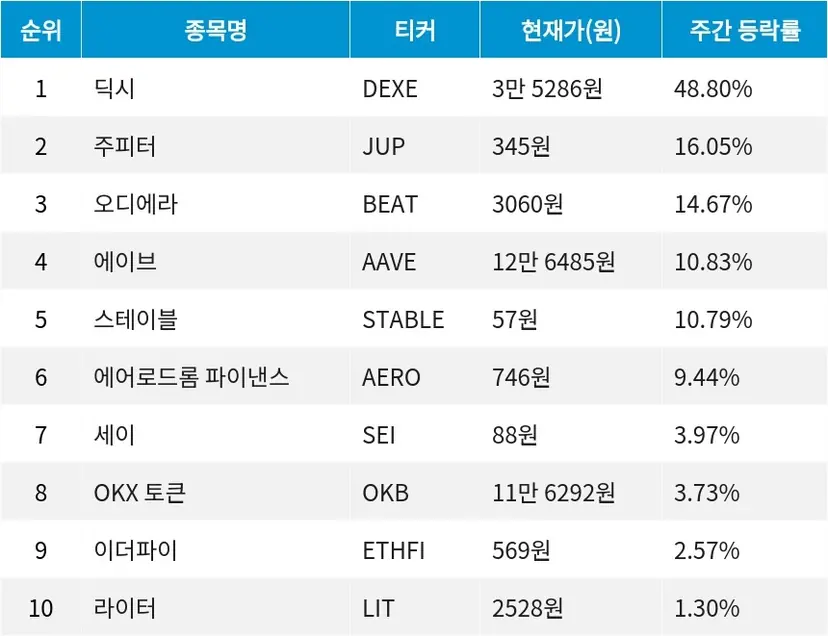
According to CoinMarketCap, a global crypto market data provider, Dixi recorded the highest weekly growth rate of 48.80% between 7:00 AM on June 19 and 7:00 AM on June 26. Dixi’s current price is 35,286 KRW, having risen 1.72% in the last 24 hours.
Between 7:00 AM on June 19 and 7:00 AM on June 26, Dixi ranked 1st in the crypto market with a weekly growth rate of 48.80%.
Dixi is a DeFi infrastructure project that facilitates decentralized organization and governance operations. Unlike general payment tokens, it differs in that token holders are not merely hoping for price appreciation; they participate in the protocol's direction, fund management, and decision-making processes.
Dixi's surge signals a shift in market sentiment toward governance tokens. For a while, these were viewed as 'assets with voting rights but uncertain cash flow.' However, as DeFi protocols grow, the question of who decides on fee distribution, collateral policies, liquidity incentives, and ecosystem fund management becomes increasingly critical.
Recently, the crypto market has shown growing interest in areas intersecting with institutional finance, such as stablecoins, tokenized assets, and DeFi lending. Within this trend, governance tokens are being reinterpreted not as simple reward tools, but as rights to define protocol rules. Dixi's top growth this week is closely linked to this revaluation.
However, it is difficult to attribute a nearly 50% price increase in one week solely to governance value. It is highly likely that factors like circulating supply, trading concentration, and short-term buying pressure played a role. While the appeal of decision-making power in governance tokens is clear, the gap between price and actual influence can widen if participation rates are low or if influence is concentrated in specific wallets.
Jupiter ranked 2nd with a weekly growth rate of 16.05%. Its current price is 345 KRW, up 2.89% in the last 24 hours.
Jupiter is a leading liquidity aggregation protocol in the Solana ecosystem that compares liquidity across various decentralized exchanges to find the best exchange paths. Users do not need to check each exchange separately; the protocol consolidates liquidity scattered across various pools to offer lower slippage and faster execution.
Jupiter's rise coincides with the anticipation that trading activity is reviving within the Solana ecosystem. Solana is frequently highlighted whenever altcoin trading becomes active, thanks to its low fees and high processing speeds. Beyond swaps, Jupiter has expanded its features to include limit orders, dollar-cost averaging (DCA), perpetual futures, and staking rewards.
If Jupiter was once closer to a 'convenient swap tool,' it is now more of a gateway to Solana DeFi. It plays the role of identifying the best prices for traders buying or selling any token. As actual trading volume increases within the chain, the presence of such aggregation protocols grows.
Of course, Jupiter’s price movement must be viewed alongside the overall trading temperature of the Solana ecosystem. Liquidity aggregation protocols react strongly during bull markets, but growth expectations can cool rapidly if trading volume drops. This rise is a bet on the recovery of Solana trading and a test of whether the altcoin rotation will continue.
Odiera recorded a weekly growth rate of 14.67%. Its current price is 3,060 KRW, having surged 17% in the last 24 hours, showing strong short-term momentum.
Odiera is known as a Web3 audio platform project that combines music streaming with fan engagement features. It is designed to allow users to consume content and participate in ecosystem activities by bundling music content, fan communities, and token reward structures.
Odiera's rise this week shows that even in a DeFi-centered market, short-term buying can flow into content-based Web3 projects. Specifically, the fact that its 24-hour growth rate is more pronounced than its weekly growth rate suggests that buying pressure was concentrated toward the end of the week. It is more likely that individual stock supply-demand and increased trading volume drove the price rather than overall market trends.
Odiera is something of an exception on this leaderboard. While Dixi and Jupiter moved based on structural narratives regarding governance and trading infrastructure, Odiera saw its price elasticity expand due to short-term buying within relatively low liquidity. While entertainment and token rewards are easy for users to understand, content success and token prices do not always move in the same direction.
Aave rose 10.83% for the week. Its current price is 126,485 KRW, up 4.89% in the last 24 hours.
Aave is a major DeFi lending protocol that automates deposits and loans via smart contracts. Users can deposit crypto as collateral to borrow other assets or earn interest by depositing their own assets. It is a prime example of bringing traditional bank lending functions on-chain.
Aave's rise this week reflects expectations for a reorganization of the DeFi lending market. With its V4 upgrade, Aave has prioritized improving liquidity structures and collateral management efficiency. The key is to connect liquidity scattered across various markets more efficiently and to categorize risks by asset type.
In DeFi, lending protocols represent the most fundamental financial infrastructure. If exchanges are where assets are bought and sold, lending protocols are where assets are deposited, borrowed, and managed. As markets recover, both leverage and deposit demand tend to increase, often causing major lending protocols to move first.
However, lending protocols also quickly reveal risks when the market falters. If collateral prices plummet, liquidations can occur in a chain reaction, and risks related to smart contracts, oracles, and governance structures remain. Aave's rise shows a recovery of trust in the DeFi lending market, but simultaneously reminds us how sensitive this financial instrument can be.
Stable rose 10.79% over the week, making it onto the top-gainer list. Stable's current price is 57 KRW, up 4.96% in the last 24 hours.
Stable is introduced as a Layer 1 blockchain project designed for dollar payments and stablecoin utilization. True to its name, it centers its narrative on stablecoin-based payments and settlements.
Stable's rise this week is connected to the policy environment. Discussions are underway in the US, UK, and Europe regarding how to handle stablecoins within institutional finance. As reserve assets, issuer oversight, anti-money laundering obligations, and user protection measures become more concrete, stablecoins could move from being 'waiting capital' inside exchanges to infrastructure for payments, remittances, and tokenized asset settlement.
Previously, stablecoins were mostly used as liquidity waiting to buy or sell crypto on exchanges. Now, however, their role is expanding to the basis for cross-border payments, on-chain loan collateral, real-time remittances, and settlement of tokenized assets. Stable's rise shows that this shift is spreading beyond major stablecoin issuers to payment-focused blockchain projects.
Of course, clearer regulations do not necessarily mean good news for all stablecoin projects. Issuers or chains that cannot meet the criteria may actually be pushed out of the market. Stable's rise demonstrates expectations for payment-focused blockchains, but actual adoption and regulatory compliance are separate issues.
The direction is clear. Aerodrome Finance and Sei are connected to trading infrastructure, OKX Token to the centralized exchange ecosystem, Ether.fi to staking and restaking, and Lyra to derivatives trading infrastructure. While the gains were not massive, they are all connected to channels where capital flows.
In particular, Aerodrome Finance's presence on the list shows that the DeFi rally was not limited to the Ethereum mainnet. Interest in exchange and liquidity provision structures continued in Layer 2 ecosystems like Base. The rise of the OKX Token suggests that the altcoin rotation was partly reflected in exchange tokens. Conversely, the limited rise of Ether.fi and Lyra indicates that market interest this week was more strongly concentrated on lending, liquidity aggregation, and governance rather than staking or derivatives.
Outside the market, policy news supported this trend. The UK has adjusted its stablecoin regulation proposal to reflect some industry demands, while the US is discussing exception rules that could allow the trading of tokenized stocks. Europe is refining rules for issuers and transaction service providers through the MiCA framework. Although the approaches of the three regions differ, they share one common point: the next chapter of the crypto market is moving closer to actual financial functions like payments, settlements, lending, and tokenized assets rather than simple speculation.
While we cannot definitively conclude that this flow is the direct cause of any specific asset's rise, it is clear what the market is placing a high value on. In a market where Bitcoin is wavering, altcoins did not all collapse together; investors chose assets based on their own criteria: What can it do? Where is it used? Are trading and fees actually occurring? Is the regulatory environment opening up? This week's price tags responded to these questions.
Of course, it is difficult to say that the DeFi market has fully revived based solely on one week of gains. Dixi faces the possibility of profit-taking after its short-term surge, and Odiera’s volatility could increase as buying was concentrated toward the end of the week. Jupiter and Aerodrome Finance could see their growth momentum weaken if trading volume decreases, and Aave always carries the risk of collateral price plunges and liquidations.
Nevertheless, the scene in the crypto market for the 26th week of 2026 was clear. Investors chose structures that actually function rather than flashy promises. Dixi showed the return of governance, Jupiter the recovery of Solana liquidity, and Aave the reorganization of the DeFi lending market. Stable proved that stablecoins and payment infrastructure remain a live theme.
※ This article was written by BizHankook and MetaVX's Generative AI.