

[비즈한국] He is steadily stacking up books as thick as bricks. I am talking about artist Park Kun-woong. The artist who brought ‘Flowers’ into bloom in 2004 has, after twenty years, drawn ‘Paradise.’ It is a paradise formed by the history of the people, once driven into the shadows, blossoming into flowers. In every shaded corner of modern Korean history—the independence movement, the Bodo League, partisans, the No Gun Ri Massacre, Jeju 4·3, the People's Revolutionary Party case, torture fabrication, the Sewol ferry, and more—he has placed a book like a brick to build a tower. Flowers have bloomed where his heart has reached.
“I’m busy. I’m working on two projects at the same time.”
When I asked to meet in May, his reply came back breathless. I could clearly picture him, drawing panels on A3-sized paper and diligently filling them in. Thinking of his promise to meet after the deadline, it felt perfectly suited for this column's concept. After waiting a month, in mid-June, I met the artist at a knife-cut noodle (kalguksu) restaurant in Bucheon.
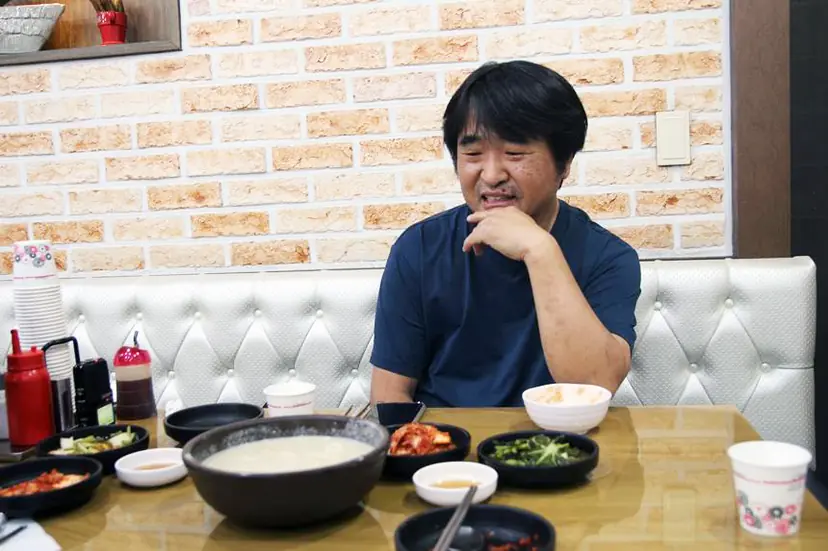
The Clam Knife-Cut Noodles We Even Ate on Our Wedding Day
Since he moved his studio from near Hongdae to Bucheon around 2004, he has been visiting this noodle place, making it a regular spot for twenty years. The artist, who didn’t particularly enjoy knife-cut noodles, became captivated by the taste here and has made it a point to visit twice a month ever since. Both he and his wife have loved this place since they were dating; they were such regulars that on their wedding day, they came here to eat immediately after the ceremony, without even removing their makeup.
Before the noodles arrive, you get a teaser of barley rice, which you mix with young radish kimchi (yeolmu-kimchi) and gochujang, topped with a swirl of sesame oil. Just as you finish that fragrant spoonful, the thick perilla seed sujebi (hand-pulled dough soup) arrives. The artist picks up the ladle and serves a bowl with a kind smile. He says there's a joy in sharing a ladle-full when eating with others. The dense, nutty flavor of the perilla seeds is impressive.
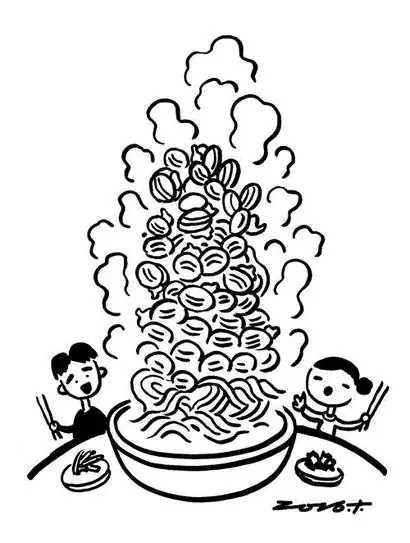
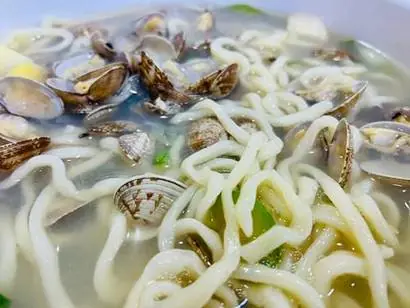
The knife-cut noodles, boiled with a generous helping of clams, are indeed, as the artist said, clean and light in flavor. He mentioned that in the past, the pile of clams was so large that his hands would cramp from shucking them, but even with the portion reduced, it remains top-tier—like a king's robe, which is still silk even if the collar is torn. The straightforward, hearty broth truly soothes the stomach. It is well-suited to be a regular spot for an artist who has spent over twenty years washing away the knots of history. Since both the artist and the restaurant have stayed true to their place without being swayed by the currents of time for over twenty years, one might even say they resemble each other.
From Painting to Comics
Artist Park Kun-woong graduated from the Department of Painting at Hongik University. Like many, he once shared the societal bias that looked down on comics or illustrations in favor of fine art. He was deeply shocked when he experienced the Kang Kyung-dae activist incident during his freshman year of college. Kang Kyung-dae was the same age as him. Stories he wanted to tell began to ripen within him. After finishing his military service, while searching for a way to express himself, he encountered Art Spiegelman’s ‘Maus.’ The work, which the artist drew to understand his father who survived the Holocaust in Nazi Germany during World War II, reveals in three dimensions how the horrors of war shatter human beings. Watching this masterpiece, which transcends the narrative of a Jewish victim to tell a story about humanity itself, the artist began drawing comics. It was his debut work, ‘Flowers.’
He mentioned that Scott McCloud’s ‘Understanding Comics’ was a great help when he was at a loss for how to express himself in the medium. By explaining that comics are the sequence between panels, he realized that the sequence of paintings, with which he was already familiar, could also become a comic. So, he made comics by connecting pictures without words (dialogue). It was the first volume of ‘Flowers,’ which resembled the woodcut prints of 1980s minjung art. He never forgot the realization from that period. Later, he even serialized a comic on the Kyunghyang Shinmun blog, ‘Between Panels.’
From Historical Testimony to Comic Proof
‘Flowers’ is a work that surveys the period from the Japanese colonial era to the Korean War through the life of its protagonist, Jaeng-cho. As Shin Young-bok wrote in his review, calling it “a work that digs up the truth buried in ten fathoms of darkness beyond the reach of concealment and oblivion,” artist Park Kun-woong testified to the history that power had obscured and the world had forgotten.
It was not just ‘Flowers.’ From ‘No Gun Ri Story,’ which recorded the massacres during the Korean War, ‘Hong-i Story,’ which dealt with the Jeju 4·3 incident, ‘The Life of a Revolutionary 1920-2010,’ which depicted the life of long-term unconverted prisoner Heo Young-chul, ‘The Time of the Beast,’ which documented the torture endured by democratic activist and former lawmaker Kim Geun-tae in Namyeong-dong, ‘That Spring,’ which contained the stories of the eight executed victims of the People’s Revolutionary Party case, to ‘Jesse’s Story,’ ‘Yenan Song,’ and ‘Arirang,’ which dealt with independence activists—just as he never forgot his own spring at twenty, the artist has stood firmly against unjust oblivion. Testimony seemed to be his calling.
Then, he changed. Rather than simply testifying to historical facts as they were, he moved toward reconstructing those facts in a comic-like way to prove the implications of the truth. Examples include ‘Golden-dong People,’ which tells the story of civilian massacres through fantasy, and ‘Paradise,’ which deals with fundamental human themes like memory, oblivion, time, and parental love, while alluding to the Sewol ferry disaster.
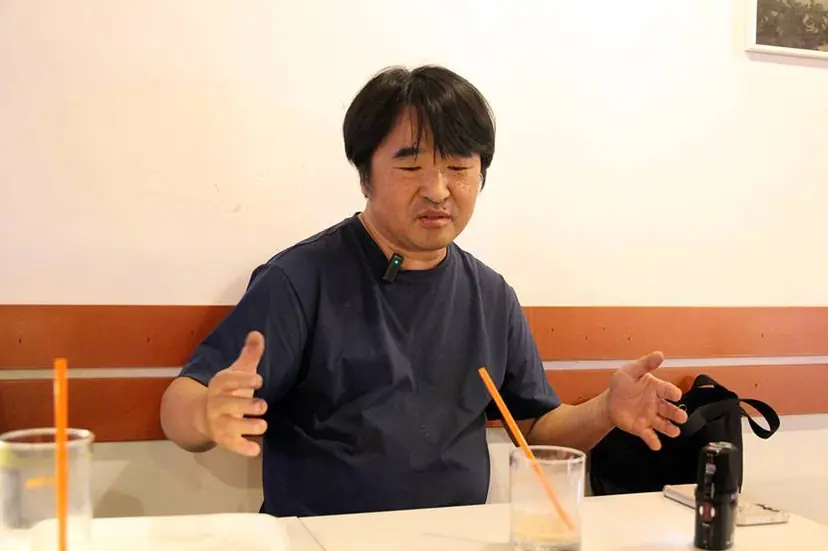
Explaining his direction, the artist used the movie ‘The Zone of Interest’ as an example. He explained that by depicting the deceptive tranquility of Rudolf Höss, the commandant of Auschwitz, and contrasting it with the family of the Nazi officer living a life so colorful and happy beyond the camp walls, the film allows the viewer to feel the reality of violence without showing it directly.
In an interview long ago, the artist once said, “Comics have the power to make the invisible visible,” but now he is talking about comics that “make things better seen by keeping them invisible.” I could feel the depth of the artist’s perspective, having evolved from historical testimony to comic proof.
The Hands of a Working Man
“I still feel anxious if there’s no ink on my hands.”
Watching his hand holding the chopsticks, I saw that ink was deeply stained into his skin. When I brought up his hands, the artist looked slightly embarrassed and added that he feels anxious if the ink on his hands fades because he hasn’t been able to work for a few days. Hearing that, I remembered what the French Minister of Education said while holding up Jean-Henri Fabre’s hands: “The hands of a working man are never dirty. These are clearly the hands of someone who works.” His steadfastness, having seemingly produced a book a year for twenty years, was stained black onto his hands. His dark, ink-stained hands shone brightly.
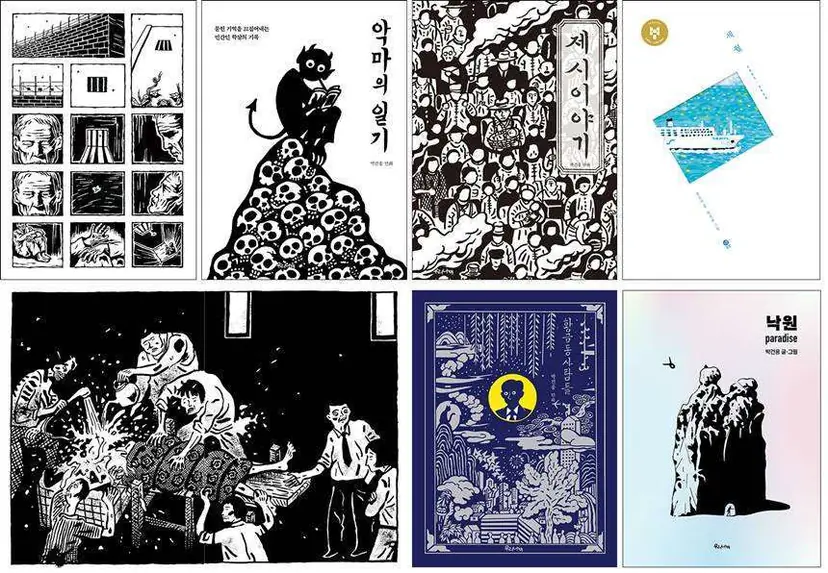
In the process of publishing about 20 books, he has reportedly drawn 30,000 to 40,000 original pieces, moving between Sajeol (394×545mm) and A3 (420×594mm) papers. He says that once he holds a large-scale exhibition covering all his work so far, he plans to return to painting. While I look forward to his exhibition, I also feel a desire for him to keep his place in comics.
To his complaints that his physical stamina isn't what it used to be, I countered with the stories of Cho Kwan-je and Lee Doo-ho, who haven't put down their pens even in their eighties. It doesn't seem likely that he will leave comics, especially since he has even made rules for the sustainability of his creative work—such as not staying up all night and working only on weekdays like an office worker. I look forward to the next panel from an artist who still has so many stories left to tell.
Artist Park Kun-woong was born in Seoul in 1972. He majored in Western Painting at Hongik University's College of Fine Arts. Influenced by minjung art, he presents a unique style that captures the texture of woodcuts, and he consistently draws in a graphic novel format based on the materiality of books, acting as a powerful visual medium with literary depth. While some refer to Park Kun-woong as an ‘auteur cartoonist,’ he has consistently spoken to the public about the topical issues of the era.
He received the Today’s Korean Cartoon Award in 2011 for ‘No Gun Ri Story,’ the Grand Prize at the 11th Bucheon Cartoon Awards in 2014 for ‘The Time of the Beast,’ and the Special Award at the 2024 Korea Picture Book Awards and the Golden Apple at the 30th Bratislava Illustration Biennale in 2025 for ‘Time 1994-2014’.
Artist Park Kun-woong, who performed actions that comic art can demonstrate among the people by working on large banner paintings with colleagues in the plazas after the passing of Presidents Roh Moo-hyun and Kim Dae-jung, continues to address current social issues by posting political cartoons on Instagram, even amidst his busy schedule.
He co-planned the 2009 Korean Comics 100th Anniversary Exhibition ‘Comics, Ten Thousand Stories - That Endless Story’ with Kim Han-jo, the author of ‘Wake Up Kang Gwi-chan’ and ‘Riddle Boy Seo Dong’.
Writer Seo Chan-hwi is a comic columnist who has explored and organized the flow and connections of comics and surrounding cultures in a historical context. Since 1998, he has operated the comic information community ‘Manhwain’ and has written for various media including the Hankyoreh, Ilyo Shinmun, Incheon Ilbo, and Defense Daily. Writer Song Ha-won is the CEO of UR Art, a public culture development center, and runs the alternative comic bookstore ‘Homtong.’ He is a cultural planner, comic researcher, an adjunct professor at the Department of Media and Communication at Sungkonghoe University, and a board member of the Geumcheon Cultural Foundation. Through ‘Cartoonist’s Soul Food,’ the two aim to look into the lives and work worlds of Korea’s representative cartoonists through the food they love.
![[Cartoonist’s Soul Food] The Cream Bread of That Dawn, Sustained by Dreams](https://s.bizhankook.com/attachments_thumb/2026/05/98392_thumb.webp)
![[Cartoonist's Soul Food] Art is in the 'Hand-taste', Food is in the Joy of Eating Together](https://s.bizhankook.com/attachments_thumb/2026/05/98652_thumb.webp)
![[Cartoonist's Soul Food] 'Kkadegi' author Lee Jong-cheol's 'Mother's Kimchi Jjigae'](https://s.bizhankook.com/attachments_thumb/2026/06/106516_thumb_1a338228.webp)
![[Cartoonist's Soul Food] 'Ghost Teacher' Author Nam Dong-yoon: "Undoubtedly, Sundae-guk"](https://s.bizhankook.com/attachments/2026/07/e57a933e6fe0_36ef77a3.jpg)
![[Cartoonist's Soul Food] Artist Park Kun-woong, Whose Knife-Cut Noodles Soothe the Knots of History](https://s.bizhankook.com/attachments/2026/07/9f3485391c47_2d2281a7.jpg)
![[Cartoonist's Soul Food] "A Red Bean a Day": A Visit with Manga Writer and Film Director Lee Dong-eun](https://s.bizhankook.com/attachments_webp_no_wm/2026/07/134567_no_wm_0b8d2928.webp)