

[비즈한국] As geopolitical conflicts intersect with the global climate crisis, core logistics routes that have supported the modern global economy are being blocked or facing severe restrictions. With major maritime and overland trade routes—the arteries of global commerce—facing simultaneous crises, alarm bells have gone off across the global supply chain.
This complex crisis demands a fundamental paradigm shift in the global logistics industry. If the top priority for global logistics in the past was 'efficiency'—minimizing costs and reaching destinations in the shortest time—securing a 'safe detour' that remains unaffected by unexpected external variables has now become the survival standard for companies and nations. We take an in-depth look at the current status and macroeconomic significance of these emerging supply chain detours that are replacing existing trade routes.
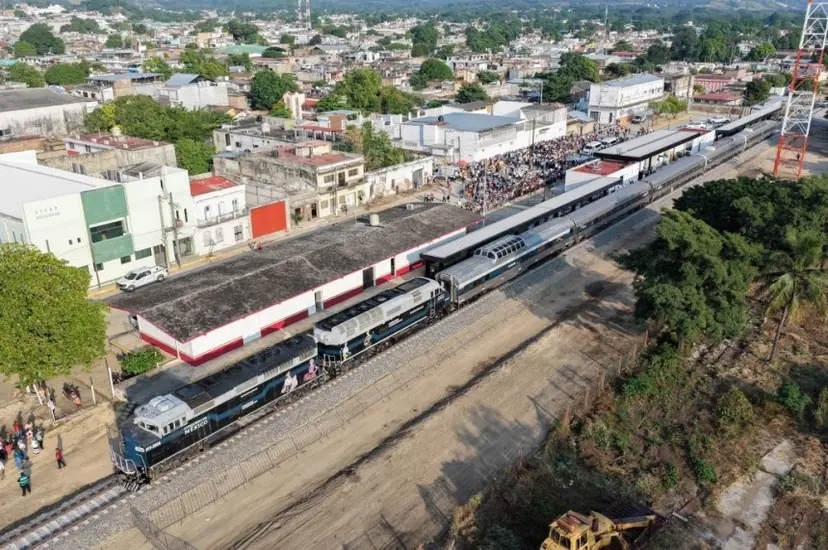
Due to the declining water levels in the Panama Canal causing global maritime congestion, the 'Interoceanic Corridor of the Isthmus of Tehuantepec (CIIT)' promoted by the Mexican government is emerging as a detour for the shipping industry. As passage restrictions at the Panama Canal have lengthened waiting times for ships, logistics companies requiring on-time delivery have begun considering Mexico's overland railway as an alternative. This is interpreted as a diversification strategy by companies seeking to maintain stable supply chains, even at the cost of additional expenses, to mitigate risks associated with reliance on a single route.
Ship to Train, Back to Ship… Cumbersome but Stable
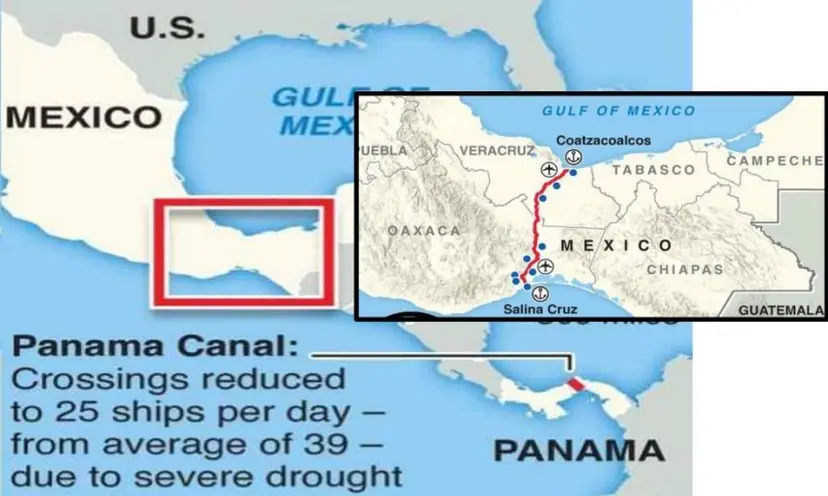
The Isthmus of Tehuantepec is a land bridge between the Gulf of Mexico and the Pacific Ocean, with its narrowest point being about 200km wide. 'Isthmus,' referring to a narrow strip of land connecting larger landmasses, has long been considered an optimal candidate for canal construction. The Panama Canal connecting the Pacific and Atlantic, and the Suez Canal connecting the Mediterranean and Indian Oceans, are prime examples. It is no coincidence that Tehuantepec became a stage for a cross-continental logistics route; it stems from the geographical reality that the distance between the two oceans is shortest within Mexican territory.
Interestingly, this competitive landscape dates back a century. This railway is not a newly built line. It was originally opened in 1907 during the government of Porfirio Díaz to transport freight between the two oceans, but it suffered a decisive blow. When the Panama Canal opened in 1914, the year World War I broke out, the newly inaugurated Tehuantepec railway lost its competitiveness. A route that was pushed aside by the Panama Canal a century ago has been given a chance to revive after 110 years, as the very same Panama Canal falters due to the climate crisis. Former Mexican President Andrés Manuel López Obrador attended the opening ceremony in December 2023, stating, "A project that felt like a dream for decades has been resumed."
The Panama Canal, connecting the Pacific and Atlantic, is a core piece of infrastructure for global maritime trade. However, extreme weather in recent years has disrupted canal operations. This is because the water level of Gatún Lake, which provides the water needed to operate the canal locks, has dropped significantly due to drought. As water shortages intensified, the Panama Canal Authority implemented measures to limit the number of ships passing through per day. This led to longer wait times for ships waiting to enter the canal, delaying the overall flow of logistics.
As this bottleneck persisted, the Trans-Tehuantepec Railway, pushed by Mexico as a national project, emerged as an alternative. It is a roughly 300km line connecting the Port of Salina Cruz on the Pacific coast of Oaxaca with the Port of Coatzacoalcos on the Gulf of Mexico coast in Veracruz. Instead of going through the canal, ships unload cargo at one port, transport it by rail to the other, and reload it onto ships.
Mexican local media often emphasize the term 'canal seco' (dry canal). Unlike the Panama Canal, it does not use water; containers arrive at one port, traverse the country by rail, and are reloaded onto ships in the other ocean. This is the key competitive advantage the Mexican government promotes. It is free from the structural limitation of freshwater scarcity facing Panama, allowing for more stable and predictable operations even during drought. It is not just a single rail line, either. It consists of three major rail lines with a total length exceeding 1,200km, and 14 industrial parks are being developed along the corridor. It is a national project aimed at going beyond a simple replacement for the Panama Canal to tie the entire southern part of Mexico into a logistics and industrial belt.
The logistics industry fears that water shortages in the Panama Canal will become a chronic risk. Consequently, it is considering the Mexican railway as one of the alternatives to ensure stability. Although it requires an additional transshipment process—moving goods from ship to train and back to ship—it is being valued as an alternative route because it allows companies to avoid the uncertainty caused by canal congestion.
Hyundai Glovis, First-Half Pilot Run: “Permanent Route to be Decided After Consultations with Shippers”
In the logistics and shipping market, what companies fear most is the uncertainty of the transport process. Jeong Soo-hyun, a professor of international logistics at Pyeongtaek University, said, "Shipping lines prefer to avoid uncertainty over when they can pass through, even if it costs more. The reason they bypass the Cape of Good Hope when the Suez Canal is blocked, even if it takes 10 days longer, is because they can guarantee 'on-time delivery,' which is the date promised to customers."
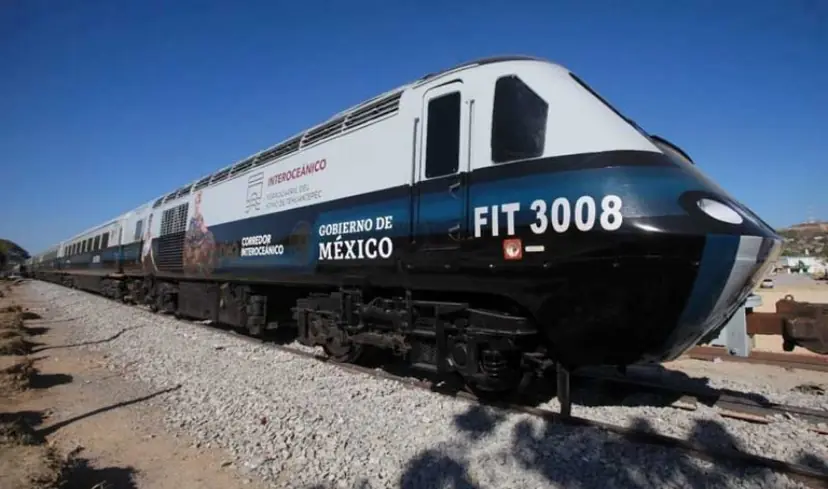
To maintain such punctuality, the Korean logistics company Hyundai Glovis conducted a pilot run using the Mexican Trans-Tehuantepec Railway in the first half of this year. They transported 900 finished vehicles through the Tehuantepec railway to the Port of Brunswick in Georgia, on the U.S. East Coast. Regarding this pilot run, Hyundai Glovis stated, "As ship passage restrictions in the Panama Canal are recurring due to drought and water shortages caused by the climate crisis, we are reviewing transport via the CIIT as one of the ways to respond to supply chain risks," adding, "We plan to decide whether to use it as a regular transport route after discussing with shippers and others based on the data obtained through the pilot run."
The figures presented by Mexico are aggressive. Local logistics media emphasize that the Trans-Mexico Railway can go from ocean to ocean in 72 hours, comparing this to the '15–20 days' recently seen at the Panama Canal. However, this comparison uses different benchmarks. The actual transit time of the Panama Canal is only 8–10 hours during normal times, and '15–20 days' is a figure based on adverse conditions including wait times during the peak congestion caused by drought between late 2023 and early 2024. The average usage time including wait times is known to be around 1–2 days. Furthermore, the 72 hours in Mexico only calculates the railway crossing segment and does not include transshipment times, making it unreasonable to pit the two numbers directly against each other.
Above all, the biggest problem is transshipment. The structure of having to unload and reload cargo is an inherent weakness compared to direct maritime transport. Cargo volume also falls short of expectations. While the CIIT aims for 300,000 containers per year by 2028 and 1.4 million containers (approx. 33 million tons) when fully operational, the Panama Canal saw 63.2 million tons of container cargo pass through even in 2022, when it was hit by drought. This means that even if Mexico's long-term targets are met, it would only be half the level of the struggling Panama Canal. Even local Mexican media diagnose that low demand, environmental and safety risks, and a lack of specialized personnel limit its practical influence. Hong Sung-woo, a team leader at the Korea Institute for International Economic Policy (KIEP), noted, "Looking for alternative routes is a valid consideration," but added, "As global supply chains are being reorganized toward local manufacturing, the actual volume of logistics may decrease compared to the past."
The Shadow Behind the 'Dry Canal': Economic Viability and Conflicts Over Environment and Human Rights
The fundamental limitations and practical concerns of the CIIT are clear. The biggest problem is the rise in logistics costs and the time required for transshipment. It is pointed out that direct maritime transport to the final destination port is the most efficient method, and adopting a transshipment method that requires unloading and reloading cargo multiple times in the middle inevitably increases costs and time. Compared to the general cost of passing through the Panama Canal, the economic viability of this detour route remains low.
Therefore, the prevailing view is that this route serves as a limited alternative that functions when the Panama Canal is not operating properly. The Panama Canal has not yet completely lost its functionality, and canal authorities are also devising long-term infrastructure improvements, such as water recycling. Thus, a cautious view is raised that the Mexican railway may remain only a temporary stopgap.
Even within Mexico, the CIIT is not accepted solely as a 'rosy future.' This is because the Isthmus of Tehuantepec, where the corridor passes, is home to numerous indigenous communities. Environmental groups point to the destruction of rainforests, the fragmentation of habitats for endangered species, water shortages due to surging industrial water demand, and the risk of leaks from associated oil and gas infrastructure. Human rights issues are even more serious. Between December 2022 and May 2025, 67.7% of conflicts—including threats, violence, and arrests against land and environmental activists across Mexico—occurred in the Isthmus of Tehuantepec, and all were related to this project. Adding to this, safety doubts emerged when a train carrying 241 passengers derailed on the Z-line on December 28, 2025, resulting in over 100 casualties.
Structural changes in the manufacturing market are also a variable that affects the sustainability of land transport demand. Global manufacturers are increasingly establishing local factories and internalizing production within major consumer markets to respond to tariffs and trade regulations. If a structure where production and consumption are completed without intercontinental maritime travel spreads, long-term, large-scale cross-border logistics demand itself could decline. This could act as a negative factor for securing the long-term economic viability of railway routes built as alternative paths.
The Tehuantepec rail line, pushed aside by the Panama Canal a century ago, has returned to the center of the world trade map on the back of the climate crisis. However, the answer is not yet out as to whether its revival will settle as a stable alternative or remain a 'limited detour' reliant on the canal's temporary crisis. From the inefficiency of transshipment and less than half the expected volume, to conflicts over the environment and human rights, and the safety challenges left behind by derailments, the test that Mexico's 'dry canal' must pass remains long and difficult.
![[Supply Chain Detours] ① Finding Another Way to Avoid War and Climate Disaster](https://s.bizhankook.com/attachments/2026/07/12752f5971a9_639505e7.jpg)
![[Supply Chain Detours] ② Expectations and Concerns Surrounding the 'Trans-Mexico Railway' as an Alternative to the Panama Canal](https://s.bizhankook.com/attachments/2026/07/a7e020919bbb_9ef3d72b.jpg)
![[Supply Chain Detours] ③ How the Hormuz Blockade Reshaped the Maritime Logistics Map](https://s.bizhankook.com/attachments_webp_no_wm/2026/07/134357_no_wm_d75f72f0.webp)
![[Supply Chain Detours] ④ Is the ‘Middle Corridor,’ Spotlighted by the Russia-Ukraine War, the New Silk Road?](https://s.bizhankook.com/attachments_webp_no_wm/2026/07/134633_no_wm_84fcb68e.webp)