

[비즈한국] “Participate in the Reading Run and get an eco-bag!”
On the 24th, the 2026 Seoul International Book Fair was held at COEX in Gangnam-gu, Seoul. In front of the Yes24053280 experience booth, visitors stood in long lines waiting for their turn. Inside the booth, participants read aloud sentences presented on a monitor as quickly as they could. It is an experience that converts the number of characters read accurately within a time limit into the distance run.
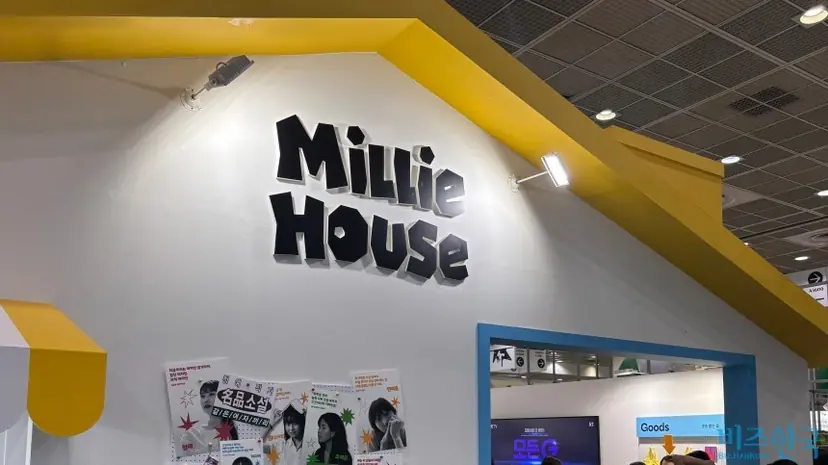
Instead of mere book displays, a ‘housewarming’... visitors linger in experience booths
The landscape of the book fair, which used to focus on reading or buying books, is changing. At this year's book fair, experiential events where visitors can personally explore spaces and participate in missions were placed everywhere. Moving beyond simply displaying and selling books, it has become about having visitors stay inside the booth to directly experience activities related to reading.
On this day, Millie operated an experiential booth with a housewarming concept. To celebrate the 10th anniversary of its service, the booth was decorated like the inside of a home, including an entryway, kitchen, bathroom, and living room. Visitors could follow the flow, scan barcodes of paper books to link to e-books, or check out webtoons and audio content. The final space featured the company's own published books.
Inside the booth, visitors scanned paper book barcodes themselves, wrote postcards, and took photos of the space with their phones. By structuring the booth to take visitors through various experiences along a set path, the time spent by visitors was longer than in regular booths that only displayed books and services. At the entrance, visitors waited in line to get inside.
A representative from Millie explained, “As a service that provides a reading experience online, we have incorporated many experiential elements into our offline booth as well,” adding, “We structured it so that visitors can naturally get closer to reading during the experience process.” They added, “Operating the book fair booth seems to have a certain effect on attracting new subscribers and expanding app usage.”
Finding tastes through questions, and turning reading into running
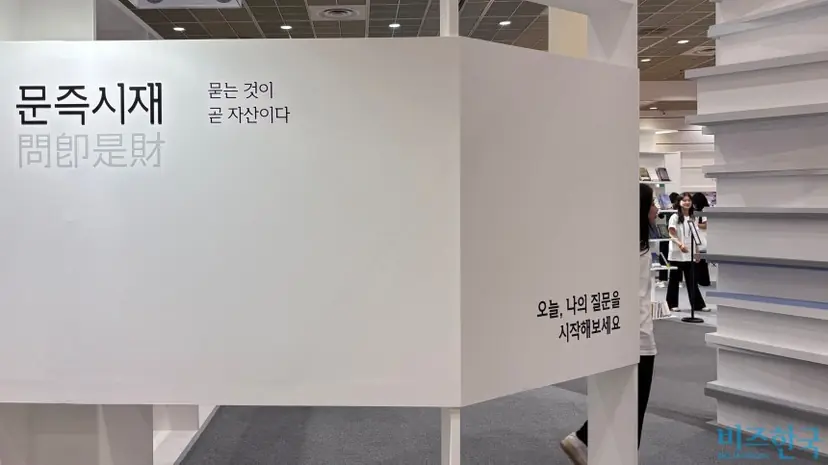
At the booth prepared jointly by Shinhan Bank and the Seoul Metropolitan Library, an experience was held where participants could identify their reading type. Under the theme of ‘Asking is Wealth (Mun-jeuk-si-jae)’, it is a space that combines reading and finance.
Here, participants choose the topics they are most curious about among questions related to work, money, human relationships, and life attitudes six times to identify their own type. The types are categorized into 9 variations, such as 'Boundary-Crossing Challenger,' 'Asset Godfather,' 'God-Saeng (diligent life) Saver,' and 'Fact Digger.' After confirming their tendencies, they can open a safe set up on the wall to receive a transcription notebook.
The notebook introduces 15 recommended books selected by the booth and provides space to transcribe book passages. The process of answering questions, confirming one's tendencies, and manually copying sentences from books to leave thoughts is structured as a single experience. The notebook also suggests asset portfolio types tailored to the participant's tendencies. It is an attempt to naturally reveal the bank's brand message by connecting reading tastes with financial inclinations.
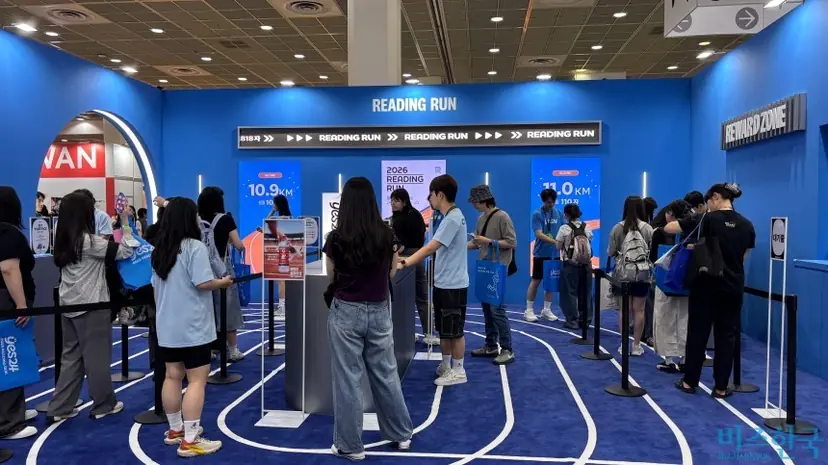
Yes24 set up a ‘Reading Run Offline Basecamp’ to add elements of running and gaming to reading. The concept is that visitors become ‘Reading Runners’ by combining the recent running craze with reading.
At this booth, when a visitor reads the sentences presented on the screen into a microphone, one character is converted into 0.1km. If 100 characters are read accurately, it is recorded as having run 10km. The more characters read accurately in the allotted time, the longer the running distance becomes. Visitors who completed certain missions were provided with souvenirs such as eco-bags.
Kang (a pseudonym), a person in their 20s who visited the book fair with a friend, said, “I came to look at merchandise and books, but I entered because I saw a fascinating booth,” and added, “There are many experiences to try besides just looking at books, so it's not boring and it's fun.” Another visitor in their 20s, Song (a pseudonym), added, “It was nice to be able to get a rough idea of books I didn't know well by reading their passages. I plan to look up more about the plots when I get home.”
Whether this will lead to actual reading and purchasing remains uncertain
The expansion of experiential booths at the book fair is largely due to the influence of a reading market that has been reorganized around online platforms. While the paths for readers to purchase and read books have diversified with the popularization of online bookstores and e-book platforms, the opportunities for publishers and platforms to meet readers directly offline are limited.
Accordingly, companies participating in the book fair are preparing devices to make visitors enter and linger in their booths. By utilizing games, personality tests, and space exhibitions, they appear to be widening the touchpoint with not only existing readers but also those who are not familiar with reading. The fact that it can induce visitors to take photos or videos and share them on social media is also cited as a reason for the increase in experiential booths.
However, whether these experiences lead to actual reading and book purchases is a separate issue. If interest is focused solely on participating in games, receiving souvenirs, or taking photos, visitors might stay in the booth for a long time without actually paying attention to the books or content introduced.
Regarding this, Lee Eun-hee, a professor of Consumer Science at Inha University, said, “As internet usage has increased among the younger generation, the way they encounter and read paper books has become relatively awkward,” and added, “Experiential booths can serve as devices to induce visitors to feel interested in books and look up the content themselves.”
She further added, “For this interest to lead to actual purchases, bookstores also need to actively promote the books introduced during the experience process,” and, “We should consider ways to introduce various experiential elements into bookstores as well, rather than just stopping at displaying books for consumers to look at and buy.”