

[비즈한국] As the adoption of generative AI accelerates, public institutions are finding themselves in a deeper predicament. Recent incidents, such as the leak of personal information and startup ideas during the Ministry of SMEs and Startups’ “Everyone’s Startup” national project, combined with the rise of sophisticated cyberattacks targeting both public and private sectors using AI, have shifted the primary challenge of public AI from utilization to trust. At the “2026 Public AI Expo,” which kicked off on the 23rd, discussions on security, governance, and accountability frameworks were as prominent as those on AI technology for business innovation.
Hosted by the Ministry of the Interior and Safety and the National Information Society Agency (NIA), the expo highlighted AI services applicable to public operations, along with the cloud and security systems required to support them.
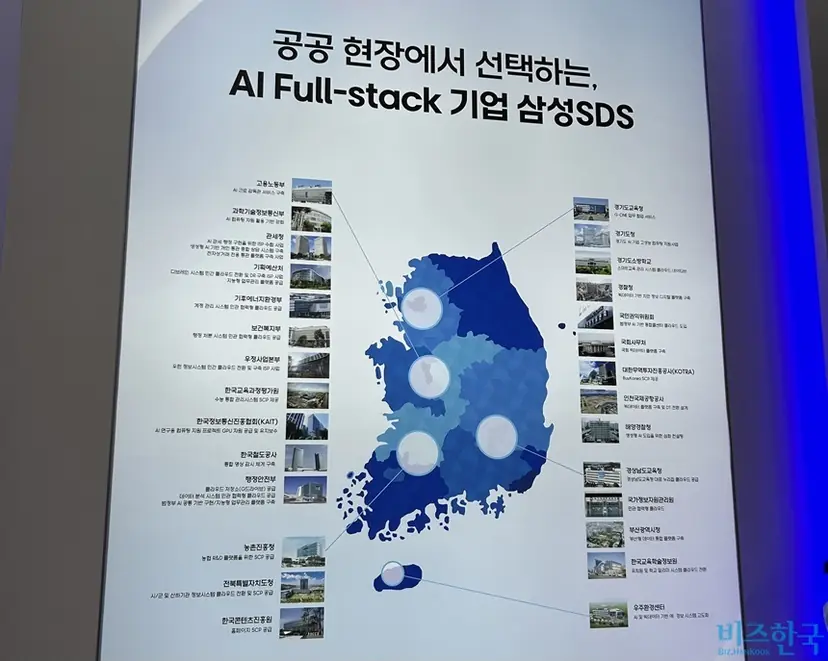
Samsung SDS018260 showcased major public projects, including the Ministry of Employment and Labor’s AI Labor Inspector service, the Korea Customs Service’s AI Customs Administration implementation project, a generative AI-based customs consultation system, and the Korean National Police Agency’s big data-based public safety platform. In particular, it presented projects being conducted in government AI infrastructure, such as the Ministry of the Interior and Safety’s G-Drive, the pan-government AI common platform development, and public-private partnership cloud projects.
The AI infrastructure strategy drew significant attention. Samsung SDS introduced a public AI operation structure that links its Daegu PPP Center, Dongtan Data Center, and Haenam National AI Computing Center. It also exhibited its GPU-as-a-Service (GPUaaS) based on NVIDIA B300 (Blackwell Ultra) GPUs, launched in March, emphasizing its infrastructure competitiveness to meet growing public AI demand.
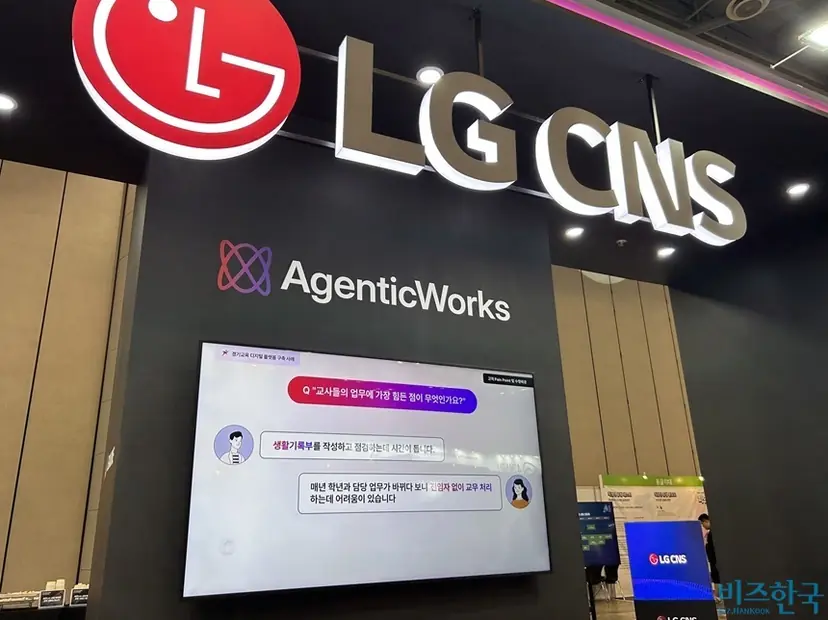
LG CNS focused its exhibition on cases of building generative AI-based public platforms. A key example is the Gyeonggi Provincial Office of Education’s Intelligent Digital Platform project, won last year. The project, worth approximately 38 billion won, aims to support teachers and administrative staff by integrating information previously scattered across school websites, School Alimi, and internal messengers for around 2,800 elementary, middle, and high schools in the province.
An official from LG CNS explained, “We focused on reducing the administrative burden on teachers, which has increased due to revisions in the curriculum,” adding, “We are providing functions that support administrative tasks based on past data and records.” The company views this as a leading case for the introduction of generative AI in education administration.
The “Intelligent AI Foreign Affairs and Security Data Platform” project, currently being pursued with the Ministry of Foreign Affairs and valued at approximately 30 billion won, was also highlighted. This project provides functions such as drafting, classifying, and summarizing diplomatic documents, recording minutes, and multilingual translation. The first phase of the three-phase service was launched earlier this year.
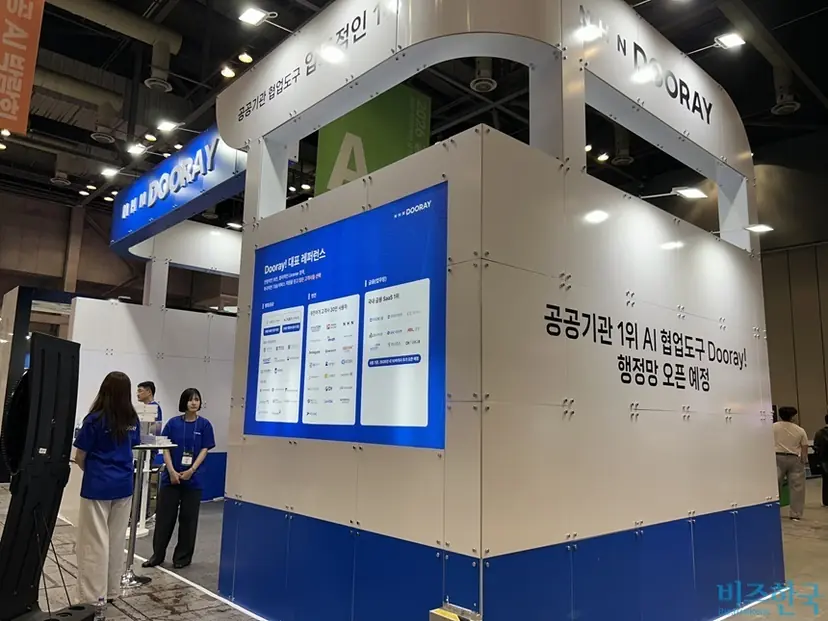
NHN Dooray! presented its AI-based collaboration platform, “Dooray!.” Its defining feature is the integration of project management, email, messaging, and calendars into a single environment, linked with various large language models (LLMs) such as ChatGPT, Gemini, and Claude. It offers email summarization, draft generation, and work automation functions, with NHN Cloud-based public services expected to be launched in the second half of the year.
An official from NHN Dooray! said, “Public institutions still face inefficiencies from having to switch between multiple work systems,” adding, “Our strength lies in a design that allows workflows to proceed naturally within a single platform.”
“As Much as You Use AI, You Must Monitor AI”
Security was the most frequently mentioned word at this year’s expo. The background for this is the recent “Mythos shock,” caused by Anthropic’s security-specialized AI model “Mythos 5,” which demonstrated a high level of vulnerability detection capability. As concerns grow that AI could amplify security threats, the public sector is also accelerating efforts to develop response strategies.
LG CNS suggests an “AI Guardrail” system as the core of generative AI security. It is a safety device designed to prevent AI from accepting malicious prompts or circumventing instructions, and to block the input and output of personal and sensitive information.
The company explained that it applies prompt filtering, where a separate AI model analyzes the user’s intent and context to judge risks, and data filtering technology, which automatically identifies and de-identifies sensitive information within institutional data. It is building control systems in line with Financial Supervisory Service standards for the financial sector and National Intelligence Service standards for the public sector.
An LG CNS official noted, “Previously, perimeter-based security—assuming safety if you were inside an internal network—was the norm, but that is no longer valid in the era of AI agents,” adding, “A zero-trust architecture based on the premise of ‘never trust anyone’ is becoming vital.” They continued, “Logs and access records are increasing exponentially, making human-led monitoring impossible. Ultimately, we are in a structure where we have no choice but to use AI for security as well.”
Within the industry, there are also voices suggesting that the control system is becoming more important than the technology itself. An industry insider stated, “Public institutions can only maintain internal control if they can trace step-by-step which questions were asked, which model responded, and what data was used,” adding, “The key is a system that can visualize and audit the AI processing pipeline.”

The expansion of private cloud utilization is also intertwined with security discussions. According to industry sources, security requirements differ between public institutions and central administrative agencies. In particular, administrative agencies, which are connected to the national administrative network, previously faced limitations in adopting private clouds. However, with the creation of the Public-Private Partnership (PPP) zone at the National Information Resources Service’s Daegu Center, the use of private services that meet security standards is becoming possible.
The Condition for an AI Government is ‘Uninterrupted Service’
Another hot topic for public AI is Disaster Recovery (DR). The fire at the National Information Resources Service’s Daejeon Center last year is considered an incident that exposed the vulnerabilities of public IT infrastructure. Following this, the government is pursuing a project to build disaster recovery systems for approximately 15,000 public information systems by 2030.
Samsung SDS also presented data center redundancy and disaster recovery services using “Active-Active” (operating reserve centers simultaneously) and “Active-Standby” (switching to a reserve center in case of primary center failure) methods at the expo, offering examples of their application in the public and financial sectors. Experts believe that in the AI era, the ability to ensure service continuity during failures, beyond just security, is emerging as a core competitiveness.
Bae Il-kwon, Director General of the AI Government Bureau at the Ministry of the Interior and Safety, stated at the expo, “Building a safety net for AI government infrastructure is not something the government can achieve alone. Only when the cutting-edge technological capabilities held by the private sector are combined with public accountability can an uninterrupted AI government be achieved.”