

[비즈한국] The universe is immense. There are countless stars, and the history of the universe itself spans 13.8 billion years. It took at most 5 billion years from the birth of the solar system and Earth to the emergence of current human civilization. The age of the universe is more than double that. Given such a vast number of stars and planets, and a sufficient amount of time, shouldn't there be other extraterrestrial civilizations as advanced as ours somewhere in the universe? Yet, we haven't captured a single signal. Where are they hiding? This question is famously known as the 'Fermi Paradox'.
However, looking at the Fermi Paradox from a different perspective leads to an even more surprising answer. If we stop asking “Why are there no signs of alien civilizations?” and instead ask, “What does the absence of alien civilizations tell us?”, the current reality points to a rather chilling conclusion. A surprising answer to the Fermi Paradox was recently proposed: perhaps all extraterrestrial civilizations that existed in the universe vanished before they could survive for even 5,000 years.
The Drake Equation provides the most intuitive look at the possibility of extraterrestrial civilizations. Popularized by Carl Sagan, the original Drake Equation seems long and complex as it breaks down various variables one by one, but it can be expressed quite simply in the end.
If we define NEH as the number of planets in our galaxy that have conditions similar to Earth and can support life, the value is calculated by multiplying the total number of stars in our galaxy (N*) by the probability that such a star has a habitable planet nearby, and by the probability that such a planet has Earth-like conditions.
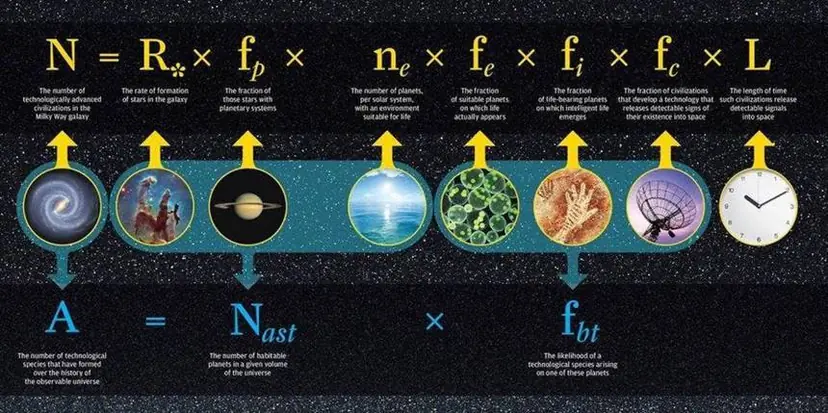
However, this is not enough. We must consider the most important and enigmatic variable: time. What has been calculated so far is merely planetary environment. We must evaluate how often and how easily a complex technological civilization can emerge on those planets, and how long such a civilization can survive without disappearing. Let 'f' be the probability that an intelligent civilization capable of industrialization will emerge on an Earth-like, habitable planet. Then, the probability of an intelligent civilization emerging over the lifetime of a star, Ls, is NEH * f / Ls. By multiplying this by 'L', the lifespan of a civilization once it is born, we can estimate the average number of intelligent civilizations, N, present in our galaxy.
Human civilization has been in a full-scale technological society for about 200 years. We don't know if humanity will last another 1,000 or 10,000 years, but if we express the lifespan granted to humans as a power of 10, we could say it will last 10^n years. By considering the total number of stars in our galaxy and the frequency of Earth-like exoplanets in habitable zones—inferred from the last 20 years of exoplanet exploration—we can express the value of N as a function of 'n'. In other words, the number of alien civilizations we can find in our galaxy is a function of the exponent representing the average lifespan of intelligent civilizations, including humans. We can compare how the number of discoverable alien civilizations, N, changes according to 'n'.
Now, let's plug in the reality. We have not found any alien civilizations yet. In other words, N has not exceeded 1. The result of applying this reality is quite chilling. For N not to exceed 1, the average lifespan 'L' of a technological civilization must not exceed 5,000 years. N exceeds 1 when 'n' becomes 3.7. 10 to the power of 3.7 is approximately 5,000. In other words, the explanation for why we haven't caught any signals is that almost all technological civilizations that might exist in our galaxy disappear before they can last even 5,000 years.
While at least one technological civilization might exist in our galaxy, several could not coexist simultaneously. As one was born, another vanished, and this cycle repeated. Consequently, two different civilizations never had the opportunity to coexist and recognize each other. In a galaxy filled with civilizations that disappear in less than 5,000 years, this tragic timing issue might be at play.
The figure of 5,000 years is quite unsettling. It is similar to the total length of human history since we began recording it in writing. It gives rise to the fear that we might be a 'terminal' civilization with little time left. However, there is no need to worry immediately. This paper does not include primitive agricultural societies or ancient civilizations in the calculation of lifespan; it refers to the lifespan after acquiring modern technological capabilities capable of sending and receiving signals into space. The study assumes that humanity has only been at the threshold of such cosmic civilization for about 200 years. Since the Industrial Revolution, humanity has only just lit a flame in terms of cosmic time. But 4,800 years from now, that flame might end up burning our own house down.
This analysis goes one step further. Communication via light and electromagnetic waves would likely be the most frequent among intelligent civilizations. The diameter of our galaxy is 100,000 light-years. It also takes 100,000 years for radio waves to cross the galaxy's diameter. If any technological civilization anywhere in our galaxy had sent out a signal powerful enough to be detected at least once in the last 100,000 years, in principle, that signal could have reached us. Therefore, if there had been a civilization in our galaxy that survived for a sufficiently long time without collapsing and transmitted stable, strong radio waves, the silence we face now would be difficult to explain. Given the possibility of space communication based on electromagnetic waves, the silence of the universe feels even more eerie.
We can also think of physical exploration, where they travel to us by spaceship before even bothering to send radio waves. Let's assume an alien civilization sends out a spaceship. If a single ship explores the galaxy by moving randomly from star to star, the process is similar to gas molecules diffusing. The maximum distance it can spread is proportional to the square root of the number of movements. For simplicity, let's assume the average distance between stars in our galaxy is 1 light-year and the size of our galaxy is 100,000 light-years. If a single spaceship makes 10^10 moves, it could explore 10% of all stars in our galaxy. The problem is speed. Even if that ship moved at 10% the speed of light, it would take 100 billion years to search the entire galaxy. This is an unfathomably long time, incomparable even to the age of the universe.
Of course, an alien civilization advanced enough to achieve interstellar travel wouldn't just send one ship. If they sent numerous probes simultaneously, the exploration time would be significantly reduced. If there were a highly aggressive civilization that sent out an extreme number of spaceships, the time to search the entire galaxy could be reduced to about 1 million years. Thus, the timescale for physically exploring the galaxy ranges from at least 1 million to 100 billion years. While this is a wide range, the lesson is clear: a civilization that lasts only a few thousand years is insufficient to survey the galaxy one by one. Only civilizations that can survive longer than that are granted the opportunity to traverse the galaxy. A mere 5,000 years is too short to conquer the galaxy.
Let's make a somewhat extreme but simple assumption. Suppose our galaxy is a large disk with radius 'D'. If 'N' is the number of technological civilizations existing simultaneously, the density is N divided by the area of the galactic disk. Based on this, the average distance between two neighboring technological civilizations is the galactic radius divided by the square root of N. Let's engage in some 'hopeful thinking' that at least two technological civilizations coexist in our galaxy; that is, N=2. If they can move their spaceships at 10% the speed of light, it would take approximately 200,000 years for the two civilizations to recognize each other's existence. In other words, for two civilizations to visit and realize each other, the lifespan of a technological civilization must be at least hundreds of thousands of years. If one disappears before that, they can never meet.
This interesting analysis forces us to view the Fermi Paradox from a different angle. Asking "Are there aliens or not?" does not tell us the likelihood of discovering other civilizations. It's not about whether they exist; the most critical issue is whether they survived long enough to coexist in the same era as us.
Our galaxy might have once enjoyed a heyday full of civilizations. It might have spent a time filled with planets where oceans existed, single-celled organisms emerged, and intelligent beings formed cities. They might have even sent various radio waves beyond their homes and embarked on brave voyages in spaceships. But if those brilliant civilizations collapsed in less than 5,000 years, no encounter would have occurred. On a galactic scale, that is barely a blink of an eye. There are fireflies living throughout the night sky, but if each of them blinked only once, they would all go out before noticing each other's light.
If the chilling conjecture that a space civilization cannot cross the 5,000-year barrier is true, what is the reason? Why can't a technological civilization last longer? It could be an asteroid impact, a massive volcanic eruption, or simply the bad luck of being swept up in a nearby gamma-ray burst. However, beyond natural disasters and external factors, even greater risks may be those created by the civilization itself. We can imagine nuclear war, pandemics, uncontrollable artificial intelligence, biotechnology, and the abuse of resources. There are already cases in Earth's history where various civilizations, such as Rome or the Maya, collapsed due to internal causes. Of course, those were the collapses of city-states and did not lead to the extinction of all humanity. But the world today is different. Everything—economy, energy, food, information—is intertwined like one giant city-state. Now, the failure of one civilization no longer remains a problem limited to a single region.
Of course, this analysis rests on a very important optimistic premise: the expectation that life and intelligent civilization will almost certainly emerge on planets with Earth-like conditions. Conversely, if that probability itself is very low—that is, if life rarely emerges even on planets with good conditions, or if intelligence rarely develops, or even if intelligent beings don't progress into technological civilizations—then the lifespan granted to each civilization increases. If 'f' is 0.01 instead of 1, the lifespan of a technological civilization extends to 10^5.7 years, or about 500,000 years. Of course, for those hoping for the eternal prosperity of humanity, that is still a quite unsettling amount of time.
We can hold onto one last shred of hope. Perhaps alien civilizations have managed to survive beyond the 5,000 or 500,000-year barrier, but they use communication methods other than radio waves, unlike us. Or perhaps they only transmit signals in very narrow directions, and we happen to live in a blind spot. They might be using frequencies we cannot detect at all. It is possible that space civilizations, realizing that revealing one's location is quite dangerous, have evolved in a way that they no longer intentionally leave traces in the universe. If they are intentionally choosing not to communicate or are using methods we cannot reach, we do not need to be bound by the too-short 5,000-year limit.
In any case, humanity has not yet reached the 5,000-year wall. We have only been a technological civilization for 200 years. Yet, in that short time, we have already gained the power to change the planet's climate, and with nuclear weapons, we can blow up a city in an instant. We are entering an era of editing genes and using artificial intelligence to alter the structure of knowledge and power. From a cosmic perspective, this is a very rapid change. In 200 years, a species has gained geological-scale power over its own planet. The question is whether we are mature enough to wisely handle the powerful force we possess.
Astronomer Carl Sagan, who made the Drake Equation famous, took a dim view of this. He called humanity a 'technologically adolescent' civilization, fearlessly playing with dangerous toys that might wound them. Looking at the various forms of chaos and reality we face today, even the most desperate calculation of this analysis—projecting a minimum lifespan of 5,000 years for human civilization—feels like an optimistic expectation.
Someday, after we have vanished, a successor civilization appearing much later might listen for signs from our galaxy. Like us, they might look at the unexpectedly quiet sky and ask, “Where is everyone?” If we are still around by then, and if we survive long enough to leave our mark between the stars, the answer to that question will surely be different. I hope that silence is not a law of the universe, but just a fleeting moment in history that hasn't been broken yet. Perhaps the answer to the Fermi Paradox does not depend on alien civilizations. The answer lies with us. The most certain way to reveal why our galaxy is quiet is to ensure that we do not quietly vanish.
References
https://academic.oup.com/mnras/article/548/3/stag405/8499605?login=false
About the author, Ji Ung-bae: He loves cats and space. After watching 'Galaxy Express 999' as a child, he dreamed of sharing the beauty of the universe. He is currently an assistant professor in the Faculty of Liberal Arts at Sejong University, participating in various science communication activities including lectures and writing. He has authored books such as 'On the Uselessness of Astronomers,' 'We Are All Born as Astronomers,' and 'Strange Questions That Come to Mind When Looking at the Universe,' and translated works such as 'How I Killed Pluto,' 'Quantum Life,' and 'UFO.'