

[비즈한국] The global medical community is shifting its focus beyond universal disease treatment to precision medicine, tailored to individual genetic and environmental characteristics. Massive amounts of medical data are essential to achieving this. The South Korean government—spearheaded by the Ministry of Health and Welfare, the Ministry of Science and ICT, the Ministry of Trade, Industry and Energy, the Korea Disease Control and Prevention Agency, and the Korea Health Industry Development Institute—has launched a large-scale national integrated bio-big data construction project to lay the foundation for the future bio-health industry.
Professor Han-Goo Kim (Department of Plastic Surgery), chairman of the hospital council for the general public recruitment project and lead researcher at Chung-Ang University Hospital, emphasized the significance of this project: "Beyond simple data collection, it is about creating a medical environment that provides more accurate prevention, diagnosis, and treatment for each individual citizen. Furthermore, it will become a national strategic asset that will innovate the entire national bio-industry ecosystem, including new drug development."
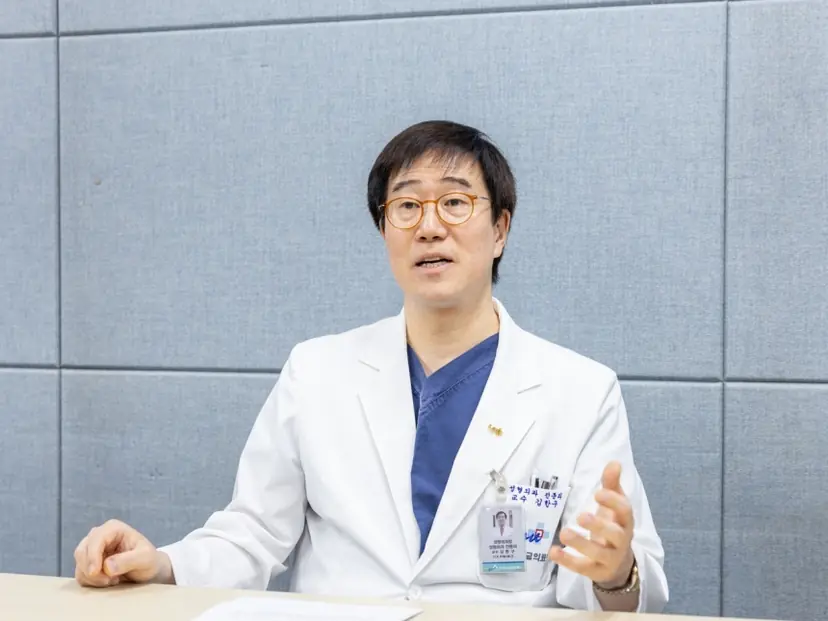
Goal of Building 1 Million Data Points by 2032 Through Voluntary Participation
The National Integrated Bio-Big Data Construction Project is a project that integrates health information, genomic data, and clinical information based on the voluntary participation and consent of the public. Phase 1 runs until the end of 2028, with the ultimate goal of building a dataset of 1 million people by the end of Phase 2 in 2032. Specifically, the data will include 710,000 from the general public, 220,000 with severe diseases, and 70,000 with rare diseases.
According to the project team, data recruitment is currently progressing smoothly. Since starting in 2024, the project has recently secured data from approximately 170,000 individuals. Recruitment for the general public is centered on 26 medical institutions, including tertiary general hospitals and large screening centers selected by the state, where those undergoing health check-ups are voluntarily participating.
The project team is also carefully considering practical utilization alongside data accumulation. Prof. Kim stated, "Starting in October, the project team will accept applications from research institutions to provide access to data for research purposes. It will be used for pure research aimed at improving public health and national industrial development, not for corporate-led commercial purposes."
The project team also explained that they have thorough countermeasures for the leakage of personal information, which is the biggest concern in building big data. Since health and genetic information are the most sensitive personal data, their leakage could lead to risks such as being denied life insurance or falling victim to targeted phishing crimes.
In fact, in 2022, the Australian health insurer Medibank experienced a massive data breach affecting 9.7 million people, where information about HIV infections and mental health treatment history was exposed on the dark web. Similarly, in 2023, the global genetic analysis firm 23andMe suffered a hack resulting in the leak of genetic data for 6.9 million users. Genetic data of specific ethnic groups, such as those of Jewish or Chinese descent, were sold and misused for racial discrimination or crimes targeting specific groups.
A project official explained, "All participant data is collected through thorough de-identification, and the nation's highest level of security standards are applied. We have fundamentally blocked the possibility of personal information leaks even if the data lake where the data is stored is exposed to external threats."
The UK and the US were early adopters in bio-big data and have already entered the utilization stage. Since 2006, the UK has been using data from 500,000 people collected via the 'UK Biobank' to actively support new drug development by global pharmaceutical companies. Since 2018, the US has also been pushing forward with the 'All of Us' project, a 1-million-person scale initiative, to gain a foothold in the personalized medicine market.
However, Prof. Kim assessed that Korea's potential competitiveness is substantial, citing the high level of digitization in the domestic medical system and the national health insurance linkage system. He noted, "Our medical system is highly digitized, and it has the advantage of being able to track and link data over a long period based on the health check-up system under the National Health Insurance. Even though we started late, based on this infrastructure, we can catch up with leading countries in a short period and become a world-class model nation for data."
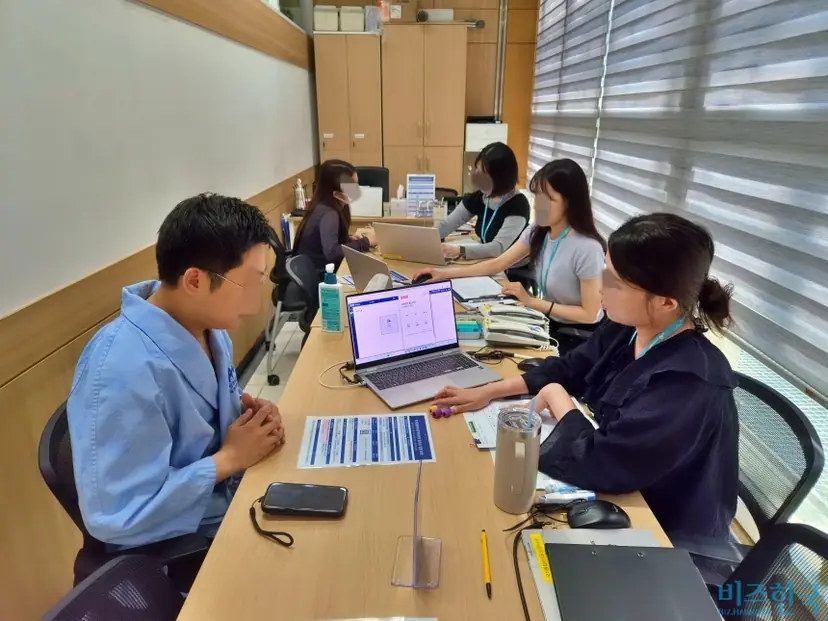
Contributing to Future National Health Through Blood and Urine Tests
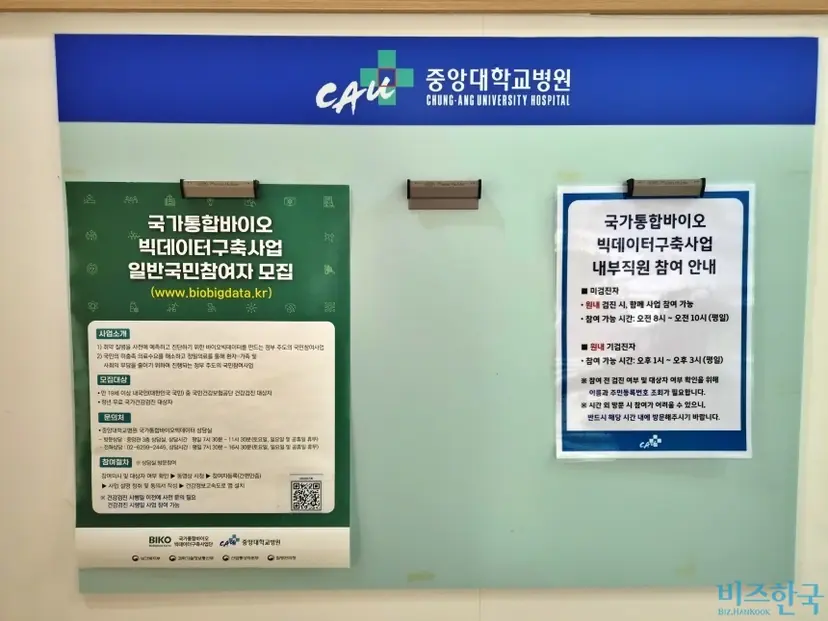
So, how is this massive project actually being carried out in the medical field? The reporter visited the Chung-Ang University Hospital National Integrated Bio-Big Data Construction Project (BIKO) team, which collects health information from the general public, to hear voices from the field.
On-site, hospital staff wearing sashes were actively encouraging those over 19 years of age scheduled for health screenings to participate in the national bio-big data project. Participants were provided with detailed pre-explanations using tablet PCs in a private counseling space. To minimize inconvenience, Chung-Ang University Hospital has set up a separate area, including a 'dedicated blood collection window' for participants, and has deployed dedicated staff to handle blood and urine collection.
The participation process at medical institutions mainly consists of signing three types of consent forms (for personal information collection, human-derived material donation, and project participation), installing the 'My Health Record' app, and undergoing the screening.
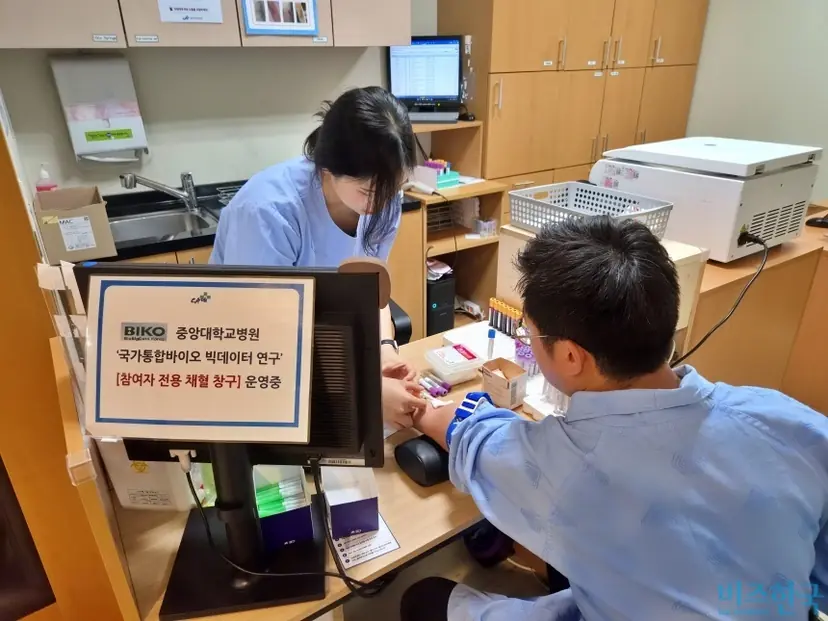
General participants who agree to the project provide 22.5ml of blood and 10ml of urine to be used for research. The collected blood and urine are picked up daily by GC Labs and sent to institutions such as Macrogen038290, JS Link, CG Invites083790, and Theragen Bio, which produce genomic data. The resulting personal health information is thoroughly anonymized (de-identified) and safely stored on state-designated secure servers.
At Chung-Ang University Hospital, 30 to 40 people consistently participate in the screenings every day, accumulating meaningful data for the future. An on-site official shared the atmosphere, saying, "Not only the younger generation but also older individuals are deeply sympathetic to the project's purpose of advancing medicine for future generations and are willingly participating in the tests."
Prof. Kim reiterated that this project is not a short-term endeavor but a healthy legacy that will leapfrog the medical standards of future generations, and he urged many people to participate. This is because the integrated data of 1 million people can become the spark for uncovering the root causes of rare diseases, cancer, and various chronic illnesses, leading to the development of innovative treatment technologies.
He said, "If researchers can derive meaningful results by utilizing this data, it will make a groundbreaking contribution to accelerating the era of personalized patient care. The precious information of each and every participant has great social significance. For the health of myself, my family, and all of us, the voluntary participation of the public is essential."