

[비즈한국] Using artificial intelligence, we deliver rapid and accurate information on real estate transactions for apartments and residential properties in Seoul over the past week.
In the Seoul residential real estate market, the trend of 'where there is demand, there is action' remained clear this week. Despite ongoing loan regulations, land transaction permit systems, and efforts to strengthen household debt management, high-end complexes in the Gangnam, Songpa, and Yongsan riverside areas continued to dominate top-tier transactions. Notably, however, this week's data shows that the market was not driven solely by the three Gangnam districts. Transactions in the 2 billion won range were observed in the 'Han River Belt' and major school districts, including Seongdong, Mapo, and Yangcheon, signaling that price levels in core residential areas of Seoul are solidifying further.
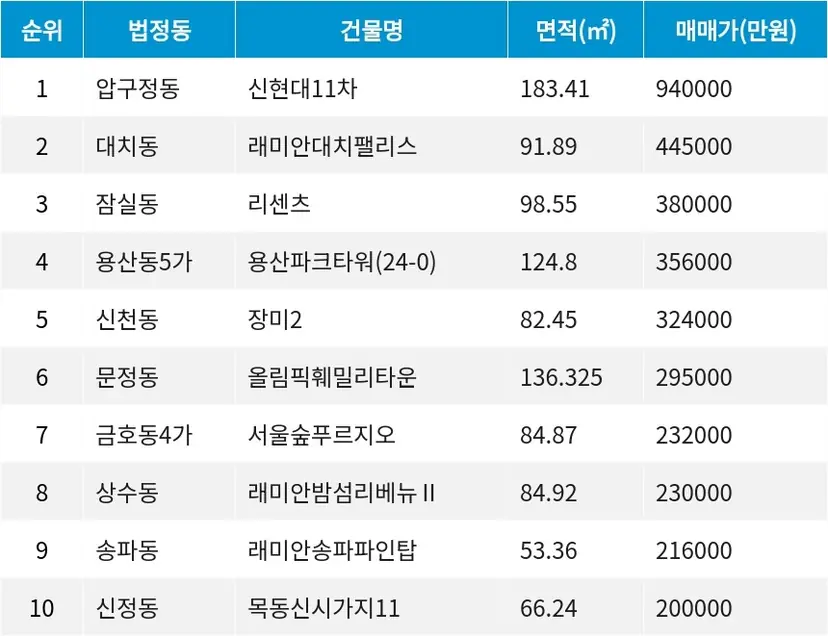
According to the Seoul Real Estate Information Plaza, data on actual residential transaction prices in Seoul from June 15 to June 19 shows that a 4th-floor unit in the Shinhydae Apartment Complex 11 in Apgujeong-dong, Gangnam-gu, with a dedicated area of 183.41㎡, was sold for 9.4 billion won, marking the highest transaction price of the week.
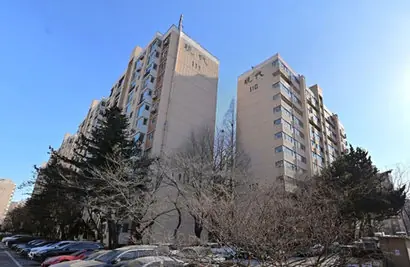
The sale of the Apgujeong Shinhydae 11 holds greater symbolic significance than the price alone. The 183.41㎡ unit is a large-format property that rarely appears on the market. It combines a prime Han River location, expectations for Apgujeong's reconstruction, and long-accumulated demand from wealthy individuals. In the high-end Gangnam market, pricing is determined less by regulatory factors and more by the question, 'Can I find another property like this?' This 9.4 billion won transaction illustrates that cash-buying power and scarcity take precedence over loan accessibility.
Following this, a 20th-floor unit of Raemian Daechi Palace in Daechi-dong, Gangnam-gu, with a dedicated area of 91.89㎡, was sold for 4.45 billion won. Raemian Daechi Palace is a representative complex that benefits from both high demand for the Daechi-dong school district and a preference for large-scale, newly built complexes. While Apgujeong's pricing reflects reconstruction prospects and riverside scarcity, Daechi-dong's prices are driven by educational demand and local infrastructure. This highlights that even within the same Gangnam area, the logic supporting prices differs.
A 11th-floor unit of Ricenz in Jamsil-dong, Songpa-gu, with a dedicated area of 98.55㎡, was sold for 3.8 billion won. With a representative Jamsil complex appearing in the top ranks, the strong price levels of Songpa-gu were reaffirmed. Ricenz is highly valued for its accessibility to Jamsil Station, the Sports Complex, and the Han River, as well as its residential stability, school district, and convenience. As Jamsil offers strong local infrastructure while maintaining proximity to Gangnam, demand remains resilient even during adjustment periods.
A 19th-floor unit of Yongsan Park Tower in Yongsan-dong 5-ga, Yongsan-gu, with a dedicated area of 124.8㎡, was sold for 3.56 billion won. Yongsan Park Tower is situated in a location where the Han River, Yongsan Park, and the International Business District development expectations converge. Transactions in Yongsan carry a different meaning compared to Gangnam. While Gangnam's strength lies in school districts, reconstruction, and historical prestige, Yongsan's prices are pushed by development expectations, urban accessibility, and the value of Han River views.
An 82.45㎡ 3rd-floor unit at Jangmi 2 in Sincheon-dong, Songpa-gu, was sold for 3.24 billion won. Jangmi Apartment is a prime example of reconstruction expectations in the Jamsil area. Within the same Songpa district, while Ricenz represents residential stability and large-complex premiums, the Jangmi 2 transaction reflects future urban maintenance project expectations.
Additionally, a 136.325㎡ unit at Olympic Family Town in Munjeong-dong was sold for 2.95 billion won. As a flagship large-scale complex in southern Songpa, Olympic Family Town offers generous space and a stable residential environment. This transaction proves that demand for large properties in Songpa, beyond just the Jamsil core, remains vibrant.
Furthermore, an 84.87㎡ unit at Seoul Forest Prugio in Geumho-dong 4-ga was sold for 2.32 billion won, and an 84.92㎡ unit at Raemian Bamseom Lavenue II in Sangsu-dong was sold for 2.3 billion won. These two deals are significant scenes in this week's transaction data. With 84㎡ apartments in Seongdong and Mapo establishing a price point in the early 2 billion won range, it is clear that the axis of high-end residential real estate in Seoul is expanding from Gangnam and Yongsan toward the northern bank of the Han River.
A 53.36㎡ unit at Raemian Songpa Pinetop in Songpa-dong was sold for 2.16 billion won. Although the area is relatively small, the premium of being in a core Songpa location is reflected in the price. A 66.24㎡ unit at Mok-dong New Town Complex 11 in Sinjeong-dong was sold for 2.0 billion won. This transaction combines Yangcheon-gu's school district with reconstruction expectations. It has become a market where 2 billion won range transactions occur naturally outside of the Gangnam area when school districts and urban renewal projects are involved.
The disparity is even clearer when looking at the price per 3.3㎡. The sale price for the Shinhydae Apartment Complex 11 in Apgujeong-dong reached approximately 169 million won per 3.3㎡. This is nearly triple the average price of 59.259 million won per 3.3㎡ for Seoul apartments recorded last December by KB Real Estate. Raemian Daechi Palace in Daechi-dong stands at approximately 160.09 million won per 3.3㎡, while Ricenz in Jamsil-dong is at approximately 127.47 million won per 3.3㎡. Compared to the Seoul average, these complexes have already formed a separate market of their own.
This week's top transactions share three commonalities. First, the scarcity of large-format units and riverside locations remains powerful, as seen in Apgujeong Shinhydae 11 and Yongsan Park Tower. Second, regions that combine strong school districts with good lifestyle infrastructure maintain high price resilience, exemplified by Raemian Daechi Palace, Mok-dong New Town Complex 11, and Jamsil Ricenz. Third, reconstruction expectations continue to be reflected in actual transaction prices, as seen in Apgujeong, Jamsil Jangmi, and Mok-dong.
The policy environment is by no means loose. Financial authorities maintain their stance on strengthening total household debt management and controlling the growth rate of mortgage loans this year. With household loan growth across all financial sectors accelerating in May compared to the previous month, concerns regarding tighter loan management have intensified. Major apartment complexes in Seoul are also affected by the land transaction permit system. Since buyers must consider the permit process and actual residence requirements, it serves as a burden on investment demand.
Nevertheless, the reason top-tier transactions continue is simple. Buyers in this market prioritize location and scarcity over interest rates and loan limits. In Apgujeong, Daechi, Jamsil, and Yongsan, there are few substitutes within Seoul. Supply is limited, and demand remains high. While regulations may slow the speed of transactions, they cannot immediately lower the prices of rare assets.
However, one should not interpret this week's transactions as evidence that the entire Seoul market is rising at the same pace. The top 10 listings are concentrated in the most preferred regions and complexes. There is a temperature difference compared to the market sentiment in mid-to-low-priced areas or peripheral regions. It has become difficult to explain the Seoul apartment market with a single number; it is a market where 9.4 billion won in Apgujeong and a wait-and-see attitude in peripheral areas coexist.
Still, the message left by this week's actual transactions is clear: the baseline for Seoul's high-end housing market has moved up. Transactions for 9 billion won-range large units in Apgujeong, 4 billion won-range core units in Daechi, 3 billion won-range units in Jamsil/Yongsan, and 2 billion won-range units in Seongdong, Mapo, and Mok-dong appeared in the same week. While the center of gravity in the Seoul real estate market remains in Gangnam and the riverside, its periphery is steadily expanding.
The Seoul real estate transaction market for the 3rd week of June 2026 was less a scene of regulations suppressing prices and more a scene of scarcity enduring regulations. Loans were tightened and permit procedures became complex, but the reputations of Apgujeong, Daechi, Jamsil, and Yongsan were still printed as numbers on the transaction sheet. The one-line takeaway for the Seoul real estate market this week is: although the number of buyers decreased, those who were able to buy chose more expensive homes.
※ This article was written by Bizhankook and MetaVX's generative AI.