

[비즈한국] Artificial Intelligence (AI) is transforming not only industries and daily life but also national administration and law enforcement systems. The National Police Agency (NPA), the Public Prosecutors' Office, and the National Tax Service have recently launched or expanded dedicated AI organizations and are building systems to integrate AI into investigations, audits, and civil service tasks. While the goal is to increase efficiency and accuracy, the significance of introducing AI is profound, given that the information and authority held by these agencies directly affect the fundamental rights of the public. Bizhankook examines the current state of AI transformation among the three major law enforcement agencies—the NPA, the Public Prosecutors' Office, and the National Tax Service—and the tasks that remain in the process.
The National Police Agency is accelerating efforts to introduce Artificial Intelligence (AI) across its investigative and civil service operations. From case law searches and drafting warrant applications to recommending questions for suspect interrogation, supporting civil service consultations, and detecting deepfakes, AI is moving beyond a mere assistive tool and entering the core decision-making processes of policing. To support this, the NPA is streamlining its dedicated organizations and pushing for the development of an internal network-based AI integrated platform and a large language model (LLM) specialized for law enforcement.
According to Bizhankook's findings, the NPA is currently conducting policy research on 'establishing AI impact assessments and risk management plans.' The project, valued at 41 million KRW with a 120-day duration, is being carried out by ThinkForB. An NPA official stated, "We plan to finalize the study by the end of this year." A study on 'upgrading the NPA's personal information protection system following the introduction of AI' is also underway. The core focus is to examine risks such as re-identification during AI learning and inference, data bias, and personal information protection standards when analyzing CCTV footage.
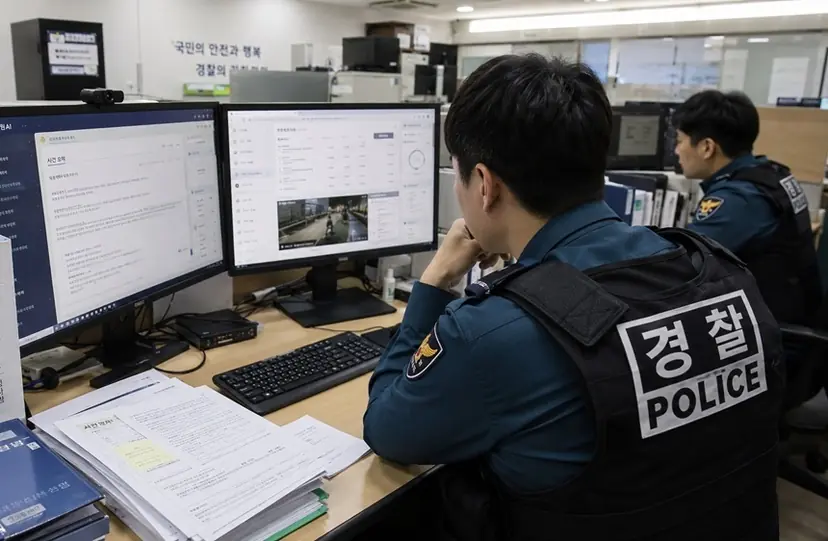
These two studies are deeply linked to responding to the AI Basic Act (Framework Act on the Promotion and Trust-Building of Artificial Intelligence) and the 'Public AI Act' (Act on the Promotion of Artificial Intelligence and Data-Based Administration) set to take effect at the end of February next year. Under these laws, various AI applications in the law enforcement sector are likely to be classified as 'high-impact artificial intelligence.' The AI Basic Act imposes obligations such as ensuring transparency and establishing risk management systems, while the Public AI Act mandates that public institutions prepare impact assessments and risk management plans before adopting AI.
From Control Tower to Integrated Platform
In addition to revamping the institutional and legal foundation, the NPA is accelerating its AI transition in three directions: restructuring organization and infrastructure, and expanding AI application in investigations and field operations.
In March this year, the NPA formalized its dedicated AI control tower by rebranding the 'Future Policing Policy Division' under the Future Policing Policy Bureau to the 'Policing AI Policy Division.' It absorbed the existing Policing AI Innovation Task Force (TF) into a regular organization and created a new AI Cooperation Officer position reporting directly to the Bureau Chief. The Information Infrastructure Division was also renamed the Policing AI Infrastructure Division.
Alongside organizational restructuring, the agency is pursuing the creation of an 'AI Integrated Platform' to apply generative AI to overall administrative tasks. Through an Information Strategy Planning (ISP) project carried out by Wearbiz, the agency is reviewing ways to integrate AI features into PolNet, the internal police network, to support report drafting, translation, and document summarization. An official in charge stated, "We are preparing to finalize the ISP project this year and reflect it in next year's budget so that full-scale construction can begin."
The Korean National Police University is in charge of developing an LLM specialized for law enforcement. In April, 'Policing AI Leader Training (CAIO)' for superintendent and senior superintendent-level managers began, covering topics such as generative AI, physical AI, and AI security and ethics.

AI Penetrating Investigative Sites… Are There Concerns?
The 'KICS-AI,' an investigative support AI introduced in November 2024, has been supporting case law searches and the drafting of warrant applications. Through an upgrade project totaling 4.6 billion KRW, the agency plans to expand its functions to include drafting decisions for judicial police officers and notices of investigation results, recommending questions for suspect interrogations, creating crime lists, and building an investigative feedback system using indictments and court rulings. AI application in digital forensics has also been pursued since last year.
In the civil service sector, 'Everyone's Police Officer,' a project with a 10.7 billion KRW investment, is being developed as part of the government's 'Public AI Transformation (AX) Project.' It is expected to support civil service consultations, reception, and document preparation by linking with Police Civil Service 24 and the 182 call center by December 2027. An advisory group ceremony involving 200 citizens and field officers was held on the 18th.
However, concerns regarding effectiveness and security surrounding the spread of such policing AI are significant. Facial recognition, AI-based voice phishing prevention, and automated investigation reports all fall under 'high-impact AI' per the AI Basic Act, and the NPA's move to establish impact assessments and risk management plans is seen as a strategic step to institutionally address these concerns.
Lee Sang-yeop, a professor at the Korean National Police University, noted in a paper analyzing international academic data that 'Data' emerged as a key keyword in policing AI research. He pointed out, "While domestic policing AI research is biased toward institutional perspectives such as law and public administration, international research is primarily focused on technology application based on computer science. It is now time to conduct research on technological advancement for safe application in police work, in addition to responding to the legal issues brought about by AI."
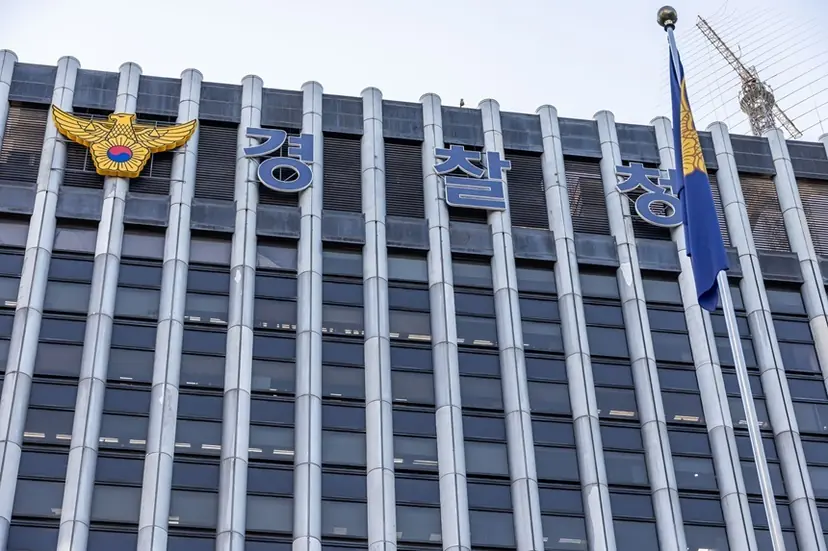
Hwang Seok-jin, a professor at Dongguk University's Graduate School of Information Security, said, "When using AI for tasks that require no bias, such as drafting suspect interrogation records or providing administrative support, there is a lack of devices to verify the results. The issue of hallucinations, where AI creates non-existent facts, is also difficult to verify." He pointed out, "There are limitations with the data itself, as it can sometimes only utilize Ministry of Government Legislation case law and struggles with image or video analysis. If bias is reflected in the algorithm, it becomes difficult to guarantee transparency, yet there are almost no institutional guidelines or manuals on who should be held responsible when a problem arises."
Because of this, some suggest that rather than adopting technology that directly affects police discretion, the agency should start by gradually introducing technologies with lower resistance.
An NPA official explained regarding these concerns, "We plan to conduct impact assessments on all AI-related projects within the NPA. Since high-impact AI is a field that can affect the public's daily lives and fundamental rights, the intent is to evaluate whether there are any infringements." He added, "We plan to refine relevant standards before the law takes effect next year to build a foundation for systematically managing risk factors."
![[Law Enforcement AI Report] ① Is a Competent and Fair 'AI Cop' Possible?](https://s.bizhankook.com/attachments/2026/07/7985a02444ff_3f2b5028.jpg)
![[AI Report on Supervisory Agencies] ② [Exclusive] Prosecution to Introduce Generative AI for Digital Evidence Analysis](https://s.bizhankook.com/attachments/2026/07/2c4f2e1d1d74_e7fcd687.jpg)
![[Administrative Agency AI Report] ③ “Convenient Tax Payment, Fair Collection”: The National Tax Service’s AI Great Transformation Takes Off](https://s.bizhankook.com/attachments_webp_no_wm/2026/07/134365_no_wm_e3e2934a.webp)