

[비즈한국] This column provides a weekly summary of major cryptocurrency market trends and the movements of top 100 market-cap assets. We provide comprehensive insights, covering major tokens like Bitcoin and Ethereum, key altcoin issues, and global policy variables. We aim to help you understand the volatile cryptocurrency market as easily and entertainingly as watching Netflix.
The protagonist of the cryptocurrency market this week was not the rising stars, but the 'pullback.' Some altcoins that surged last week fell into the top rankings of price drops this week. The market did not hold onto positive news for long. Profit-taking hit assets with high trading volume first, and buying sentiment cooled rapidly for tokens burdened by high circulating supply.
The macroeconomic environment was also unfavorable. While the U.S. Federal Reserve held interest rates steady on June 17, there were no clear signals of the easing that the market had anticipated. Instead, concerns grew across all risk assets due to predictions that rate cuts might be delayed or even the possibility of future hikes. In the cryptocurrency market, these changes were reflected more harshly in altcoins than in Bitcoin. Tokens with thin liquidity and high dependency on short-term supply and demand experienced steeper declines.

According to data as of 7:00 AM on the 19th, most of the weekly top decliners recorded double-digit drops. The most notable token is Odiera (BEAT). Odiera plummeted -82.15% over seven days, reaching a level of decline that effectively signals a collapse in value. While it rebounded by 2.62% over a 24-hour period, it was far from enough to make up for the weekly loss. Despite a market capitalization of approximately 766.2 billion KRW, the rapid price collapse raised simultaneous questions regarding its liquidity, distribution structure, and project credibility.
Odiera is a Web3 entertainment project that combines music, games, and fan-participation services with a blockchain reward structure. Recently, it has expanded its messaging to emphasize AI agents and user engagement. The problem is that the price reacted more sensitively to exchange exposure and short-term supply-demand dynamics than to the project's actual usage metrics.
Odiera surged last week due to Binance Alpha exposure, trading events, and anticipation of new content. However, the fate of any surging asset is the need for a 'next buyer.' When prices rise excessively in a short period, the incentive for early investors to take profits increases, while the burden of volatility grows for those who enter late. Furthermore, the large-scale token unlock issue in early June added to concerns about supply pressure. This week's plunge in Odiera is less the result of a single piece of bad news, and more a case where the burden of circulating supply, fatigue from the rapid surge, and market-wide risk aversion exploded all at once.
DEXE (DEXE) fell -27.81% as of the 7-day mark, recording a relatively large drop even among major altcoins. DEXE is a platform token for Decentralized Autonomous Organization (DAO) decision-making and governance, with holder voting and governance participation considered its core value.
Paradoxically, DEXE's decline is also a shadow of its previous rise. DEXE showed a strong upward trend in early June as the DAO governance theme gained traction. Some market analyses mentioned a 40% gain over 30 days and increased trading interest. However, when actual revenue models or user metrics fail to keep pace with price, governance tokens see quick pullbacks. Especially when large holders or short-term traders reduce their positions, selling volume is reflected in the price faster than the long-term narrative of governance participation.
Monero (XMR) fell -12.50%. Monero is a privacy-focused coin that hides transaction history. While anonymity and anti-tracking features are its strengths, they also bring regulatory risks. Privacy coins offer financial privacy to users, but for exchanges and regulators, they are assets that pose significant burdens regarding anti-money laundering and sanctions compliance.
The weakness of Monero this week can be seen as the result of a combination of market-wide risk aversion and structural caution regarding privacy coins. In recent years, major exchanges have been cautious about maintaining the listing of privacy coins due to regulatory pressure. In some countries, trading support for anonymity-enhanced assets like Monero has been restricted or reduced. When prices rise, the 'privacy narrative' is a strength, but when the market shakes, that same narrative turns into a regulatory risk.
Cosmos (ATOM) fell -11.36%. Cosmos is an interoperability network that connects different blockchains. While the bridge and interchain themes were vibrant last week and related tokens were strong, the atmosphere changed this week. Although the long-term narrative of inter-chain connectivity remains valid, liquidity took precedence over narrative in the short-term market. In a phase where investors are reducing risk, even tokens with strong underlying technology find it difficult to avoid selling pressure.
DeFi and infrastructure tokens also underperformed. Curve (CRV) recorded -9.75% and Night Token (NIGHT) recorded -6.30%. Curve is a decentralized exchange specializing in stablecoin swaps, functioning as a liquidity infrastructure that touts low slippage and high asset-swap efficiency. It drew attention last week amid a flow of revaluation for stablecoins and DeFi infrastructure, but it gave back some of those gains this week.
Night Token is an asset linked to the Cardano ecosystem's privacy projects, emphasizing transaction information protection and data security features. However, like Monero, privacy-related assets are not free from regulatory caution. Even if they have a differentiated technical message, in times when the market is reducing risk, the very word 'privacy' can act more as a reason to sell than to buy.
Avalanche (AVAX) and Sui (SUI) fell -5.47% and -5.30%, respectively. Both are Layer 1 blockchains that emphasize high-speed processing and scalability. Avalanche highlights its own ecosystem expansion and subnet structure, while Sui touts high throughput and developer friendliness. However, this week, the limitations of market capitalization outweighed their technical advantages. As the Layer 1 competition enters a long-term phase, investors seem to prefer assets with confirmed short-term cash flow or institutional demand.
ADA (ADA) fell -4.21%. ADA is the native token of the Cardano network, a project that emphasizes academic peer review and phased upgrades. However, Cardano-related assets as a whole have recently struggled to regain market interest. Analysis suggested that ADA had dipped near multi-year lows in early June, and despite expectations for technical upgrades, price recovery has been sluggish. While the weekly decline rate is limited compared to Odiera or DEXE, investor sentiment remains defensive.
Gram also fell -4.15%. While the decline is relatively limited, the downward trend is no different from the top-tier decliners. What the falling tokens this week have in common is that they are not 'bad projects' but are in an 'environment where it is difficult to maintain price with just a good story.' When liquidity dries up, investors first sell the tokens that have already yielded profits, then move on to reduce exposure to tokens with complex explanations. Altcoins are easily hit by both conditions at the same time.
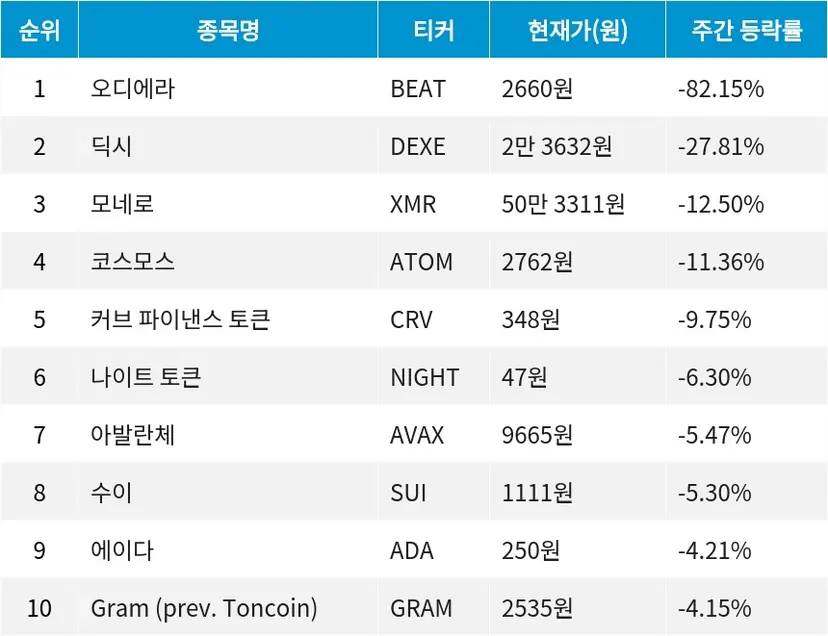
The peculiarity of the market this week is that the decline was not conducted indiscriminately. Among the top decliners were last week's high-flyers, governance theme stocks, privacy coins, and interchain/DeFi infrastructure tokens. This means that the market didn't just abandon one specific sector, but rather funds that had recently flowed into these areas were withdrawn sequentially.
Odiera is a case where the burden of circulating supply and profit-taking pressure overlapped after a surge. DEXE is a case where the demand for verification of actual usage metrics increased after the governance theme hype. Monero and Night Token are cases where privacy technology was read simultaneously as a strength and a regulatory risk. Cosmos and Curve showed how quickly the narratives of connectivity and liquidity infrastructure that were highlighted last week can cool off during a risk-off phase.
Ultimately, the 25th week of 2026 was a week that tested the 'expiration date of stories' in the cryptocurrency market. Last week, the market responded to stories like Binance Alpha exposure, bridge demand, interchain infrastructure, and stablecoin liquidity. This week, the market asked whether the price had attached itself to these stories too quickly. The answer was already on the charts.
In the altcoin market, a narrative is a spark. However, to keep the fire burning for a long time, liquidity, actual usage, and supply management are required. The recent Odiera plunge is an example of how fast the price cools when those conditions collapse. The pressure test has begun on the plumbing behind the stage that was illuminated last week.
※ This article was written by Bizhankook and MetaVX's generative AI together.