

[비즈한국] Korea Hydro & Nuclear Power (KHNP) has finalized the selection of Yeongdeok-gun in Gyeongbuk as the site for two new large-scale nuclear power plants and Gijang-gun in Busan as the site for the country’s first Small Modular Reactor (SMR) demonstration, in accordance with the 11th Basic Plan for Electricity Supply and Demand. This marks the first selection of a new large-scale nuclear power plant site in 15 years, since 2011. While expectations for regional economic revitalization through massive capital investment and job creation are rising, significant friction is expected in the project's implementation due to strong backlash from civil society and some residents concerned about environmental and safety issues.
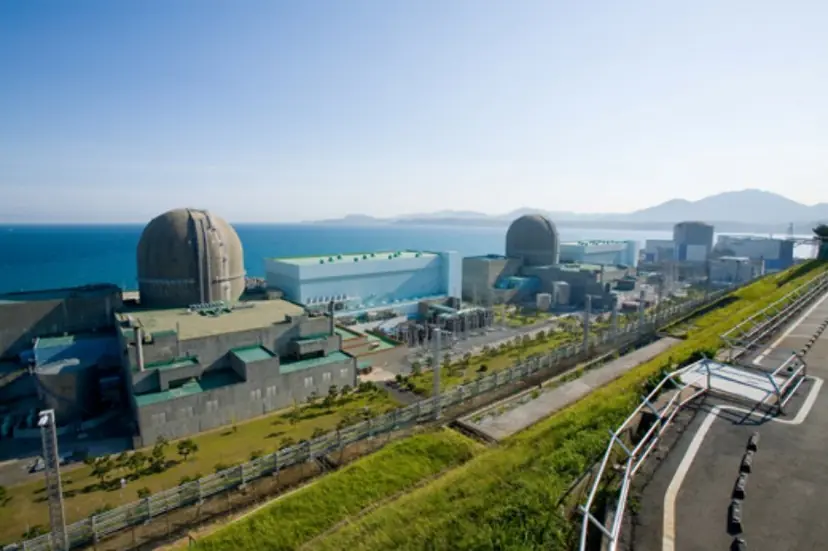
According to the announcement by the KHNP New Nuclear Power Plant Site Selection Evaluation Committee on June 16, Yeongdeok-gun, Gyeongbuk, which competed to host the large-scale plants, scored 91.01 points in the comprehensive evaluation, surpassing Ulju-gun, Ulsan (82.63 points) to be selected as the final site. For the SMR demonstration site, Gijang-gun, Busan, scored 87.11 points, defeating Gyeongju, Gyeongbuk (84.56 points).
‘86.18%’ Approval Rate Among Yeongdeok Residents Played a Decisive Role
The most decisive factor in this site evaluation was the “public acceptance” category, which was allocated a total of 25 points. Yeongdeok-gun outperformed competitor regions in the local community’s desire to host the project, recording an 86.18% approval rate in a self-conducted public opinion poll earlier this year.
The site area proposed by Yeongdeok is 3.24 million square meters, which is more than three times the required area (1.041 million square meters) initially requested by the government in its public call for applications. The fact that it possesses “scalability” for the future construction of two additional nuclear units also worked in its favor. The government plans to proceed with the project with the goal of completing the large-scale nuclear plants in 2037 and 2038, and the SMR in 2035, following subsequent licensing procedures such as environmental impact assessments.
The local community, which has confirmed the construction of new nuclear power plants, is expressing its welcome while anticipating massive economic ripple effects. In the case of Yeongdeok-gun, it is expected that the influx of personnel during the construction period will revitalize the stagnant local commercial sector, and that legal subsidies following the operation of the nuclear plants will become a growth engine to overcome the risk of regional extinction. Yeongdeok County Governor-elect Jo Ju-hong expressed his determination to concentrate all administrative power to ensure the project proceeds smoothly, aiming to directly link nuclear power construction to solving the livelihood issues of residents and creating jobs for young people.
Gijang-gun, Busan, which will house the nation’s first SMR demonstration plant, is also in an upbeat mood. It has even presented an industrial roadmap to host artificial intelligence (AI) data centers, which require vast amounts of power, by using the SMR project as a stepping stone. Gijang County Governor-elect Woo Seong-bin stated that he can now link his key pledge—the attraction of an AI data center—with this SMR project, and expressed his intention to actively persuade and embrace even those residents who oppose or express concerns about hosting the nuclear plants.
Deliberation and Discussion Must Accompany Simple Polling
Contrary to these rosy prospects, there are also strong voices of concern. In particular, since Yeongdeok has a history of having a nuclear power project canceled due to strong resident opposition in the past, civil society points out that this decision lacks procedural legitimacy. In 2012, the Cheonji site in Yeongdeok was designated as a planned area for a nuclear power plant, but in the 2015 local referendum, an overwhelming 92% result against the project was recorded in the aftermath of the Fukushima nuclear accident, and the designation was ultimately withdrawn in 2021 under the Moon Jae-in administration’s nuclear phase-out policy.
Park Soo-hong, director of the National Emergency Action for Stopping New Nuclear Power Plants, said, “Yeongdeok is a region where an overwhelming opposition was already confirmed in a resident referendum 11 years ago. Since it is a region that was already rejected once, there must be a careful democratic verification process, such as serious deliberation and discussion, rather than just a simple public opinion poll.”
Anxiety regarding the SMR site to be built in Gijang-gun is also significant. Since there is no case of SMR commercialization anywhere in the world yet, voices are saying that the idea of experimenting with an SMR with unproven stability near a large city with a population of 3.4 million is dangerous. Kim Jong-hak, chairman of the Gijang-gun Fisheries Damage Countermeasures Committee, expressed concern, saying, “The name has been changed to SMR, but only the scale has been reduced; from the perspective of the residents, it is just another unit being added to the Kori Nuclear Power Plant.” He added, “The damage caused by the thermal discharge from the existing Kori plant is not even being properly addressed.”
A structural contradiction in terms of “power inequality” from a macroscopic perspective has also been brought to the table. AI data centers and semiconductor clusters, identified as the main causes of the future explosion in power demand, are concentrated in the capital region, such as Yongin. However, the power plants required to handle this are being concentrated once again in the coastal regions of the Yeongnam area. This means the costs of building long-distance, large-scale power transmission networks to send electricity to the capital region, and the resulting social conflicts, are being entirely passed on to local residents. Lee Heon-seok, a policy committee member for Energy Justice Actions, pointed out, “Even with the Ulsan industrial complex and Pohang steelworks, when you add up the Busan, Ulsan, and Gyeongbuk regions, the power self-sufficiency rate is close to 200%. There is concern that power inequality will worsen.”
Furthermore, safety issues due to the concentration of nuclear plants on the east coast were also pointed out, as the risk of cascading accidents increases. Lee added, “If you concentrate multiple power plants in a specific area, you end up with a structural vulnerability where the entire national power grid could be paralyzed in the event of climate disasters or major accidents, as seen in past typhoon cases.”