

[비즈한국] Although the government is promoting its goal of becoming one of the top three global powers in artificial intelligence (AI) and strengthening competitiveness in cutting-edge technologies by increasing related budgets, new hiring at major public institutions under the Ministry of Science and ICT (MSIT) has yet to enter a full-scale recovery phase. While there are recent signs of a rebound after hiring numbers plummeted during the peak of R&D budget cuts, there is a clear discrepancy between agencies, with some institutions responsible for executing AI and digital policies even showing a downward trend in hiring.
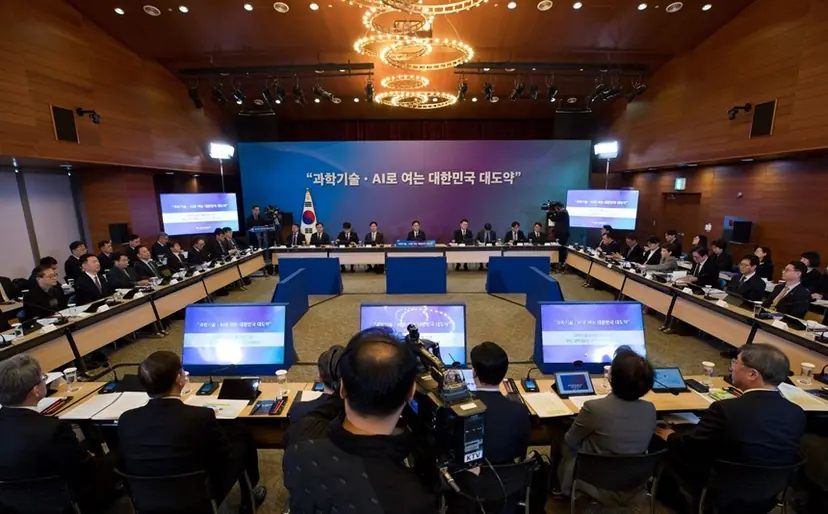
According to the Public Institution Management Information Disclosure System (ALIO), the number of new regular hires at 17 agencies under the MSIT fell from 270.5 in 2021 to 246.5 in 2022, 183 in 2023, and further dropped to 177 in 2024. Although it rebounded to 193 last year, it remains 28.7% lower than the level in 2021.
The timing of the hiring decline coincides with the government's push for public institution efficiency and the onset of discussions regarding the restructuring of the national R&D budget. Since taking office, the Yoon Suk-yeol administration has emphasized managing the headcount of public institutions and organizational efficiency, and the entire research community was shocked when the restructuring of the national R&D budget was pursued in 2023. Since then, the administration has readjusted its investment direction toward strategic technologies such as AI, semiconductors, and quantum, and recently expanded R&D budgets again, but hiring has yet to recover to past levels.
However, this analysis excludes 22 government-funded research institutes in the science and technology sector under the National Science and Technology Research Council (NST), which falls under the MSIT. These institutions were removed from ALIO disclosure requirements after their designation as public institutions was lifted at the end of 2024.
Hiring at AI Policy Executing Agencies Actually Declining
Although the government has positioned AI as a key national growth engine and is expanding related investments, new hiring at the agencies responsible for executing these policies has continued to decline.
The National Information Society Agency (NIA), Korea Internet & Security Agency (KISA), National IT Industry Promotion Agency (NIPA), Institute for Information & Communications Technology Planning & Evaluation (IITP), and Korea Data Agency (K-DATA) are the bodies responsible for planning, executing, fostering, securing, and managing R&D for national AI policies. Much of the government's hyperscale AI projects, national AI computing centers, AI semiconductors, and data industry policies are executed through these agencies.
The combined number of new regular hires for these five agencies fell from 133 in 2021 to 103 in 2022, 80 in 2023, 78 in 2024, and 75 in 2025. This is a decline of nearly 44% in four years.
There were significant differences between agencies. New hiring at the NIA dropped by nearly half, from 52 in 2021 to 29 in 2025. While the total number of employees increased from 710 to 725, new hiring decreased. The decline was even more pronounced at NIPA and K-DATA. Both agencies saw no major changes in total headcount, but new hiring plummeted. NIPA hired only 2 people last year (compared to 14 in 2021), and K-DATA, which hired 21 new employees five years ago, recorded 0 last year. IITP also saw a decline from 14 in 2021 to 8 in 2025. While the scale of AI and semiconductor R&D budget execution is expanding, the management of human resources remains conservative.
In contrast, KISA hired 36 new employees last year, an increase from 32 in 2021. The number of employees also rose from 770 to 779 during the same period. This is interpreted as a result of relatively stable hiring due to the growing importance of cybersecurity and digital trust.
Analysts suggest this is not unrelated to the fact that recent government AI policy is being pushed through the reinforcement of existing agency functions rather than organizational expansion. The priority is to utilize existing organizations and personnel rather than connecting increased project budgets to new staffing or large-scale recruitment.
Research Support Agencies Showing Recovery... but Discrepancies Remain
On the other hand, research support agencies that underpin the national R&D ecosystem are showing some signs of recovery.
The National Research Foundation of Korea (NRF), Korea Institute of Science & Technology Evaluation and Planning (KISTEP), Korea Institute of Human Resources Development in Science and Technology (KIRD), Institute for Basic Science (IBS), and Innopolis Foundation are the agencies responsible for planning, evaluating, and executing national R&D budgets, supporting researchers, and commercializing research outcomes, acting as key infrastructure connecting research sites with government R&D policy.
The total number of new regular hires at these agencies dropped from 83.5 in 2021 to 79.5 in 2022 and 79 in 2023, declined further to 66 in 2024, and then recovered to 80 last year, reaching a level close to that of five years ago.
The National Research Foundation of Korea, which oversees research funding, management, training, and international cooperation across all academic disciplines to promote national R&D and scholarship, increased its new hiring to 33 last year from a low of 16 in 2023. Its total headcount also remains at around 620. The Institute for Basic Science hired 21 people last year. This relatively high level is interpreted as a result of the government re-emphasizing the need to expand investment in basic research, thus requiring the maintenance of research infrastructure.
However, not all agencies followed the same trend. The Innopolis Foundation maintained about 14 hires for three years until 2023 but dropped to 5 last year. KIRD showed a downward trend after 14 hires in 2022, rebounded slightly to 8 last year, but failed to reach its 2022 level.
In other words, there is significant variance in the speed of hiring recovery even within research support agencies. Even if the budget increases, it takes a considerable amount of time for it to translate into actual hiring through new project planning, quota adjustments, and organizational restructuring. Public institutions are also subject to government headcount management and labor cost control systems. An official from a research support agency stated, "It is not a structure where we can immediately expand hiring just because the budget increases. Aside from the project budget, there are procedures for quota approval and securing labor cost funding, so there is bound to be a time lag before actual staffing can occur."
Some experts argue that it remains to be seen whether institutional improvements and budget increases will actually lead to an expansion of executing agencies and research personnel.
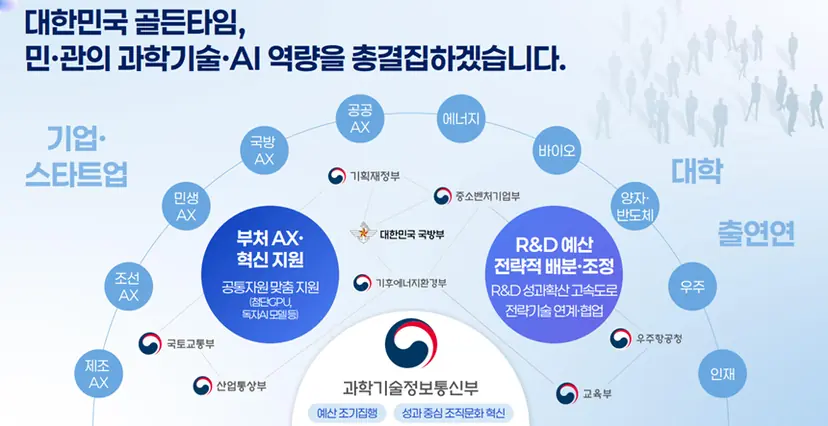
The government is recently accelerating the restoration of the research ecosystem. The government, which allocated 35.5 trillion won for R&D this year, has set the expansion of infrastructure as its top priority, including securing 260,000 cutting-edge GPUs and breaking ground for a national AI computing center by 2030. Deputy Prime Minister and Minister of Science and ICT Bae Gyeong-hoon ordered at the MSIT and affiliated agency work report meeting last January, "We must change our constitution through challenging and innovative R&D. We must boldly invest in high-risk, high-return research and build an ecosystem that transforms failure into learning and accumulation, not a dead end."
Institutional adjustments to change the constitution of the research field are also being carried out in parallel. The government has proposed the phased abolition of the Project-Based System (PBS), a structure where researchers have to cover their labor costs through project acquisition, as a policy task. The intention is to create an environment where researchers can focus on research without administrative burdens, along with simplifying research administrative procedures.
Lee Sung-yeop, a professor at the Korea University Graduate School of Management of Technology, said, "Although the AI-related budget has increased significantly, the fact that public institution hiring has not expanded in proportion is not unrelated to the nature of public institutions that must consider both public interest and efficiency. The important thing is not just to increase the number of people, but to check whether AI policies are actually being executed efficiently."
He continued, "If they are policy executing agencies, they must have enough personnel with expertise in the AI field, but in reality, there are not a few cases where they rely significantly on external experts, private consulting firms, and law firms. A task to be examined is how effectively the recurring annual projects and tasks are being planned, selected, and managed, and whether policy planning and execution capabilities are being properly secured rather than just the scale of hiring itself."