

[비즈한국] Recently, NASA Administrator Jared Isaacman ignited an unexpected scandal. He publicly announced that NASA would review whether Pluto could be restored to its status as a planet. This controversy arose after a young girl in the U.S. posted a handwritten letter on X asking for Pluto to be made a planet again, and Isaacman responded by saying he would look into the matter.
Pluto, which had been called the solar system's last planet for a long time since its discovery in 1930, was stripped of its planetary status through a vote by astronomers in 2006. The argument now is to restore Pluto, which was cast out, back to its status as a planet. But is that actually possible? On what grounds would Pluto, which was ousted, be given back its planetary status?
The possibility of Pluto's 'reinstatement' is not a simple issue. The reason Pluto lost its status in the first place was not simply because it was small or unattractive. The core issue is its dynamical status within the solar system.
In 2006, the International Astronomical Union (IAU) established three criteria for planets in the solar system. First, it must orbit the Sun. Second, it must have sufficient mass for its self-gravity to overcome rigid body forces so that it assumes a hydrostatic equilibrium (nearly round) shape. Third, it must have cleared its neighborhood around its orbit. In other words, there should not be other celestial bodies of similar size in its vicinity. It must be the overwhelmingly dominant object in its orbital zone. This third condition is what led to Pluto being stripped of its planetary status.
At that time, for the first time in human history, the IAU created a scientific definition for the word "planet," which had long been used conventionally. It was an urgent attempt to clear up traffic as the situation in the solar system became chaotic due to the discovery of too many small celestial bodies. The resolution decided at that time classified planets and dwarf planets into separate categories. Pluto satisfied the first two conditions of the newly created planetary criteria but failed to satisfy the third, eventually being downgraded to a dwarf planet.
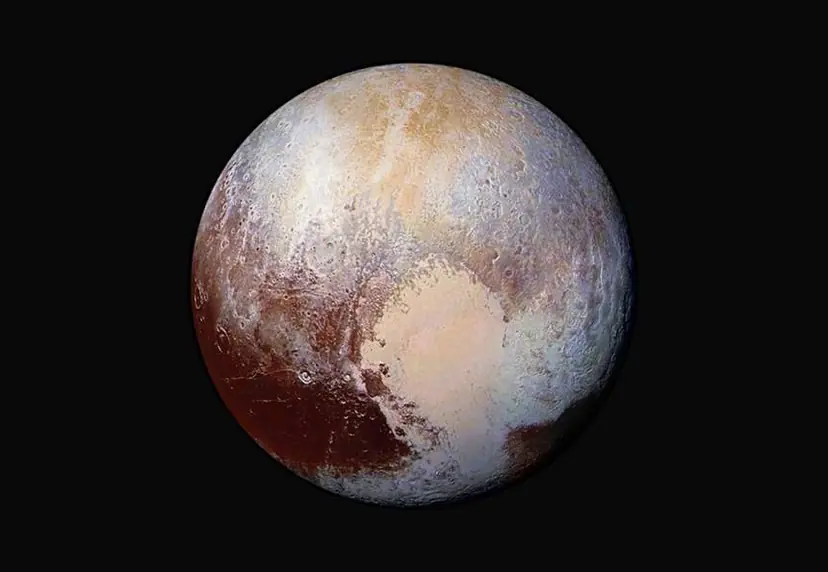
However, for those who loved Pluto, this event caused emotional distress. People began drawing sad expressions on the face of Pluto, which is just an ordinary celestial body, and felt sorry for its plight. There are even many who hope for Pluto's reinstatement. Some astronomers complained that the final third condition, which led to Pluto's demotion, was too arbitrary. In fact, Pluto became a more famous celestial body after being kicked out of the planet category than when it was a planet.
But the important point here is that Pluto was not kicked out because it suddenly became strange. It was quite the opposite. In 2006, we learned more about the solar system. For most of the 20th century, Pluto appeared as a lonely ninth planet. However, as telescope performance improved rapidly after the 1990s, numerous icy bodies beyond Neptune were discovered, and the existence of the Kuiper Belt was revealed. Pluto was not a lonely planet but one of the very large members of the Kuiper Belt.
The fatal blow to Pluto's status was the discovery of Eris. In 2005, Eris was discovered orbiting outside Neptune with a size similar to Pluto. And naturally, the following question arose: If Pluto is a planet, what about Eris? What about other subsequently discovered bodies like Haumea, Makemake, Quaoar, Gonggong, Orcus, and Sedna? Why should Pluto be the only exception? Or should we accept all those other pieces of debris as new planets just to accommodate Pluto? If we did that, the number of planets would increase endlessly every time a new celestial body was discovered at the edge of the solar system. The bold decision made by astronomers in 2006 was to prevent such chaos.
If you want to bring Pluto back, there are two main ways. One is to change the very definition of a planet. If that happens, the definition made in 2006 would be overturned in just 20 years. The other method is to find a unique characteristic that only Pluto possesses—which other Kuiper Belt objects do not—and insist that Pluto is essentially different from other dwarf planets. However, both paths are realistically difficult.
Let's consider changing the definition. In fact, there was a radical proposal a few years ago. In 2022, a paper with the bold title "The Moon is a Planet" was published. In this paper, researchers argued that planets should be defined not by the dynamical criteria of their orbits, but by the geological complexity of the celestial body itself. From this perspective, it doesn't matter whether a body orbits the Sun or Jupiter. The argument is that if it is round enough, geologically complex, and has features like volcanic activity, atmosphere, oceans, magnetic fields, or tidal heating, it should all be considered a planet. According to this logic, Pluto would naturally become a planet. But at the same time, almost all satellites, including our Moon, Io, Europa, Ganymede, Titan, and Enceladus, would also become planets. This is perhaps an even more radical claim than calling all Kuiper Belt objects planets.
Of course, this claim is worth considering scientifically. Especially from the perspective of planetary science, which focuses more on the detailed characteristics of each individual body, what kind of geological world it is might be more important than how much the body dominates its orbit. In fact, Titan has a thick atmosphere, and Europa and Enceladus harbor subsurface oceans. Io has the most intense volcanoes in the solar system. Geologically speaking, they could be more 'planet-like' worlds than the cold, dead, rocky planets.
However, if this definition is accepted as is, the problem becomes more complex. It doesn't just end with reinstating Pluto. The number of planets in the solar system would not just be nine, but could grow to dozens or hundreds. This is a conclusion that even those who feel sorry for Pluto and want its reinstatement did not anticipate. It's like incorporating the Moon as a planet just to save Pluto. Of course, it could be seen as a more consistent standard than the dynamical condition of the orbit, but it does not fit the goal of restoring only Pluto to its past status.
Then what about the second method? To exquisitely find a unique characteristic that only Pluto has, and grant it a special status different from Eris, Haumea, and Makemake. There is some hope here. Because Pluto has an atmosphere. The main component of Pluto's atmosphere is nitrogen, with some methane and carbon dioxide mixed in. The average surface pressure of Pluto is at the 10-microbar level, an extremely thin atmosphere compared to Earth's. However, it was a unique feature among objects beyond Neptune. Or so we thought.
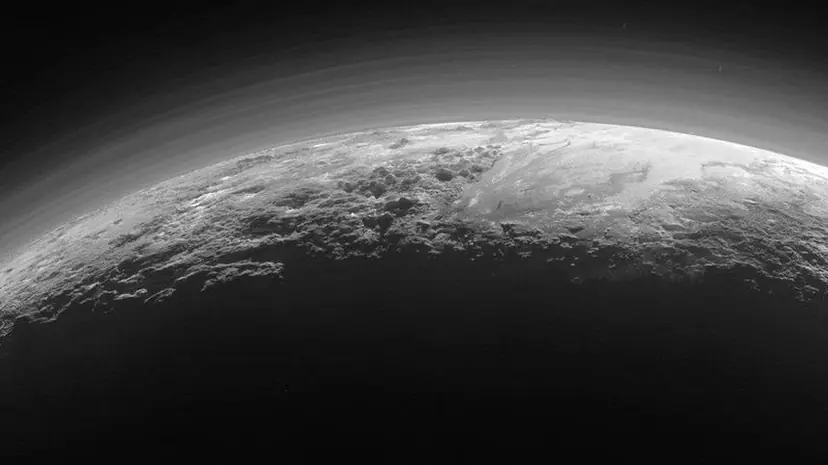

The existence of the thin atmosphere Pluto harbors is clearly revealed in photos taken by the New Horizons probe. As the probe passed behind Pluto while it blocked the Sun, a kind of eclipse occurred. At that moment, sunlight passing through Pluto's thin atmosphere scattered beyond the edge of its round silhouette, creating a clear ring of light.
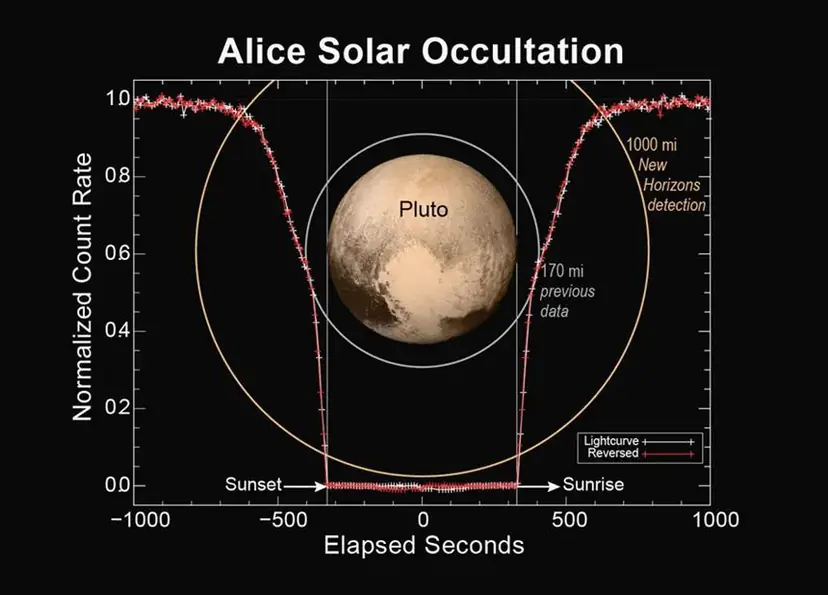
Whether other celestial bodies at the edge of the solar system have an atmosphere can be determined by using occultations, where the body blocks a background star. In the meantime, stellar occultation observations have been conducted for various Trans-Neptunian Objects (TNOs) such as Eris, Haumea, and Makemake, but no atmosphere was detected. Even if there were an atmosphere, it was estimated that there would only be a very thin atmosphere at the 1 to 100 nanobar level. In the case of Makemake, the possibility of methane gas being released was mentioned, but it is not clear whether it is a stable atmosphere trapped by Makemake's gravity or if gas was temporarily released from the surface.
However, due to a recent discovery, even the last hope Pluto held—being the only Kuiper Belt object with an atmosphere—is in jeopardy. A recent issue of 'Nature Astronomy' revealed that a signal of a thin atmosphere was also detected on another Kuiper Belt object further out than Pluto, 2002 XV93. This object is only 500km in diameter. It is much smaller than Pluto, and its gravity is weaker. However, on January 10, 2024, during the moment of occultation when it passed in front of a background star, the brightness of the star's light did not suddenly cut off. As the object blocked the starlight, it gently curved and weakened, showing traces as if the background starlight was refracting while passing through an atmosphere.
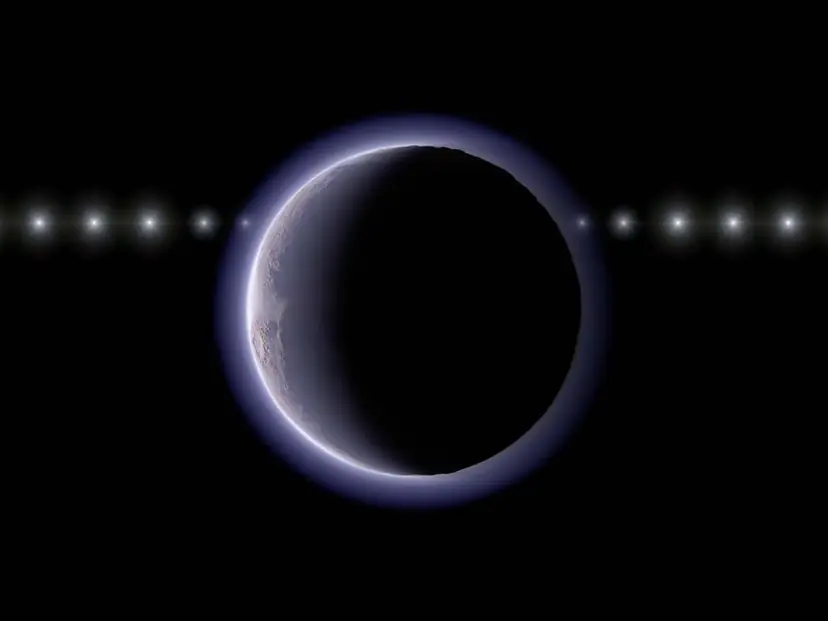
The atmospheric pressure of 2002 XV93 estimated from this is at the 200-nanobar level. It is one-millionth of Earth's atmospheric pressure. Even compared to Pluto, it is 50 to 100 times lower. However, the important point is that a detectable atmosphere can exist even on a Kuiper Belt object that is much farther and smaller than Pluto. This directly challenges the existing view that volatile gases on small celestial bodies would have already blown away long ago.
The origin of this atmosphere is not yet certain. There are two main candidates. One is that volatile materials may have been released during a recent collision with a small icy body, creating a temporary atmosphere. Another possibility is that cryovolcanic activity, where volatile materials leak from inside the celestial body, may still be active. This surprising discovery shows that Kuiper Belt objects may not simply be cold, frozen, dead rocks. Small celestial bodies can also possess their own tenuous atmospheres as they collide with other bodies in that distant, dark edge of the solar system, and as internal, yet-to-die geological activities take place.
If not only Pluto but other Kuiper Belt objects, and even smaller ones, can temporarily have an atmosphere, Pluto's reinstatement becomes even more difficult. To make Pluto a planet again, a new standard must be set. That new standard must be one that has no effect on the existing status of Mercury, Venus, Earth, Mars, Jupiter, Saturn, Uranus, and Neptune, yet can salvage only Pluto among the countless other Kuiper Belt objects. Until recently, Pluto's thin atmosphere seemed to be a sliver of hope, but now even that hope has become ambiguous. No matter what standard is used, finding a way to single out and revive only Pluto seems almost impossible.
Ultimately, the talk of making Pluto a planet again is closer to a cultural slogan responding to citizens rather than a scientific claim. Until the 20th century, Pluto was uniquely discovered by American astronomer Clyde Tombaugh, and it was so lovable that it became the name of a Disney character. In the U.S., affection for Pluto is particularly strong. However, scientific definitions and classifications do not rely simply on affection. Scientific classification exists not to favor one celestial body, but to view the universe with a more consistent eye.
New Mexico in the U.S. has already created an ordinance calling Pluto a planet on its own. New Mexico is where Tombaugh spent his later years. They claim that as long as Pluto is visible in their night sky, it is a planet. And they celebrate March 13, the day the news of Pluto's discovery was announced to the world, as "Pluto Planet Day."
However, all of this is just a political slogan and has no scientific meaning. The decision to reclassify Pluto as a dwarf planet was not a decision made by the U.S. or NASA alone. An official resolution was adopted through a vote by astronomers from all over the world gathered in Prague in 2006, and that is how the new definition of a planet was created. It can never be changed unilaterally by one country or one institution.
Do we really need Pluto to be a planet in the first place? Whether it is a planet or not, Pluto is charming and magnificent in its own right. Rather, the attempt to force Pluto back into the outdated standard of being a planet could undermine its true value. Pluto has now become the leader of the Kuiper Belt. It represents the solar system's outer orbit beyond Neptune. Becoming a dwarf planet is not actually a demotion, but simply finding its place. The title of dwarf planet reveals the larger world to which Pluto belongs.
Pluto's orbital period is 248 years. The first time Pluto was discovered by humans was in 1930. This means that since it was first discovered, it has not yet completed a single orbit around the Sun. By the year 2178, Pluto will finally have completed one orbit and will reach its 'New Year.' In the time that hasn't even been one Pluto-year, Pluto has been through a tumultuous fate—suddenly becoming a planet, then being ousted, and possibly being forced back into being a planet again.
I love Pluto too. But I don't think Pluto would want the solar system to become more chaotic just because of itself.
Reference
https://www.nature.com/articles/s41550-026-02846-1
Who is the writer Woong-bae Ji? He loves cats and the universe. After watching 'Galaxy Express 999' as a child, he dreamed of spreading the beauty of the universe. He is currently an assistant professor in the Faculty of Liberal Arts at Sejong University, participating in various science communication activities such as lectures and writing. He has written books such as 'On the Uselessness of Astronomers,' 'We Are All Born Astronomers,' and 'Strange Questions That Come to Mind When Looking at the Universe,' and translated 'How I Killed Pluto,' 'Quantum Life,' and 'UFO.'