

[비즈한국] Negotiations between ready-mix concrete manufacturers and the transport union in the Seoul metropolitan area have reached a dramatic conclusion. The union members accepted a tentative agreement that increases the per-delivery transport fee by 4,200 won and shortens the contract period to 8 months. Although the collective strike that began on the 8th had halted concrete pouring at over 100 construction sites in the capital region, the resumption of concrete delivery is expected to lead to a gradual normalization of work at these sites.
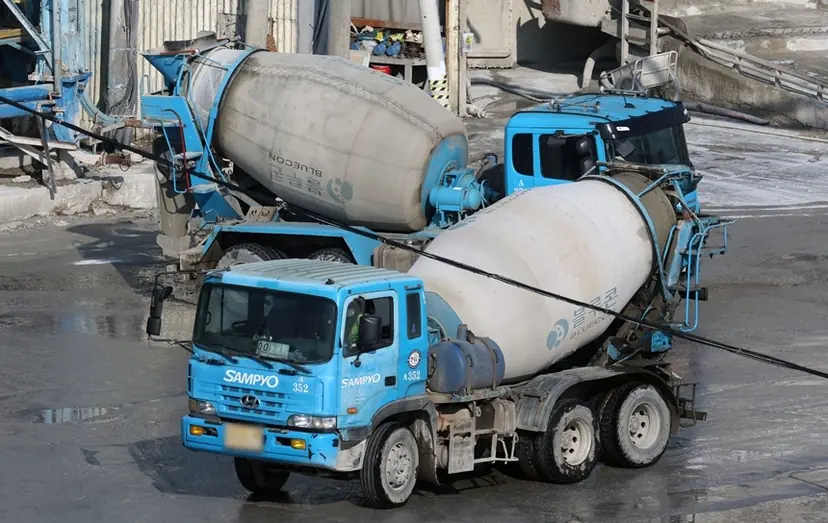
According to the ready-mix concrete industry, the National Ready-Mixed Concrete Transport Workers' Union conducted a vote among its Seoul metropolitan area members on the 15th regarding the second tentative agreement on transport fees. Out of 7,517 registered members, 7,158 participated, with 4,714 (65.9%) voting in favor, leading to the agreement's approval. This comes one week after the union began its collective strike on the 8th, demanding an increase in delivery fees and integrated negotiations for the Seoul capital region. Following the approval of the tentative agreement, the union ended its collective strike (delivery stoppage) as of that day.
Both sides reached the second tentative agreement one day earlier on the 14th. The agreement includes raising the average ready-mix concrete transport fee in the capital area from 75,800 won to 80,000 won per delivery, an increase of 4,200 won (approximately 5.5%). The increased rate will be effective for 8 months, from July 1st to February 28th of next year. They also agreed to conduct future transport fee negotiations for the capital area through an integrated bargaining method, rather than on a regional basis as done previously.
The core of this agreement lies in the shortened contract period rather than the amount of the rate increase. Both sides had previously reached a tentative agreement on the 9th to raise the fee by 4,200 won per delivery. However, that proposal was rejected the following day by 68% of the members in a vote. The second tentative agreement maintained the same increase amount but shortened the application period from the typical one year to eight months. As a result, the transport union will be able to apply new rates starting March 1st of next year through the next round of negotiations.
The union believes that by moving up the next round of negotiations by four months, they have secured an opportunity to compensate for the insufficient increase. A union official who participated in the second round of negotiations explained to Biz Hankook, "We felt an increase of at least 4,500 to 5,000 won was necessary, but the manufacturers maintained that they couldn't add even 100 won to the previous agreement. We found common ground when the union suggested shortening the contract period if a higher amount was not possible."
The two sides remained at odds over the extent of the rate increase throughout the negotiation process. The transport union initially demanded an 8,000 won increase per delivery, while the manufacturers proposed 2,500 won. It is reported that just before the deal was struck, the union lowered its demand to 4,300 won, but as the manufacturers refused further increases, they reached a compromise by shortening the contract term.
The transport union argued that it is difficult to make a living with the existing delivery rates. They claimed that in a situation where the number of deliveries has plummeted due to the construction industry slump, vehicle maintenance costs have also risen. The union official mentioned earlier stated, "The number of deliveries, which used to reach 80 per month, has dropped to less than half. After paying for vehicle acquisition, insurance, and maintenance, there is not even the minimum wage left." Ready-mix concrete drivers operate their own mixer trucks and receive fees per delivery.
Ready-mix concrete manufacturers countered that their management burden has also increased. An industry source said, "With the decrease in ready-mix concrete shipments and rising costs for raw materials such as diesel and admixtures, it was difficult to accept all of the union's demands, especially while manufacturers are bearing the burden of diesel price hikes due to the Middle East crisis." Last year's ready-mix concrete shipments dropped 15% year-on-year to 97.6 million cubic meters, the lowest since 1999 during the IMF financial crisis.
The transport union's collective strike had an immediate impact on manufacturers as well. Because ready-mix concrete is produced by mixing cement, aggregate, and water and must be poured before it hardens, it cannot be stockpiled. Manufacturers cannot respond by increasing production in advance to prepare for delivery disruptions. Therefore, when transport stops, the manufacturer's production and shipments effectively stop as well.
Construction sites in the Seoul metropolitan area also suffered significant damage. According to the Construction Association of Korea, as of the 11th, concrete supply was cut off at 105 sites of 22 major construction companies, causing delays in pouring approximately 100,000 cubic meters of concrete. By the next day, the scale of damage had increased to 117 sites of 25 major construction firms, amounting to approximately 160,000 cubic meters. Large industrial facility projects, such as Samsung Electronics005930 Pyeongtaek Campus and the SK Hynix Yongin Semiconductor Cluster, were also affected.
Even with the resumption of transport, it is unlikely that all construction sites will return to normal immediately. Since concrete pouring requires coordination with other processes and the schedules of site personnel and equipment, it is difficult to proceed with all the tasks delayed during the strike at once. At some sites, delays in construction timelines and increases in labor and equipment costs appear unavoidable.
The issue of construction delays caused by the strike remains a challenge. If construction is delayed due to force majeure, such as natural disasters, or the fault of the ordering party, the construction period can be extended and liquidated damages can be waived. However, if construction is delayed for other reasons, construction firms may be held liable for liquidated damages. In response, the Construction Association of Korea submitted a proposal to the government on the 12th, requesting measures such as recognizing the strike as force majeure to exempt construction companies from the burden of liquidated damages.