

[비즈한국] Using artificial intelligence, we deliver quick and accurate real estate transaction information for apartments and residential properties in Seoul over the past week.
The temperature gap in the Seoul residential real estate market is becoming increasingly distinct. While it is difficult to say that overall transaction volume has rebounded significantly, high-priced transactions have continued in preferred locations such as the Gangnam area, Mok-dong, Yeouido, and Seongsu. Notably, this week's top transactions included large-sized units, older complexes with reconstruction expectations, and core residential areas with excellent access to school districts and business hubs. Rather than the market as a whole being hot, the flow of "the places that will succeed, will succeed" was confirmed in the actual transaction data.
According to the Seoul Real Estate Information Plaza, the highest price among residential property transactions in Seoul recorded between June 8 and June 12 was in Hyundai 1st, Buildings 101-106, Gaepo-dong, Gangnam-gu. A unit with a dedicated area of 177.19㎡ on the 3rd floor was sold for 4 billion KRW, marking the highest residential transaction price in Seoul this week.
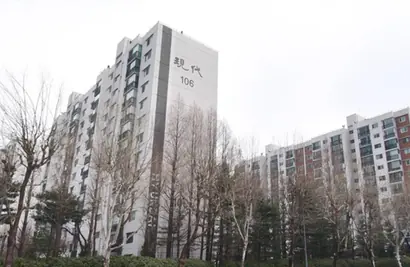
Although Hyundai 1st in Gaepo-dong (Buildings 101-106) is an aging complex built in the 1980s, the combination of its location in the Gangnam area and the scarcity of large-sized units led to a 4 billion KRW deal. This transaction goes beyond simply selling an old apartment; it shows that there is still robust demand for large-area units in core Gangnam locations.
The price per pyeong for this transaction was approximately 74.63 million KRW, exceeding the average Seoul apartment price per pyeong of 59.259 million KRW reported by KB Real Estate last December. While high compared to the Seoul average, it can be seen as a case where 'location, area, and scarcity' supported the price compared to other major complexes in the Gangnam area.
The second-highest transaction occurred at Mok-dong Sinsigaji 7 in Mok-dong, Yangcheon-gu. A unit with a dedicated area of 101.2㎡ was sold for 3.25 billion KRW. Mok-dong Sinsigaji 7 is considered the case where reconstruction expectations were most clearly reflected among this week's top transactions. The price ceiling in the Mok-dong area is rising rapidly due to solid demand from the school district combined with expectations for urban renewal projects. The price per pyeong for this transaction was approximately 106.16 million KRW, making it particularly high per unit area among the top transactions.
Mok-dong Sinsigaji complexes are considered a key pillar of the reconstruction market in southwestern Seoul. Given that it is already a highly preferred area for living, there is high expectation that the scarcity of new apartments will be pre-reflected in prices once the maintenance of old complexes begins in earnest. This transaction at Mok-dong Sinsigaji 7 shows that large capital is moving based not just on current residential value, but also on future redevelopment premiums.
A unit with a dedicated area of 158.705㎡ at Olympic Family Town in Munjeong-dong, Songpa-gu, was traded for 3.14 billion KRW. Olympic Family Town is also a representative Songpa-area complex that combines large floor areas with reconstruction expectations. The price per pyeong for this transaction was approximately 65.41 million KRW, exceeding the Seoul average. Even in the Songpa area, which was considered relatively less of a price burden compared to Gangnam-gu, there is a tendency for 3 billion KRW deals to form naturally for complexes with large floor areas and redevelopment expectations.
Transactions in the 3 billion KRW range also continued in Yeouido. A Daekyo apartment unit with a dedicated area of 95.5㎡ in Yeouido-dong, Yeongdeungpo-gu, sold for 3.05 billion KRW, and a Hanyang apartment unit of 109.42㎡ in the same neighborhood traded for 3 billion KRW. Both transactions can be seen as cases where expectations for Yeouido's urban renewal projects were reflected in the price.
Yeouido holds the dual status of being one of Seoul's representative business districts and a waterfront residential area along the Han River. As renovation projects for aging apartments gain speed here, a price revaluation is underway. Both Daekyo and Hanyang have formed price levels that are difficult to explain by current residential value alone, which is interpreted as a reflection of expectations for their potential transformation into new waterfront residential developments through reconstruction.
A particularly notable case in this week's transactions is the Jinju Town row house/multi-family housing in Seongsu-dong 2-ga, Seongdong-gu. A unit with a dedicated area of 49.68㎡ was sold for 2.85 billion KRW. In terms of area, it is among the smaller units in the top 10, yet the price approached 3 billion KRW. This shows that the Seongsu-dong area is no longer just a region explained by elite residential demand or commercial expectations, but has been incorporated as a core asset market in northeastern Seoul.
In recent years, Seongsu-dong has established itself as one of the most prominent areas in Seoul as its business, commercial, and residential functions have been simultaneously strengthened. In particular, the convergence of Han River access, Gangnam accessibility, luxury residential demand, and commercial area expansion is creating high price tags even for small residential properties. This Jinju Town transaction is different in nature from traditional high-priced apartment transactions in that it represents "a small but expensive home."
A unit with a dedicated area of 63.76㎡ in Hansol Village, Ilwon-dong, Gangnam-gu, was traded for 2.65 billion KRW. Ilwon-dong is considered a region equipped with school districts, transportation, and residential stability, as it is adjacent to the Daechi, Gaepo, and Suseo living zones. This transaction also demonstrates that real-demand and asset-preservation demand for small and medium-sized areas in the Gangnam zone remain strong.
A unit with a dedicated area of 84.762㎡ in Punglim I-Want, Oksu-dong, Seongdong-gu, was sold for 2.39 billion KRW. Oksu-dong is an area with excellent access to both Gangnam and the city center, and it carries a strong image as a waterfront residential area along the Han River. The growing presence of Seongdong-gu in Seoul's high-end residential market was reaffirmed through this transaction.
A unit with a dedicated area of 86.12㎡ in Sanho, Wonhyoro 4-ga, Yongsan-gu, was traded for 2.25 billion KRW. Yongsan is a region where development expectations and location scarcity consistently prop up prices. Regardless of the speed of large-scale development plans, accessibility to the city center, Han River frontage, and expectations for future redevelopment remain factors maintaining buying interest.
A unit with a dedicated area of 123.61㎡ in Munjeong Garak Hyundai 1st in Munjeong-dong, Songpa-gu, was sold for 2.2 billion KRW. Even within the Songpa zone, Munjeong-dong is an area where business districts and residential areas are combined, leading to steady demand for large-sized units. The fact that two of the top transactions occurred in Munjeong-dong, along with the Olympic Family Town, shows that the preference for the southern Songpa area has not easily diminished.
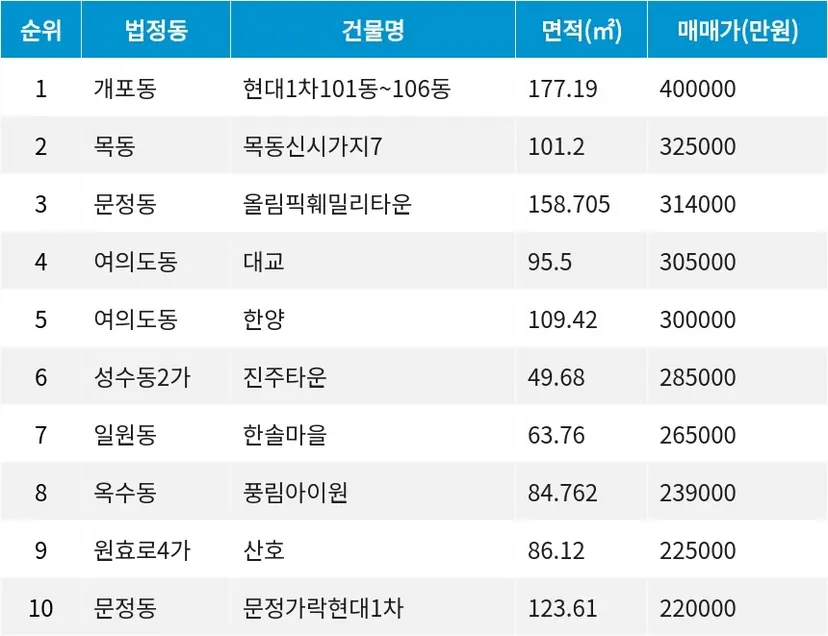
Three keywords cut through this week's top 10 transactions. The first is large floor areas. A significant portion of the top-ranked properties, such as Gaepo Hyundai 1st, Olympic Family Town, Mok-dong Sinsigaji 7, and Munjeong Garak Hyundai 1st, are medium-to-large sized or bigger. Despite the burden of high interest rates and loan regulations, demand groups with financial leverage are selectively purchasing rare large-sized units.
The second is reconstruction expectations. Many of the high-priced transaction areas this week—such as Mok-dong, Yeouido, Songpa, and Gaepo—are places where expectations for redevelopment projects are reflected in prices. As the perception that the supply of new apartments in Seoul is limited strengthens, aging complexes are being evaluated not just as old houses, but as "assets containing future new-build ownership rights."
The third is location polarization. This week's top transactions were concentrated in regions with deep demand in Seoul, such as Gangnam-gu, Songpa-gu, Mok-dong in Yangcheon-gu, Yeouido in Yeongdeungpo-gu, Seongsu/Oksu in Seongdong-gu, and Yongsan-gu. This also means that it has become difficult to explain the market using only the Seoul-wide average price. Even if average prices fluctuate or some areas undergo adjustments, preferred complexes in core locations are showing distinct price movements.
The policy environment also serves as a background for the market's selective strength. The government is maintaining a stance of tightening loan regulations and adjusting taxes to manage household debt and stabilize the housing market. In such an environment, while it becomes difficult for demand groups lacking buying power to enter, those with significant cash holdings tend to select and purchase core assets. A paradoxical trend is emerging where regulations suppress the overall market while funds concentrate even more on certain high-quality locations.
The burden of jeonse (lump-sum deposit) and monthly rent is also mentioned as a factor supporting the floor of the sales market. If rental costs remain high in major parts of Seoul, demanders who want long-term residency consider switching to home ownership. Particularly in regions equipped with school districts, work-life proximity, and transportation conditions, real residency demand acts as a force that supports prices.
This week's residential real estate transactions in Seoul are closer to an example of selective strength in core locations rather than an overall market recovery. The 4 billion KRW transaction in Gaepo, the 100 million KRW per pyeong price in Mok-dong, the 3 billion KRW deals in Yeouido, and the high-priced small-unit deal in Seongsu each have different reasons, but they all point to one conclusion. In the Seoul real estate market, funds are still heading toward places that are rare, places judged worth waiting a long time for, and places with the potential for future redevelopment or location revaluation.
However, whether this trend will spread to a rise across all of Seoul is a separate issue. Loan burdens, interest rate levels, policy uncertainty, the speed of redevelopment projects, and supply plans all remain variables. The current market is closer to a phase where prices only stick to complexes where location, product quality, and future expectations have been verified, rather than an indiscriminate bull market. This week's top transactions concisely demonstrate that reality.
※ This article was written by Biz Hankook and MetaVX's generative AI.