

[비즈한국] As the proliferation of artificial intelligence (AI) and the economic slowdown lead companies to tighten their hiring, major domestic recruitment platforms are accelerating the restructuring of their revenue models. Growth has hit a clear ceiling with the traditional approach of merely securing and displaying large numbers of job postings. Domestic recruitment platforms such as JobKorea and Saramin143240 are seeking breakthroughs by moving away from ad-centric revenue structures and reorganizing their business portfolios through AI-based services.
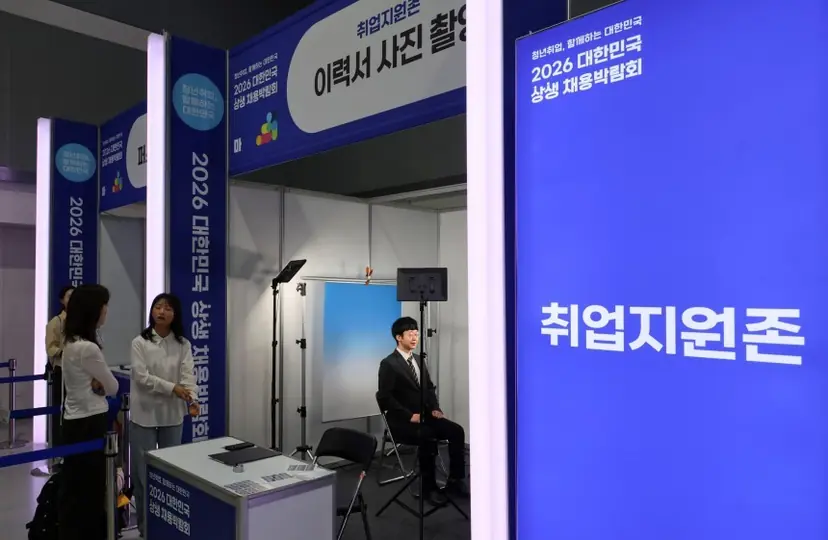
According to the e-Nara Index's 'Job Center Vacancy, Job Seeking, and Employment Status' report on the 12th, the job opening ratio at employment centers was 0.36 last year, the lowest level since official statistics began in 2001. The job opening ratio indicates the number of jobs available per job seeker. While job seeking applications rose slightly last year to 3,599,671, job openings stood at just 1,295,179.
The contraction of the recruitment market is a significant burden on the job platform industry. Typically, these platforms generate revenue through advertising products that companies purchase to post job openings or increase their visibility. However, with the spread of AI reducing hiring demand in certain roles, the uncertainty of traditional revenue structures has grown.
In fact, Saramin has recorded negative growth over the past three years. According to public disclosures, Saramin's revenue decreased from 131.5 billion won in 2023 to 128.4 billion won in 2024, and further to 121.2 billion won in 2025. As the recruitment market slump persists, it has become difficult to maintain growth solely with an ad-centric revenue structure.
Consequently, recruitment platforms are attempting to diversify their revenue sources beyond simply securing and displaying numerous job postings. While the core of the business was once connecting job seekers to companies through postings, the current trend is to expand the platform's role by strengthening HR services targeted at specific job seeker demographics or enhancing AI-based recommendation and matching functions.
Saramin has begun to diversify its portfolio by growing both recruitment-related and non-recruitment services. It has expanded its HR services by segmenting target groups such as the middle-aged and foreigners, and in its non-recruitment business, it is striving to increase payment conversion rates through services like blind dates and fortune-telling.
Conversely, JobKorea has begun a restructuring focused on its core business by liquidating non-core operations. It terminated its foreign recruitment platform 'Click' this month and is scheduled to end services for the digital business card application 'Nook' and the talent trading platform 'Gigmon'. Instead, it acquired the corporate information platform 'Jobplanet' last year, incorporating it as a subsidiary to strengthen its data capabilities directly related to recruitment. With the recruitment market slowing, the direction is to strengthen competitiveness in core businesses rather than expanding outward.
Services incorporating AI are also expanding. JobKorea CEO Yoon Hyun-joon announced a vision early this year, stating, "Now that AI has become a part of daily life, we are faced with the question of whether simply showing more job postings is enough," adding, "We will transition into an AI career agent-centered platform." Saramin is also bolstering its personalized recommendation features with its AI service, the 'Career Matching Agent.' According to Saramin, the average usage of this service last month increased by 165.5% compared to the previous month.
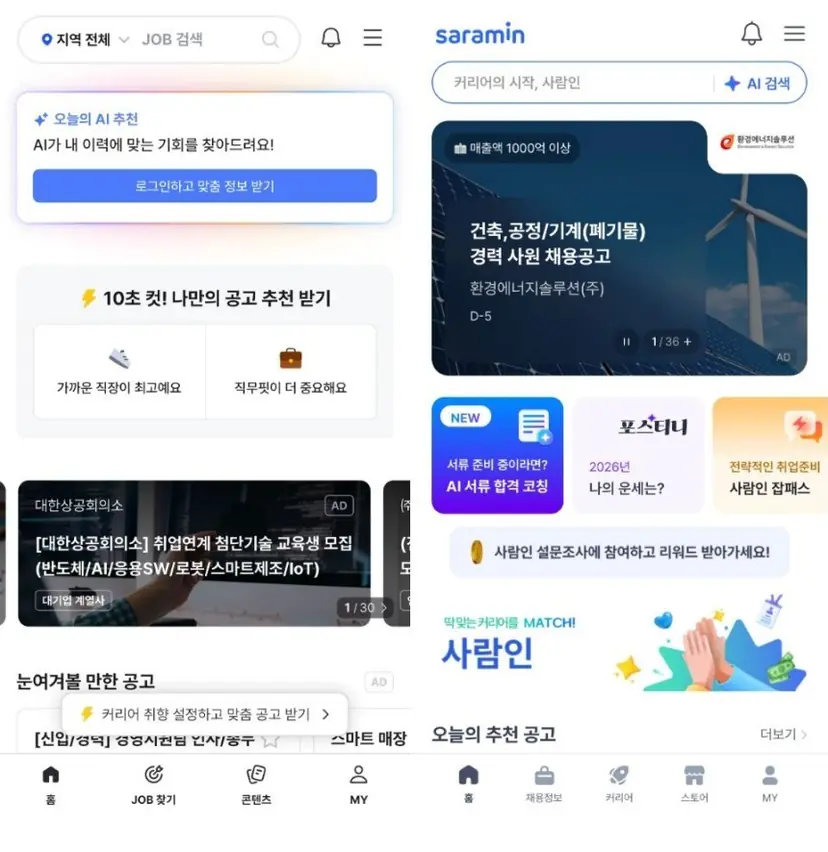
The industry believes that the competitive landscape for recruitment platforms will continue to change rapidly. This is because, even as companies reduce their hiring scale, the demand to find suitable talent quickly remains. However, some raise concerns that expanding into non-recruitment services could dilute the platform's identity if the connectivity to the core business is weak.
As a result, recruitment platforms are attempting to transform from a business model centered on ad exposure to one based on performance. The gauge of a platform's competitiveness has shifted from merely showing many job postings to how quickly it can connect companies with the talent they desire.
A JobKorea official stated, "For now, rather than launching additional new services, we are focused on upgrading our recently released AI-related services," adding, "While we previously focused on charging companies for posting job openings or increasing exposure, we are now considering restructuring our services to adopt methods like charging per applicant, allowing companies to meet the talent they want more efficiently."