

[비즈한국] A plan to legislate 'Fundamental Financial Rights' to ensure that financially marginalized groups can access essential financial services has been discussed in the National Assembly. The initiative aims to guarantee that all citizens can access financial services without discrimination and to treat support for vulnerable financial groups as a fundamental right rather than isolated policies, thereby ensuring a step-by-step path to recovery. Experts from academia and the field emphasized that legislating these rights is necessary to integrate the support system for low-income finance and break the vicious cycle of poverty caused by financial exclusion.
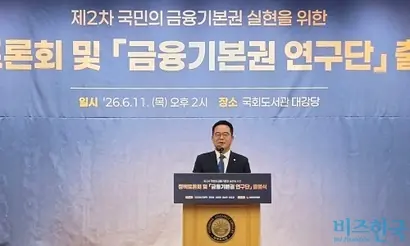
On June 11, the '2nd Policy Forum for Realizing Citizens' Fundamental Financial Rights and the Launch Ceremony of the Research Group on Fundamental Financial Rights' was held at the main auditorium of the National Assembly Library. The ceremony was organized by the Credit Counseling and Recovery Service and hosted by the offices of Democratic Party lawmakers Min Byung-duk, Jung Tae-ho, Kim Hyun-jung, Kim Nam-hee, and Ahn Do-geol.
This event followed the first forum held on April 27 and served as both a discussion on the legislation of fundamental financial rights and the official launch of a research group consisting of scholars, research institutions, and field experts. The research group plans to conduct studies to develop the system and legal draft for fundamental financial rights. While the first forum introduced the concept of fundamental financial rights and argued for their necessity based on the constitutional right to the pursuit of happiness, the second forum focused on specific methods for their legalization.
Fundamental financial rights refer to the right of every citizen to access financial services without discrimination and to use the minimum funds necessary to lead a decent life under fair conditions. The core of the discussion is to establish a legal basis by enacting the 'Basic Financial Security Act.' Currently, relief for vulnerable financial groups is fragmented into individual products like 'Haetsallon' or debt forgiveness policies. The intention is to create a comprehensive support system through this bill and build a finance system centered on the working class.
It is known that Rep. Min Byung-duk is leading the proposal of the Basic Financial Security Act. A legislative support group composed of lawmakers will also be formed to assist the initiative. In his opening remarks on the 11th, Rep. Min stated, "If the first forum raised the concept of fundamental financial rights as a topic for debate, this second forum is where we translate that discourse into legislation that works for the public's livelihood. The Basic Financial Security Act is a weapon to save the common people in a supplier-centered financial market. We will elevate the public's financial welfare from charity policies to a constitutional right to claim."
Kim Eun-kyung, Chair of the Credit Counseling and Recovery Service and President of the Korea Inclusive Finance Institute, presented a plan for promoting the enactment of the 'Basic Financial Security Act.' According to Chair Kim, the act is based on five fundamental financial rights (access, survival, recovery, self-reliance, and asset formation) and aims to implement four types of basic finance in stages.
The four basic financial pillars are basic counseling/debt restructuring, basic insurance, basic loans, and basic savings. These function sequentially according to the stage of self-reliance: basic counseling/debt restructuring → basic insurance → basic loans → basic savings. The first stage focuses on debt adjustment rather than monetary support. Then, basic insurance secures a safety net to prevent falling back into poverty. Only after the safety net is built are funds for self-reliance provided through basic loans. Finally, the basic savings stage helps form assets from generated income to block re-entry into poverty. The bill plans to prioritize vulnerable groups initially, with long-term plans to expand to all citizens.
Chair Kim emphasized, "Fundamental financial rights are about ensuring that the right to be protected is not a benefit, but an accessible legal status. It aims to protect vulnerable financial groups by guaranteeing a minimum standard of living. Since these are inherent constitutional rights that are currently abstract, they must be legislated to become concrete." Chair Kim explained that the rights should be concretized based on the constitutional right to pursue happiness (Article 10), the right to a decent life (Article 34), and restrictions for public welfare (Article 37).
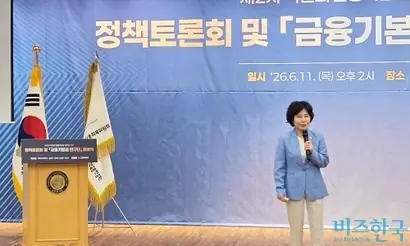
In Gyeonggi Province, which implemented ultra-low credit loans as an emergency measure after the COVID-19 pandemic, researchers also highlighted that vulnerable financial groups face crises because they are outside the institutional system. Seok Hee-jung, a researcher at the Gyeonggi Welfare Foundation, stated, "Vulnerable financial groups are being pushed out of the institutional system by exclusion mechanisms. They do not even realize there is a problem with the society's financial system. The current system selects financial consumers based on credit rating systems for fiscal stability. Those excluded in this process cannot get loans, so they seek illegal private finance and fall into a vicious cycle. We must move away from the perception that this is an individual's failure."
Researcher Seok suggested that low-income finance should be evaluated based on the 'recovery rate' rather than the 'repayment rate.' Regarding the criticism of low repayment rates for ultra-low credit loans, she argued, "We should not apply private market repayment rates directly. We must focus on the recovery rate rather than the collection rate and take a long-term view. If we focus solely on repayment, a cycle occurs where people take out high-interest loans to pay back debt. We need to create new performance indicators—such as credit recovery rates, re-employment/self-sufficiency rates, and debt recurrence prevention rates—and reflect them in credit scores."
The final speaker, Professor Han Jae-jun of the Department of Finance at Inha University, explained debt restructuring from the perspective of fundamental financial rights. Professor Han pointed out, "When adjusting debt from the perspective of fundamental financial rights, we must look beyond finance at complex problems like housing instability, health deterioration, and social isolation. Debt restructuring must be justified by correcting market failures and realizing constitutional values."
Professor Han analyzed, "So far, debt restructuring has focused on adjusting the rights relationship between creditors and debtors. However, from the perspective of fundamental financial rights, we must also focus on the causes of debt. Debt arises not just from breach of contract, but from various involuntary causes like unemployment, gambling, financial illiteracy, and family breakdown. We must correct financial polarization to reduce the individual's debt burden while creating a virtuous cycle that leads them back into the institutional system."
In addition, Professor Han proposed improvement measures including: practical guarantee of fundamental financial rights through constitutional protection; creating an ex-officio debt discharge track with simplified bankruptcy procedures; differential cost-of-living standards by debt restructuring type; complex support through a one-stop integrated platform; and strengthening debt restructuring governance while guaranteeing the legal status of debtors.
The discussion following the presentations included Professor Kang Kyung-hoon of Dongguk University, Professor Lim Jung-ha of the University of Seoul Law School, Professor Yoo Kyung-won of Sangmyung University, Yoon Young-mi, CEO of Consumers Together, and Kim Mi-sun, head of Rolling Jubilee.