

[비즈한국] With its initial public offering (IPO) approaching on June 12 (local time), SpaceX recently unveiled the design and specifications of 'AI1', an experimental satellite for a space-based AI data center, proposing a new business domain: space computing. Amid the rapid growth of the artificial intelligence (AI) industry, which is pushing the power demand of terrestrial data centers to their limits, this is an attempt to utilize orbital space as an alternative. However, experts analyze that several technical and economic challenges, such as heat dissipation, space radiation, communication latency, and astronomical construction costs, must be resolved for actual operation.
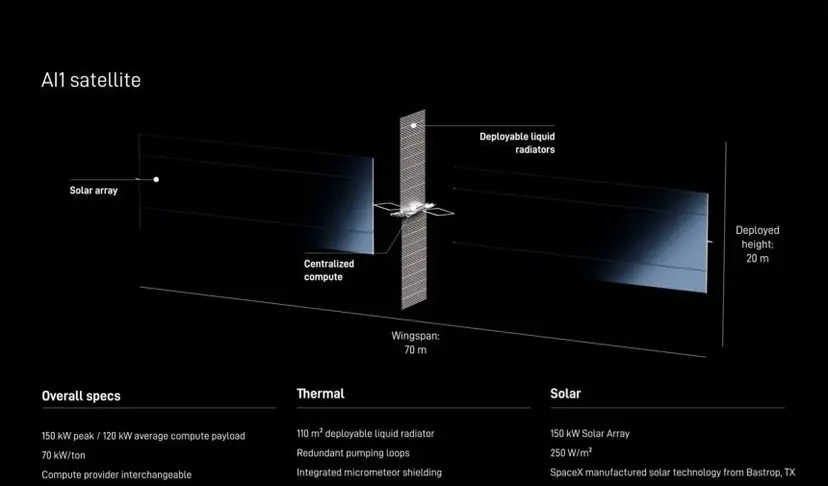
Elon Musk, CEO of SpaceX, recently posted a 31-minute discussion video filmed at the Starlink terminal factory in Bastrop, Texas, on the social media platform X (formerly Twitter). In this video, featuring SpaceX engineer Ian Dal, CEO Musk introduced the concept of an orbital AI data center and the first experimental satellite, 'AI1', to the public.
This is interpreted as an attempt by SpaceX to expand its business model beyond a mere space launch vehicle company and telecommunications provider into an AI infrastructure company that handles data calculation and processing.
Why Conceive a Space Data Center?
The main background for SpaceX's proposal of a space data center is the physical limitations faced by terrestrial power grids. The power density required to process the training and complex inference calculations of recent massive large language models (LLMs) is rising rapidly. According to data from major institutions such as the 'World Energy Outlook Special Report: Energy and AI' published by the International Energy Agency (IEA), it is projected that power bottlenecks are highly likely to occur in the future as the expansion speed of terrestrial-based energy supply chains fails to keep pace with the increasing demand from data centers.
Low Earth orbit (LEO) has emerged as an alternative to bypass these terrestrial infrastructure constraints. Beyond the atmosphere, there is no loss of solar energy due to clouds or atmospheric scattering, offering the advantage of securing pure solar radiation energy 24 hours a day with approximately 36% higher efficiency than on the ground. Additionally, while terrestrial data centers consume tens of millions of liters of cooling water for servers, raising concerns about water resource depletion, space provides the advantage of avoiding these environmental burdens.
The newly unveiled experimental satellite 'AI1' differs from typical communications satellites by taking the form of a massive flying server rack. Deployed in low Earth orbit (LEO) at an altitude of 600–800 km, this satellite has a wingspan of about 70 meters and a height of about 20 meters when fully deployed in space.
In terms of computing performance, a single 'AI1' satellite is designed to handle an average power load of 120 kilowatts (kW) and a maximum of 150 kW. This is similar to the power consumption and computing capacity of a single high-end NVIDIA server rack (GB300) currently installed in terrestrial AI data centers. A significant portion of the satellite's structure is dedicated to oversized solar panels to generate this massive power and liquid cooling radiator systems to control heat.
Obstacles to Realizing Space Data Centers
However, for space data centers to be commercialized, they must overcome complex technical barriers. The most critical task is heat dissipation technology to prevent high-performance semiconductor chips from overheating. Although the ambient temperature in space is very low, the vacuum state lacks a medium like air or water to transfer heat, making natural heat dissipation through convection or conduction impossible. Therefore, all heat must be released into space via thermal radiation in the form of electromagnetic waves. SpaceX plans to maximize heat dissipation performance by rotating its 70-meter deployable radiators to face away from the sun, thereby increasing the surface area.
Data transmission speed and latency are also major challenges to be resolved for commercialization. Since a single satellite's computing power is insufficient for training the latest massive AI models, SpaceX plans to operate them as one giant virtual data center by connecting multiple distributed satellites via a communications network.
To this end, they intend to utilize the existing Starlink satellite network and apply high-speed laser link technology capable of achieving a data transmission bandwidth of 1 terabit per second (Tbps) between satellites and low latency at the 3-millisecond (ms) level. However, experts remain cautious about whether perfect and stable data synchronization, equivalent to terrestrial optical cables, can be achieved between satellites that are scattered and moving across a physically vast orbit.
Special environmental factors unique to space orbits, distinct from those on the ground, also affect operational stability. The first is space radiation. LEO space, which lacks the protection of Earth's atmosphere, is continuously exposed to solar winds and high-energy cosmic radiation. If sensitive AI semiconductors based on ultra-fine processes are exposed to such radiation, there is a risk of temporary computational errors (soft errors) or shortened physical component lifespans.
Collision risks due to increased orbital congestion are also being raised. According to SpaceX's long-term vision, up to 1 million satellites would need to be launched for infrastructure expansion. Considering that the total number of artificial satellites currently operating in Earth's low orbit is around 15,000, this is an unprecedented scale. Experts warn that if satellite density surges, it could significantly increase the probability of the 'Kessler Syndrome', where a single collision triggers a chain reaction of debris collisions, paralyzing the entire orbit with space junk.
From an infrastructure maintenance perspective, an inherent limitation of space data centers is the impossibility of immediate physical repairs in the event of a failure. In the case of terrestrial data centers, if there is an issue with server components or cooling equipment, engineers can be deployed on-site to quickly replace the parts.
However, in space, even a minor circuit failure could lead to the total shutdown of a satellite. To prevent this, dual or triple redundant circuits must be designed for critical components. Yet, such safety designs inevitably increase the satellite's overall weight and volume, which directly translates into the economic burden of higher launch costs.
So, Is It Economically Viable?
All the technical challenges mentioned earlier ultimately boil down to economics, i.e., business feasibility. A report by industry research firm 'MoffettNathanson' estimates that it would cost approximately $5 trillion (approximately 7,657 trillion KRW) to build and maintain a 1-million-unit space data center infrastructure as envisioned by SpaceX.
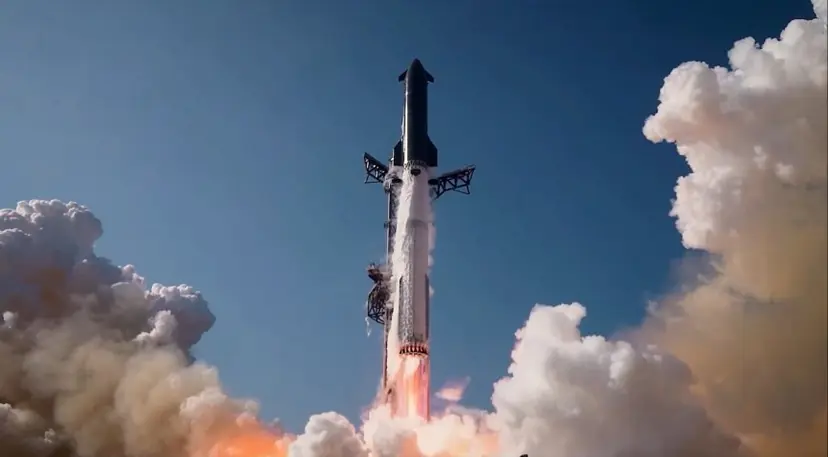
To recover these massive initial investments and secure commercial competitiveness over terrestrial data centers, revolutionary cost reductions in satellite launches are essential. Industry analysts suggest that economic feasibility can only be discussed if launch costs, currently at several thousand dollars per kilogram (kg), are reduced to the $200 range. SpaceX explicitly stated in its IPO-related documents that the currently operating Falcon 9 or Falcon Heavy cannot deploy V3 satellites and space data centers. The operation of space data centers requires the full and stable commercialization of SpaceX's next-generation, super-heavy reusable rocket.
The space data center vision presented by SpaceX is a noteworthy attempt to solve the fundamental limitation of terrestrial infrastructure—securing power—by utilizing a new space environment. However, there are realistic barriers such as the physical constraints of controlling heat dissipation, the dangers associated with large-scale orbital operations, and securing profitability against astronomical costs. Whether this plan will establish itself as a new infrastructure that shifts the paradigm of the industry depends on future continuous technical validation and trends in launch cost reduction.