

[비즈한국] The Lee Jae-myung administration has frozen various public utility rates to ease the burden on ordinary citizens. In particular, as prices showed signs of rising due to the oil price hike following the Middle East war, the government not only froze central public utility rates but also maintained a policy of keeping local public utility rates frozen. However, as the prolonged war has caused the deficits of public institutions, especially local ones, to grow even further, experts point out that a series of public utility rate hikes in the second half of the year is inevitable. This is because the political burden of raising public utility rates has decreased for local government heads now that the June 3 local elections have concluded.
Furthermore, if they postpone rate hikes only to implement them next year, it could affect the 2028 general elections, so it is highly likely that a series of hikes will occur in the second half of this year. For local public institutions, debt has surged by approximately 24% over the past three years while assets grew by only 10%, leaving them buried in debt. Realizing the low rate recovery ratio is cited as a solution to this rise in local public institution debt, making rate increases inevitable.
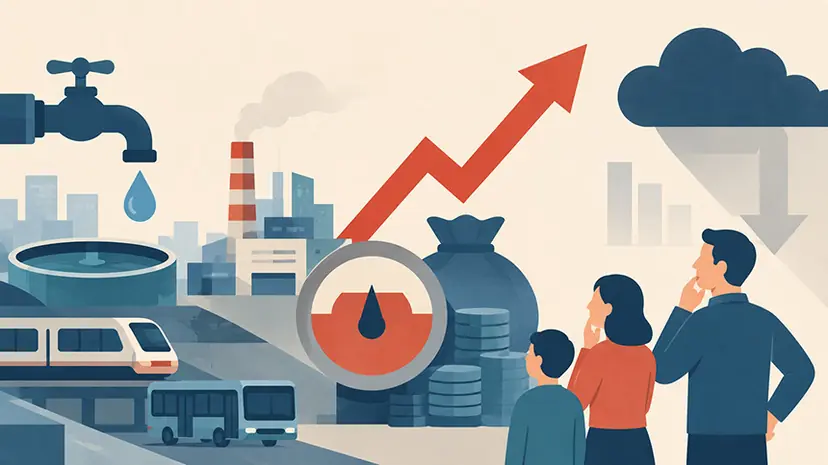
On March 26, the government held an emergency economic meeting presided over by President Lee Jae-myung and announced the ‘Emergency Economic Response Plan for the Middle East War.’ The primary measure was stabilizing the cost of living. To this end, it announced that it would freeze central public utility rates in the first half of this year and actively manage local public utility rates, including water, sewage, city buses, and subways, under the principle of freezing them in cooperation with local governments. Deputy Prime Minister and Minister of Economy and Finance Koo Yoon-cheol emphasized, “Under the stern recognition that this is an ‘economic wartime situation,’ we will mobilize all policy tools to respond in stages so that the momentum of recovery in people’s livelihoods, which was achieved with great difficulty, is not shaken.”
According to the ‘2025 Local Price Stability Management Evaluation’ conducted by the Ministry of the Interior and Safety for 243 local governments nationwide at the end of last year, 443 out of 605 local public utility rates (73.2%) were frozen. In particular, South Jeolla Province and Gangwon Province among the 17 cities and provinces completely froze their respective public utility rates. In addition, out of 195 local public utility rates scheduled for increases, 36 cases (18.5%) had their increase timing staggered or deferred until after 2026. In this situation, the government decided to freeze local public utility rates once again in March this year, citing the Middle East war.
The problem is that as local public utility rates have been continuously frozen since the Lee Jae-myung administration took office, the financial situation of public institutions has further deteriorated. According to the National Assembly Budget Office and other sources, as of the 2024 fiscal year, the total assets of 418 local public institutions were 247.775 trillion won, and the total debt was 69.7598 trillion won. Considering that the total assets of these local public institutions were 222.3779 trillion won and total debt was 56.3436 trillion won in 2021, debt has increased by 23.8% over the past three years while assets grew by 11.1%. This means that the rate of debt growth is more than twice as fast as the growth of assets.
In particular, financial debt among total debt is increasing rapidly. The financial debt of local public institutions showed a growth rate of 48.0%, rising from 25.1582 trillion won in 2021 to 37.2388 trillion won in 2024. If the Bank of Korea shifts its monetary policy toward tightening by raising the base interest rate this July, the burden of principal and interest repayment for local public institutions will grow even larger.
Among these local public institutions, those related to real estate, such as urban development or public development corporations, are recording surpluses as they are able to generate revenue, but water, sewage, and urban railway sectors have limited profitability, resulting in sustained large-scale deficits. As of the 2024 fiscal year, the 122 local public water supply companies nationwide recorded a net loss of 490.2 billion won, a deficit approaching 500 billion won. Local water supply public enterprises have continued a chronic deficit streak of 400 billion won for four consecutive years, with -483.2 billion won in 2021, -448 billion won in 2022, and -414.3 billion won in 2023. The amount of loss compensation provided by the government and local governments to make up for these deficits alone has reached 609.4 billion won over four years.
The situation is even worse for sewage systems. The net loss for 104 local sewage public enterprises in the 2024 fiscal year is 1.8235 trillion won. The scale of the deficit is nearly 2 trillion won. Local sewage public enterprises have seen their deficits grow over time, with -1.3962 trillion won in 2021, -1.5383 trillion won in 2022, and -1.7356 trillion won in 2023. Consequently, the loss compensation poured in over four years reached 3.043 trillion won. This deficit is due to the fact that the rate recovery ratio for water supply is only about 74% on average, and for sewage, it is only about 47%.
The situation is the same for the six local urban railway corporations. The net loss of these local urban railway corporations for the 2024 fiscal year is 1.2453 trillion won. Even at best, Seoul has the highest rate recovery ratio at 53.9%, followed by Daejeon at 41.0%, Incheon at 38.0%, Daegu at 35.1%, and Busan at 32.2%, creating a structure where the more they operate, the more they lose money. In the case of Gwangju, the rate recovery ratio is only 19.6%, meaning a minor rate increase cannot escape the deficit structure.