

[비즈한국] As Elon Musk's SpaceX enters the final countdown for its Nasdaq IPO, it is projected that astronomical levels of capital will flow into the space industry ecosystem. With launch costs expected to fall, the Korean pharmaceutical and bio industry's steps toward space expansion are preparing to enter the commercialization stage. Beyond simply building space laboratories, concrete commercialization models such as Contract Development and Manufacturing Organizations (CDMO) and Contract Research Organizations (CRO) are emerging.
Representatives from leading domestic space bio companies, Space Linetech and Boryung003850, met at the Korea-Switzerland Life Sciences Symposium held at the Westin Josun Seoul Hotel on the 10th and presented specific blueprints to gain an early lead in the upcoming era of massive space infrastructure.
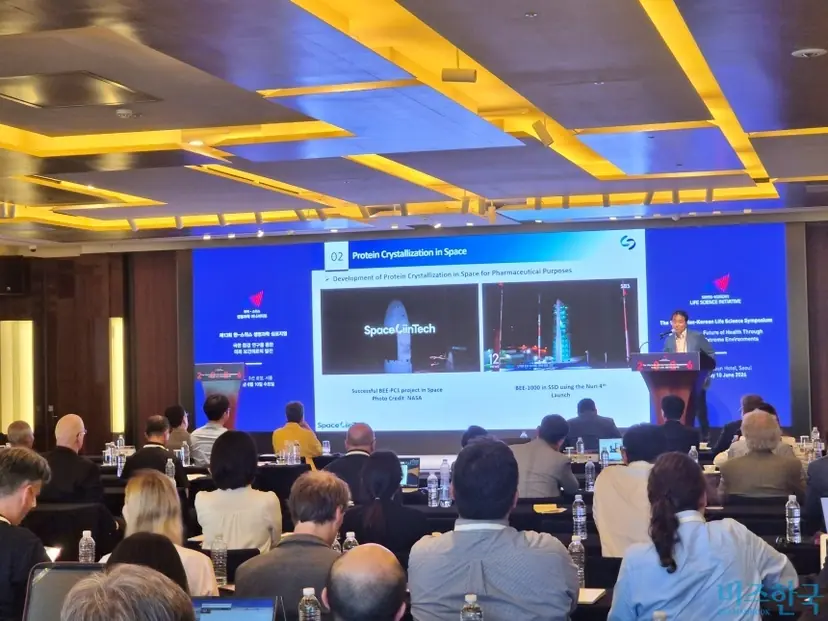
Space Linetech: “Producing Pure SC Formulations Without Enzyme Additives… Focusing on High-Value, Small-Batch Production”
Space Linetech has staked its life on the space CDMO business utilizing commercial space stations. Following the successful deployment of its first protein crystallization payload to the International Space Station (ISS) last year, it will launch a module twice the size of the previous one into space this coming September. Yoon Soon-hak, CEO of Space Linetech, predicted that space manufacturing, particularly in the pharmaceutical sector, would be the area with the greatest impact following the SpaceX IPO.
The most noteworthy aspect is the fundamental differentiation in technology that converts intravenous (IV) drugs into subcutaneous (SC) formulations. Currently, the global SC formulation conversion market is led by companies like Alteogen196170 and Halozyme, which utilize human hyaluronidase enzymes to expand skin tissue.
CEO Yoon pointed out the clear limitations of the existing enzyme-addition method. “Technologies from companies like Alteogen require adding a new substance called an enzyme, which means every time the drug changes, the conditions must be completely altered, necessitating complex new clinical trials,” Yoon noted. “This inevitably makes the clinical process more complicated, consuming both time and money.”
In contrast, the microgravity environment allows for high-purity crystallization by altering only the physical form of the contents without the addition of separate drugs or enzymes. Yoon explains that the advantage lies in bypassing complex clinical stages to achieve SC formulations. “Space CDMO technology does not change the manufacturing process itself; it purely crystallizes the pharmaceutical contents in space, so no components other than the drug are included,” Yoon emphasized. “Because the requirements for clinical trials are significantly relaxed, the development hurdles are lower, and we can capture the market through much lower costs and higher productivity than ground-based methods.”
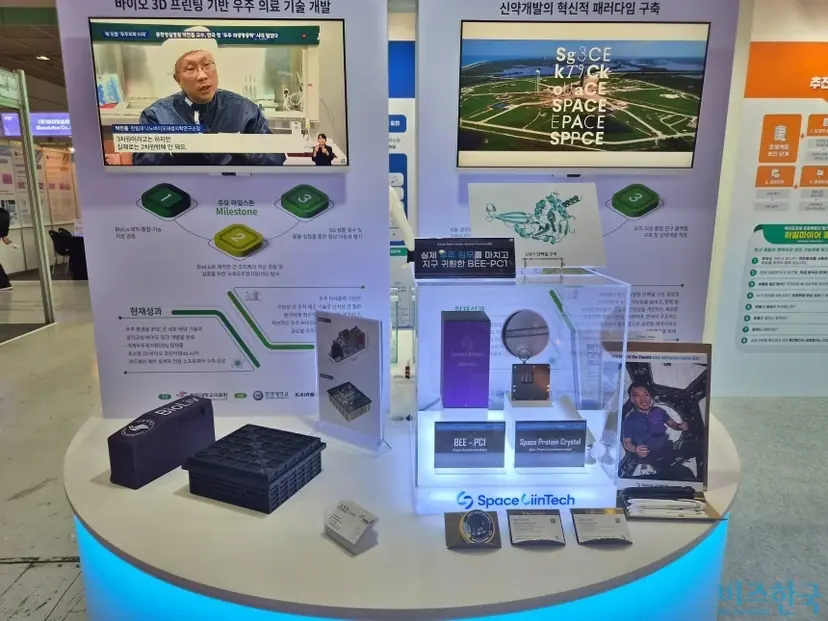
He brushed off concerns regarding production costs and scaling up in space. Citing that the amount of the core substance for the vaccines Pfizer supplied globally amounted to only two gallons of milk, he stated that the company plans to focus on producing ultra-high-value, made-to-order medicines that create massive value with small quantities. “Just because we are producing medicine in space does not necessarily mean we need massive facilities,” Yoon explained. “Rather than mass production, we can sufficiently improve profitability by meeting the diverse demands of various pharmaceutical companies through made-to-order production.”
The company also plans to accelerate demonstration work to advance its technology. Space Linetech originally planned to launch a cartridge module payload that is twice as large (12U) this August, but the launch schedule has been shifted to around September due to detailed schedule coordination with agencies like the Korea Aerospace Administration (KASA).
The core competitiveness of Space Linetech's space CDMO business lies in complete automation. The module developed by Space Linetech features an advanced automated system that, without needing intervention from astronauts, simply requires being plugged into a rack to automatically mix proteins and buffers to create crystals. As the stay time of astronauts itself entails astronomical costs, this unmanned system is expected to become a weapon that significantly lowers CDMO unit costs for global pharmaceutical companies.
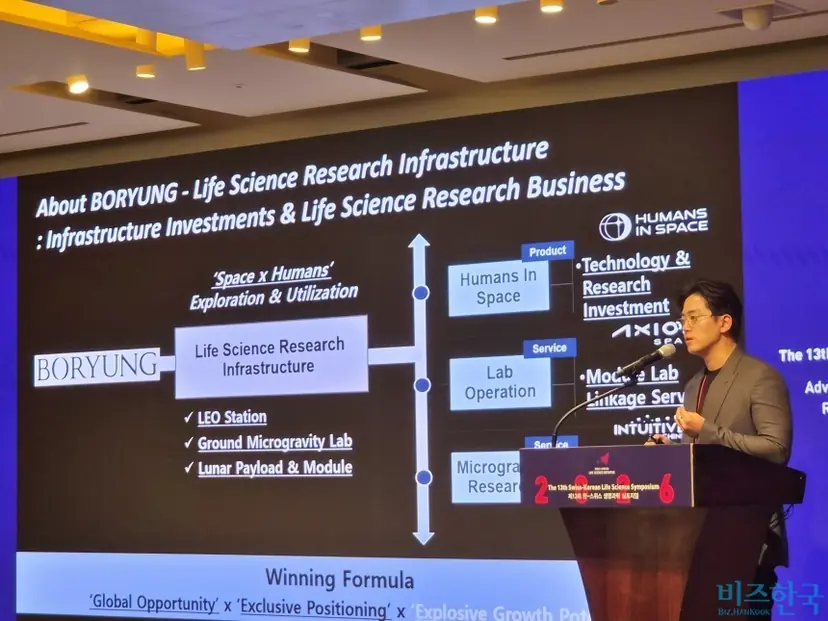
Boryung Targets Space CRO Market… “Considering Diverse Capital Alliances”
Boryung, which is pioneering the ecosystem by making direct investments in massive infrastructure such as private space station developer Axiom Space, also cites the increased frequency of launches and cost reductions triggered by the SpaceX IPO as the biggest opportunity. This is because as the frequency increases and costs decrease, the profitability of the space CRO business, which connects the ground to orbit, can be rapidly improved.
Given the nature of the space business, which requires massive capital expenditure, the option of joining hands with external private equity funds (PEF) or financial investors (FI) is also being actively reviewed. In fact, Boryung has been aggressively investing in equity to preempt the space healthcare ecosystem. Following a total investment of $60 million (approximately 78 billion KRW) in U.S. commercial space station developer Axiom Space in 2022, it officially launched the space joint venture Brainspace in January 2024 by co-investing with Axiom at a 51:49 ratio. Through this, it secured exclusive domestic rights to utilize low Earth orbit infrastructure. Furthermore, it is expanding its space business domain to the Moon by executing a $10 million (approximately 14 billion KRW) equity investment in Intuitive Machines, the first U.S. commercial lunar lander company.
As this is an infrastructure business that requires enormous capital input over a long period, the possibility of attracting external investment remains. Regarding this, Lim Dong-ju, Head of Boryung's Strategic Business Division, responded, “We are continuously receiving related investment proposals, and rather than a publicly traded company bearing all the risks alone, we are carefully weighing and considering from various angles what kind of capital alliance would be more beneficial to the company.”