

[비즈한국] Although the top five construction companies have begun refining their articles of association in line with the trend of governance improvement, it has been found that tasks regarding shareholder protection and board independence remain to be addressed. None of the five companies have actually implemented cumulative voting, and Samsung C&T028260 is the only company where an outside director serves as the board chair. Among the firms, Daewoo E&C047040 showed the most vulnerabilities in governance-related areas, such as general meeting notices, dividend policies, and the independence of audit organizations.
According to an analysis by Bizhankook of the corporate governance reports of the top five construction companies—Samsung C&T, Hyundai E&C000720, Daewoo E&C, DL E&C375500, and GS E&C006360—the average compliance rate for key governance indicators among these companies was 79% last year. Out of 15 total key indicators, Samsung C&T complied with 13 (87%), Hyundai E&C with 12 (80%), Daewoo E&C with 10 (67%), DL E&C with 11 (73%), and GS E&C with 13 (87%).
Corporate governance reports are documents through which listed companies explain their current governance status to investors. Companies voluntarily verify their compliance with 10 key principles and 15 key indicators set by the Korea Exchange, and provide explanations for any items they failed to comply with, along with future plans. Since the system was introduced as a voluntary disclosure by the Korea Exchange in 2017, the scope of mandatory disclosure has expanded, making all KOSPI-listed companies subject to mandatory disclosure starting this year.
Daewoo E&C had the lowest compliance rate among the top five. It failed to meet five criteria: providing notice of the general meeting four weeks in advance, informing shareholders of dividend policies and implementation plans, having an outside director serve as board chair, adopting cumulative voting, and establishing an independent internal audit department. The general meeting was notified 21 days in advance, and there was no dividend policy, so no notification was sent to shareholders. Although an internal audit department exists, it lacked the authority to take personnel actions against all its members.
Samsung C&T and GS E&C had the highest compliance rates. Each company failed to meet only two indicators. Samsung C&T failed to provide predictability regarding cash dividends and adopt cumulative voting, while GS E&C failed to appoint an outside director as board chair and adopt cumulative voting. Both companies removed the clause excluding cumulative voting from their articles of association at this year's general meetings and plan to implement it starting this September.
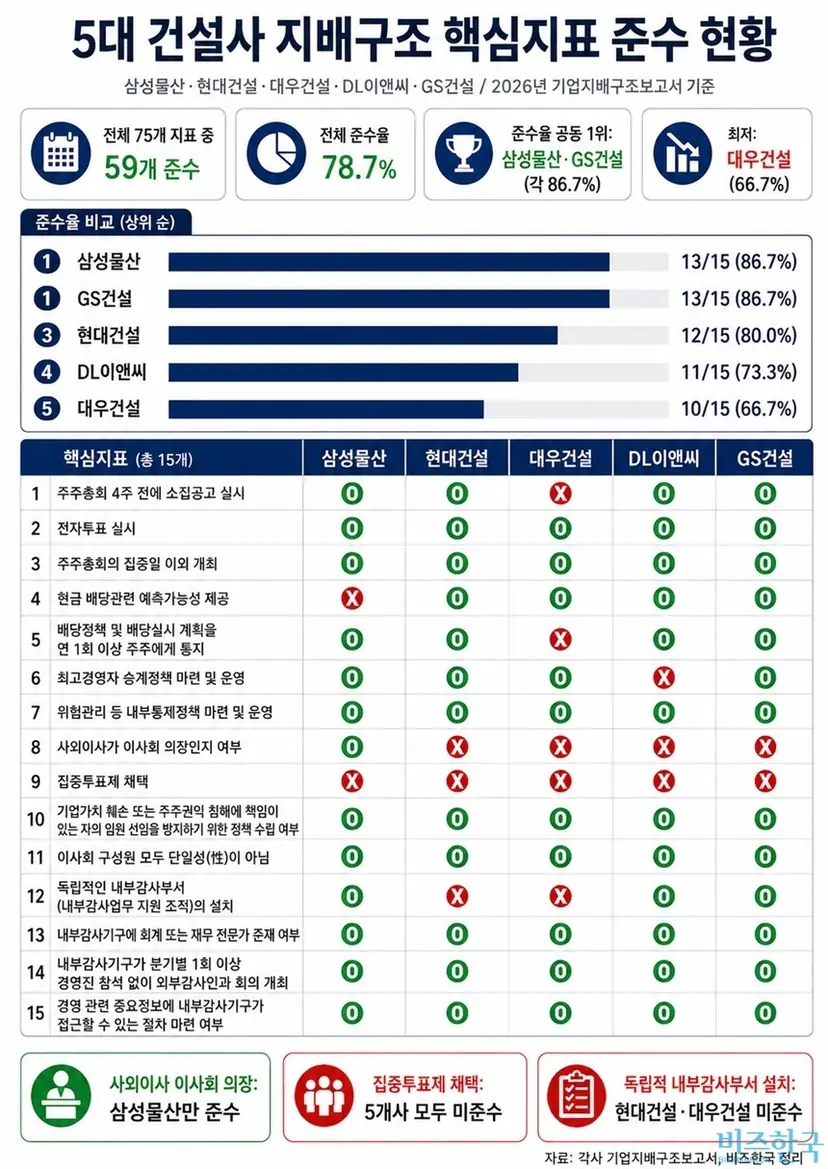
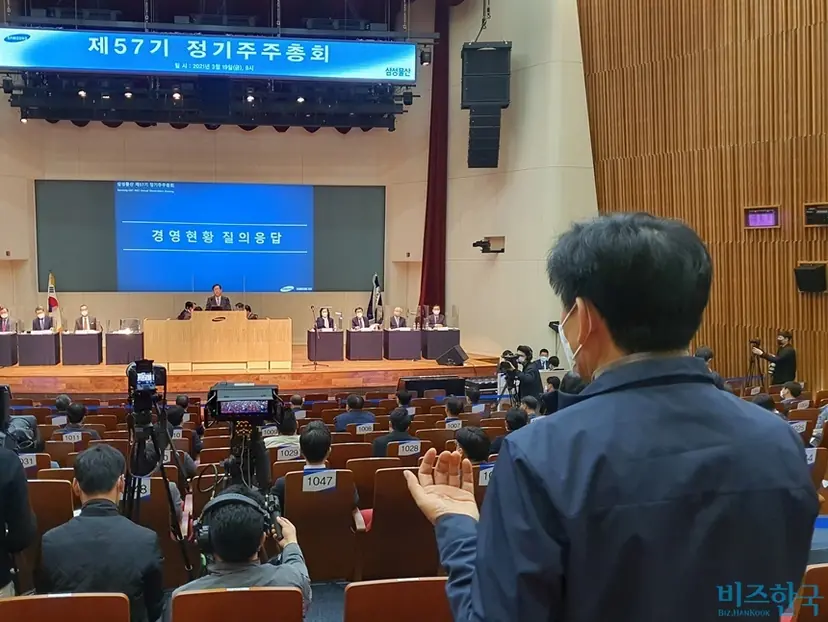
None of the top five construction companies have yet introduced cumulative voting. Cumulative voting is a system that allows shareholders to concentrate their voting rights on a specific candidate when electing multiple directors. It is considered a mechanism to increase the chances of minority shareholders entering the board. However, the five companies, including the aforementioned Samsung C&T and GS E&C, have now removed the exclusion clause from their articles and plan to apply it from general meetings for director appointments held after September.
Samsung C&T was the only company to have an outside director serve as board chair. Samsung C&T has appointed an outside director as board chair since 2021. In contrast, until now, the CEOs serve as board chairs at Hyundai E&C, Daewoo E&C, and DL E&C, while Chairman Huh Chang-soo, who is the largest shareholder and an executive director, serves as chair at GS E&C. As the construction industry faces high management risks related to project orders, safety, quality, construction costs, and project financing (PF), the independence of the board chair is considered a vital check-and-balance tool.
A source in the corporate governance evaluation industry pointed out, "Considering project financing (PF) insolvency, poor construction, and safety/health issues, construction companies actually need even greater board independence. If operations are centered around insiders, check-and-balance functions may be neglected. Therefore, it is important for the board to have an environment and related committees where professional external experts can provide an independent perspective. It is necessary to monitor whether cumulative voting actually functions properly at shareholder meetings, rather than just stopping at the removal of the exclusion clause from the articles of association."