

[비즈한국] Where do we all come from? Astronomy provides a truly marvelous answer to this question: we are all 'stardust.' We are all stars and cosmic dust. This is not just a metaphor; it is scientifically accurate. We are all made of the materials left behind by stars that exploded and vanished long ago.
It is perfectly true when broken down to the atomic level. However, if we think about the process by which those atoms gather one by one to form more complex molecules, many mysteries remain unsolved. The one that puzzles us the most is the origin of water. The Earth's surface is 70% covered by oceans. Water is the most important ingredient for life on Earth. Yet, surprisingly, we still do not know exactly where this water came from.
Looking at water molecules themselves, composed of two hydrogen atoms and one oxygen atom, water is a common ingredient that can be easily found anywhere in the universe. Naturally, one might assume that water identical to Earth's exists here and there in the cosmos. For example, there is water ice on asteroids and comets at the edge of the solar system. Even interstellar objects flying in from outside the solar system are covered in ice. It is easy to assume that their water is not much different from ours. The expectation that water is quite common naturally leads to expectations for extraterrestrial life.
However, the universe shows a completely unexpected side. Confusingly, Earth's water seems truly special. It appears to be a unique type of water that cannot be easily found elsewhere in the solar system.
In 2025, a very strange visitor arrived in our solar system: 3I/ATLAS. As the name suggests, it is officially the third interstellar object confirmed to date. It is not an asteroid or comet born and raised with us in our solar system, but an object formed around an entirely different star that wandered out of its home and crossed the space between stars, accidentally entering our solar system.
The first interstellar object discovered in 2017, 'Oumuamua, excited us even more due to its strange orbit and elongated, unfamiliar shape. Some even hoped it might be a probe from an alien civilization rather than a natural object. In 2019, the second interstellar object, Borisov, was discovered. It was quite unremarkable compared to the first, and people did not pay much attention to it. It showed a much more typical comet-like appearance. As the ice sublimated, a massive coma of gas and dust formed around it, and it even grew a tail. And in 2025, the third visitor, 3I/ATLAS, arrived.
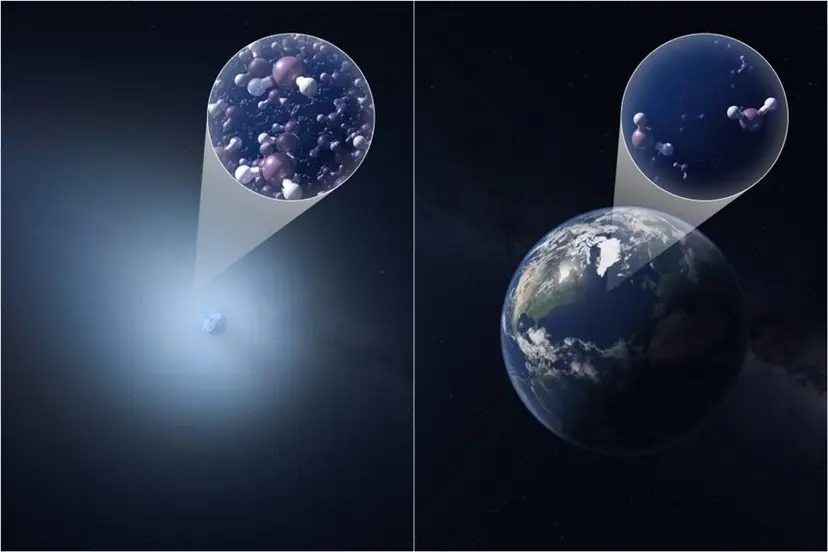
Where and when did this object come from? These simple questions lead us to even more amazing mysteries. Astronomers investigated how long this object had been drifting through interstellar space and whether clues to extraterrestrial life were hidden within it. They hoped for evidence to support the expectation that water and the ingredients for life similar to Earth's might be common in the vast universe beyond our solar system. However, they were faced with a frustratingly opposite result.
3I/ATLAS also contains water ice. But it is composed of water molecules much heavier than Earth's. More precisely, the hydrogen in its water molecules is not ordinary, light hydrogen, but a heavier isotope of hydrogen called deuterium. If one of the hydrogens in a water molecule is deuterium, it becomes HDO, known as semi-heavy water. There are even cases where both hydrogen atoms are deuterium, resulting in D2O, which is referred to as heavy water in the narrowest sense. In astronomy, HDO is actually more important. Since deuterium is so rare to begin with, a water molecule with two deuterium atoms is extremely scarce. Therefore, by measuring the ratio of HDO alone, we can determine the environment in which the water was formed.
Then, where does deuterium come from? Deuterium is produced more abundantly in cold environments. Before a star is born, in cold molecular clouds, an ion called H3+ plays a very important role. This ion reacts with HD molecules—a form where one ordinary hydrogen is combined with one deuterium—to create H2D+. This reaction occurs more readily at lower temperatures. Conversely, as the temperature rises, it reverts to its original state, proceeding in the direction of creating H3+ ions. Naturally, the number of ions and molecules containing deuterium decreases.
Therefore, in very cold environments, more ions and molecules containing deuterium are created. The deuterium produced in this way freezes onto the rough surfaces of dust grains within molecular clouds and enters the water ice. When that ice is later formed into a comet or planetesimal, the environment of the moment when the deuterium-laden water ice was frozen remains intact. Thus, by calculating the D/H isotope ratio in a comet's ice, one can infer the environment at the time the object first froze and formed.
On November 4, 2025, just a few days after 3I/ATLAS passed its perihelion—its closest point to the Sun—the ALMA radio telescope in Chile targeted the object. At that time, 3I/ATLAS was only 1.37 AU from the Sun. This distance is sufficient for the sublimation of water ice to occur strongly. Astronomers used ALMA to scour the spectrum for traces of water, semi-heavy water (HDO), and methanol (CH3OH).
As a result, emission lines for HDO and various methanol lines appeared. There was no distinct signal for ordinary water. Since 3I/ATLAS is clearly a comet, it should have had plenty of water ice, yet regular water was not visible, and almost only HDO was seen. It was difficult to find a meaningful D/H value using simple ratio calculations. Therefore, a more sophisticated method was used, utilizing methanol—which is neither water nor semi-heavy water. By using the excited state of methanol molecules, they indirectly estimated how much water was being produced within the coma of 3I/ATLAS.
In a comet's coma, methanol molecules collide with other nearby molecules and are excited to a specific energy level. As they drop back down to a lower energy state, they emit radio waves of a specific wavelength. By looking at the shape of the spectrum emitted by the methanol, one can determine the density and temperature at which the methanol molecules exist. Assuming that the primary collision partner for methanol molecules in a comet's coma is water molecules, the excitation state of the methanol molecules becomes an indicator of the surrounding water density and water production rate. The temperature of the 3I/ATLAS coma is estimated to be around 70K. Applying this temperature results in an estimated water molecule production rate of about 10^29 molecules per second for 3I/ATLAS.
However, there are limitations to accepting this figure as is. The actual coma of 3I/ATLAS could contain other volatile gas molecules such as carbon dioxide, carbon monoxide, and methanol, not just water. In particular, there are results suggesting that 3I/ATLAS has much more carbon dioxide than other comets in the solar system. Therefore, this figure should be viewed as an upper limit rather than the exact amount of water on 3I/ATLAS. Based on this, comparing the amount of HDO with the upper limit of water molecules, the D/H ratio of 3I/ATLAS is approximately 6.6×10^−3. While this looks like a very small number, it is more than 40 times higher than the D/H ratio of Earth's ocean water. 3I/ATLAS is frozen solid with heavier water molecules made of much heavier hydrogen than Earth's.
What should be kept in mind here is that the actual number of ordinary water molecules on 3I/ATLAS could be even lower. As explained earlier, the estimate of water molecules used in this analysis is an upper limit. In reality, with the presence of other molecules like carbon dioxide and carbon monoxide, the quantity of water molecules could be lower. Since the number of ordinary water molecules is in the denominator of the D/H ratio, if the actual number of water molecules decreases, the D/H ratio increases. Even with this rough estimate, 3I/ATLAS already showed a high value over 40 times that of Earth's ocean water; in reality, it could be much larger!
This is not just a matter of 3I/ATLAS's water tasting slightly different from Earth's. This astonishing result shows that 3I/ATLAS was born in an environment completely different from comets in the solar system. Furthermore, it reveals how planets, asteroids, and comets are born around other stars beyond the solar system, and under what conditions their ice and water are created. It also provides clues as to how universal or how highly unusual our Earth and solar system are when viewed in the context of the entire universe.

So, how exactly does the birthplace of 3I/ATLAS differ from our solar system? First, 3I/ATLAS is highly likely to have formed in an environment much colder than that of the comets in our solar system. Deuterium enrichment generally occurs efficiently in extremely cold environments below 30K. While solar system comets also froze in very cold places, 3I/ATLAS provides evidence that it was born in an environment with even more extreme low temperatures.
Second, the home star of 3I/ATLAS might have been born in an environment very different from the Sun's. The Sun was likely born in a star cluster environment where stars were somewhat crowded together. Although it now shines lonely and isolated after losing the dynamic struggle, the Sun itself is a very ordinary star. If other stars were nearby when the Sun was originally born, the intense ultraviolet light from neighboring stars would have heated the ice and gas at the edge of the primitive solar system. In such an environment, it is difficult for the D/H ratio of water ice to become extremely high.
However, if 3I/ATLAS's home star had been in a much more isolated environment—with almost no nearby stars illuminating the comet—the environment of 3I/ATLAS would have been kept much colder. As a result, more deuterium might have been enriched within the ice.
A third possibility is that 3I/ATLAS formed at the very outer edge of a primitive planetary system, far, far away from its home star. Near a star, water and organic molecules go through a repeated process of being heated, evaporated, and then refrozen. In that process, traces from the original cryogenic environment can disappear. However, if 3I/ATLAS had been drifting at the edge of its home star from birth until it escaped its home, the cryogenic environment could have been continuously maintained. The icy planetesimal created that way could preserve a much more primitive isotopic composition.
A fourth and final possibility is that 3I/ATLAS was ejected from its home star too early, immediately after it was born. If it had stayed near its home star for a long time, the central starlight would have heated the ice. It would have also undergone processes of colliding with other celestial bodies and gravitational heating by other large nearby planets. Through these processes, much of the deuterium should have disappeared. But if it was ejected from its home star very early on, it could have set off on its interstellar journey while maintaining a high D/H ratio before the deuterium had a chance to be erased.
Considering how harsh the journey of drifting through interstellar space is, the state of 3I/ATLAS is truly surprising. Escaping a home star system does not mean it completely avoided hot starlight. The universe is still full of stars, and 3I/ATLAS, being just a tiny comet fragment compared to a star, is easily caught up in the gravity of other neighboring stars. Just passing near another star can lead to immediate interactions with cosmic rays, ultraviolet light, and interstellar materials, causing the chemical composition of its surface to rapidly deteriorate. Yet, 3I/ATLAS has remarkably well-preserved its original state formed in a cryogenic environment.
In the end, the most natural interpretation is that despite passing through the harsh environment of interstellar space, it maintained such a high D/H ratio because it started with a very, very high D/H ratio from the very beginning.
3I/ATLAS is an interstellar version of a meteorite. Just as it is difficult to go directly to Mars but we can indirectly investigate Martian components by picking up Martian meteorites that occasionally fall to Earth, we cannot directly visit other stars or exoplanets beyond our solar system, but thanks to 3I/ATLAS, which endured long time and distance to fly to us, we can gauge the diverse environments in which exoplanets can be born. Until now, we had to examine the ambiguous traces of water molecules buried in blurry spectra while looking at the silhouettes of exoplanets hundreds or thousands of light-years away, but thanks to the sudden arrival of 3I/ATLAS, we were able to analyze extraterrestrial components right in front of our eyes.
Comets are often considered time capsules that show the history of the early formation of the solar system. Simply put, a comet is dirty ice. It is a mass of ice mixed with rocks and dust. As it approaches the Sun, the surface ice sublimates, drawing a long tail. Analyzing the molecular components emitted at this time reveals the chemical composition of the ice the comet held. A comet that has been frozen solid at the edge of the solar system for a long time lets out the secrets it has kept for ages as it is drawn by solar gravity and approaches the Sun.
Reference
https://www.nature.com/articles/s41550-026-02850-5
About the author, Ji Ung-bae? He loves cats and space. After watching 'Galaxy Express 999' as a child, he dreamed of sharing the beauty of the universe. He is currently an assistant professor in the Faculty of Interdisciplinary Studies at Sejong University, engaged in various science communication activities including lectures and writing. He has written books such as 'On the Uselessness of Astronomers,' 'We Are All Born Astronomers,' and 'Strange Questions That Come to Mind When Looking at the Universe,' and translated 'How I Killed Pluto,' 'Quantum Life,' and 'UFO.'