

[비즈한국] It was a Black Friday. On the 5th, the KRW/USD exchange rate exceeded 1,550 won during night trading and briefly peaked at 1,553.6 won during the day, marking the highest level in 17 years since the global financial crisis of March 2009. On the same day, the KOSPI plunged 5.54% in a single day, dropping to the 8160 line, as foreign investors offloaded large-scale net sales. The exchange rate later broke through the 1,560 won mark, and some airport currency exchanges even charged over 1,600 won for $1 in cash.
In the past, when the won weakened, the phrase "it's a boon for export stocks" would come up first. However, this market was different. The exchange rate soared, and stock prices collapsed alongside it. The weakening of the won is no longer seen as a buffer for the stock market, but as a signal that foreign investors are pulling out of Korean assets.
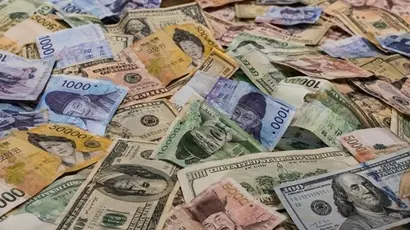
It is difficult to attribute this surge solely to a "strong dollar." While it is true that the dollar strengthened due to favorable US employment data that day, that alone is not a sufficient explanation. The more fundamental problem lies in the fact that the won has become particularly vulnerable compared to other currencies. According to the securities industry, the won has seen the largest depreciation among major currencies since late February, when the military conflict between the US and Iran began. The real effective exchange rate, which shows the real value of the won, has fallen 2.3 standard deviations below its long-term average, leading to diagnoses that it is "excessively undervalued."
The core issue is that the exchange rate does not easily come down despite the largest-ever current account surplus. It is not because the dollar is strong, but because the won is weak. The oil price spike triggered by the Middle East, the daily multi-trillion won in net foreign stock sales, and high dependence on energy imports are all weighing on the won at once. Recently, it has been pointed out that off-book transactions, such as non-deliverable forwards (NDF) in offshore markets, are shaking the won as much as foreign selling. Bank of Korea Governor Rhee Chang-yong has directly pointed to this influence, and authorities have begun reviewing ways to increase the transparency of these transactions.
We are already heavily betting on the exchange rate. Anyone who receives a salary in won and holds most of their savings and homes in won has, without knowing it, staked their entire fortune on the won. However, when you consider overseas travel, children's tuition, fuel costs, import prices, and investments in US stocks, we need dollars every day, yet our assets are tied solely to the won. Both the money we earn and the money we have saved are in won, yet the money we will need in the future is increasingly denominated in dollars. This imbalance silently erodes our purchasing power every time the exchange rate rises, without even touching our bank balances. Therefore, holding some dollar assets is not a speculation aiming for a "jackpot," but rather closer to correcting a life position that is already deeply tilted to one side.
It is the same even without grand overseas spending. The moment we fill up at a gas station, buy imported food at a grocery store, change our phones, subscribe to overseas streaming services, or go abroad for a summer vacation, we are paying in dollars. When the exchange rate goes from 1,200 won to 1,550 won, we have to pay nearly 30% more won for the same consumption. Even though we did nothing, our burden has increased.
The problem is the old belief that the exchange rate will inevitably come down. The idea that it's expensive if it exceeds 1,400 won and will return to normal soon if it exceeds 1,500 won has solidified from the experience of the past decade. Indeed, the exchange rate has always returned without fail each time. But this time, there are structural variables weighing heavily on the won even if short-term bad news like the Middle East crisis or foreign selling subsides: investment commitments to the US. Export companies that have promised large-scale investments in the US have no reason to convert their earned dollars into won, and as investments materialize, they may actually have to buy more dollars. Some analysts point out that the commonality among Korea, Japan, and Taiwan—countries with healthy fundamentals but weak currencies—is their "dependence on exports to the US" and "agreements for large-scale investment in the US."
We cannot conclude that 1,500 won is the permanent new normal. However, the cost of being wrong is too high to base asset allocation solely on the premise that "it will return to the 1,300 won range soon." Just as companies manage dollars in line with their investment plans, households should diversify their currencies according to their life plans, such as tuition, travel, and import expenses.
Of course, this does not mean you should buy a ton of dollars right now. As the exchange rate is already at its highest level in 17 years, buying at the peak all at once is another type of bet. The securities industry also believes that the won is excessively undervalued in the short term, so some retracement may occur. Therefore, the direction should be about "proportion," not "timing." It is more realistic to buy in increments of a certain amount every month rather than exchanging a large lump sum at once, or to secure only as much as needed for planned overseas spending. There are many options, such as dollar deposits, currency-exposed overseas ETFs, and split exchange, but the important thing is not a specific product, but aligning the currency structure of your life and assets.
Ultimately, the exchange rate is not a target to be predicted, but a position to be managed. No one can guarantee whether the exchange rate will be 1,400 won or 1,600 won next month. However, you can look at which currency your assets are concentrated in right now. I am not saying you should bet on a forecast. I am saying we should not take for granted a state where you have almost no dollar assets, or conversely, a state where you are excessively concentrated only in US stocks. Diversifying currencies so that your life does not wobble regardless of which way the exchange rate jumps is the financial management strategy for the era of high exchange rates. The question posed by this Black Friday is not "How high will the exchange rate go?" but "Which currency have I already bet everything on?"