

[비즈한국] The domestic industry and capital markets are reacting strongly to the visit of NVIDIA CEO Jensen Huang. From AI semiconductors, high-bandwidth memory (HBM), and robotics to 'physical AI,' data centers, autonomous driving, and cloud computing, his every movement and remark has become a subject of intense analysis by the stock market and various industries.
However, this visit should not be viewed merely as an event for a semiconductor company or a promotional trip by a global CEO. It carries significant implications for the real estate market as well. Yet, these implications are not the simplistic interpretation that "house prices in a certain region will rise because Jensen Huang visited." Instead, it poses a more fundamental question: What will be the standard for reshuffling the value of Korean real estate in the future?
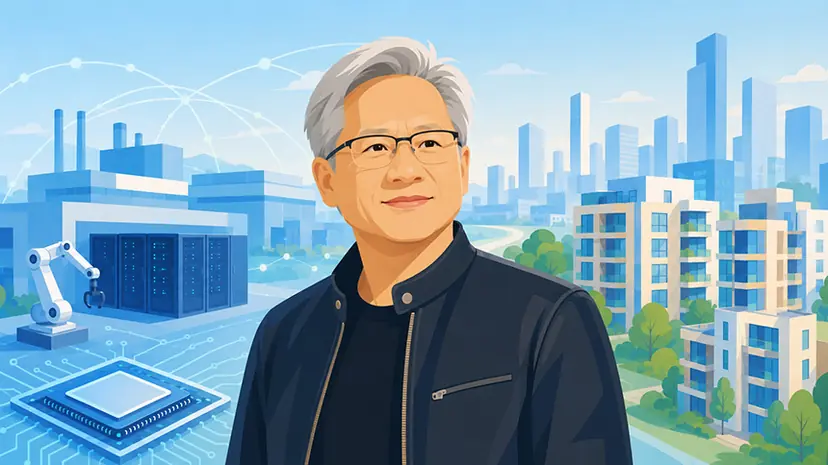
To start with the conclusion, the impact of Jensen Huang's visit on Korean real estate is not a short-term price increase factor, but rather a mid-to-long-term factor for re-evaluating locations. House prices do not rise overnight due to a global CEO's visit. However, real estate values inevitably respond when the axis of industry shifts, high-income jobs move, and corporate investments accumulate in specific regions.
The history of Korean real estate is ultimately a history of jobs. Gangnam did not become Gangnam solely because of education; it became what it is through the combination of business, transportation, education, and demand from wealthy individuals. Pangyo did not grow just from apartment complexes; it became Korea's representative city for living near one's workplace as IT companies and high-income professionals flocked there. It is also difficult to explain the current status of Dongtan and Pyeongtaek without the overwhelming industrial foundation of Samsung Electronics005930. Ultimately, real estate follows the shadow of industry.
A point to note during this visit is that NVIDIA does not view Korea merely as a sales market. Reuters reported that during his visit, Jensen Huang mentioned robotics as Korea's next major industry and emphasized that Korea's manufacturing capabilities can be combined with AI and semiconductor production foundations. CEO Huang also left open the possibility of cooperation with major companies such as Samsung Electronics, SK Hynix00660, Hyundai Motor005380, LG003550, and Naver035420. It was also highlighted that Korean companies play a crucial role in the supply chain for memory used in NVIDIA AI chips.
The reason this is important for real estate is clear. Future real estate value will not be determined solely by residential preferences. Regions with industrial competitiveness, areas where high-income jobs are increasing, and locations where advanced manufacturing and R&D operate simultaneously will become stronger. Until now, the common criteria in the real estate market have been proximity to subway stations, school districts, new construction, large complexes, and brand. Of course, these criteria remain valid. However, one more standard is being added: the 'AI Industry Zone.' Regions connected to semiconductors, robots, data centers, autonomous driving, cloud computing, advanced packaging, HBM, and power infrastructure are highly likely to form a new real estate premium.
The first areas to pay attention to are not residential, but industrial real estate. The direct impact of Jensen Huang's visit is more likely to appear first in industrial complexes, factory sites, R&D land, data center locations, and land near power infrastructure rather than apartment prices. The AI industry is different from general manufacturing. It requires immense computing power, stable electricity, cooling facilities, a high-performance memory supply chain, advanced packaging technology, and high-level research personnel simultaneously. Therefore, for future industrial locations, the question of "whether electricity, water, transportation, and permits are possible" will become more important than "is there a large plot of land?" Data centers and advanced factories are industries that run on electricity. Regions with weak power grids will struggle to become hubs for the AI industry, no matter how cheap the land is.
From this perspective, Yongin, Hwaseong, Pyeongtaek, Icheon, Cheongju, and Cheonan-Asan need to be looked at again. These regions already possess the foundation for semiconductors and advanced manufacturing. Yongin combines the semiconductor cluster and Platform City with the residential bases of Giheung and Suji. Hwaseong has a manufacturing axis that can be linked to the Samsung Electronics, automotive, battery, and robot industries. Pyeongtaek has established itself as a representative industrial city in the southern metropolitan area based on the Samsung Electronics Pyeongtaek Campus and wide-area transportation networks.
Icheon and Cheongju are the core axes of SK Hynix and the memory industry, while Cheonan-Asan serves as a hinterland for semiconductor equipment, displays, and automotive parts industries. These regions will not all rise at the same speed. However, they share a clear commonality: as long as Korea remains a key partner in the AI supply chain, the industrial foundation of these regions will be a force supporting the floor of real estate values.
However, one must be cautious here. Industrial benefits and rising real estate prices are not the same thing. Especially in places with large-scale move-in volumes, such as some parts of Pyeongtaek, Hwaseong, and Yongin, jeonse (long-term deposit rental) prices may weaken in the short term even if industrial benefits are strong. If jeonse prices weaken, investment yields decrease, and purchase prices may also be suppressed for a certain period. The real estate market does not move on expectations alone. Actual supply, the ratio of jeonse to purchase price, loan environment, taxes, living infrastructure, schools, and transportation networks all work together. Therefore, investments solely labeled as 'NVIDIA beneficiaries' are risky. While the growth potential of the AI industry is clear, not all land and not all apartments will benefit.
The path for the influence to shift to the apartment market is somewhat slower and more concrete. When corporate investment increases, jobs are created. When jobs are created, the population flows in. In particular, the workforce in AI, semiconductor, robot, and cloud industries has relatively high income levels. The residential areas they prefer are not just places near factories. They are regions where commuting is possible, and education, commercial districts, healthcare, culture, and transportation are well-established. Therefore, superior residential areas connected to industrial complexes may become stronger than areas immediately next to industrial complexes. In Yongin, core residential areas in Giheung and Suji may be more stable than Cheoin, and in Hwaseong, the competitiveness of Dongtan may be re-emphasized. In Pyeongtaek, Godeok and the Jije Station area will be the centers, but one must consider both the supply volume and the price burden.
Seoul and Pangyo are also indirect beneficiaries. The AI industry is not completed by manufacturing plants alone. It requires headquarters, R&D, startups, venture capital, global collaboration, and high-end talent networks. These functions are highly likely to cluster in business, research, and startup hubs such as Gangnam, Pangyo, Magok, Seongsu, and Yongsan. Gangnam remains the top-tier residential area for high-income professionals and entrepreneurs.
Pangyo and Bundang are representative markets for living near one's workplace favored by IT, game, platform, and semiconductor design personnel. Magok has a foundation for large corporate R&D and bio/advanced industries. Seongsu and Yongsan are areas where the symbolism of global companies and startups is being added. While Jensen Huang's visit does not immediately raise prices in these areas, it is certainly an event that strengthens the argument for the long-term defense of prime locations.
The biggest lesson the Korean real estate market should learn through this incident is that "the definition of location is changing." In the past, the core of a location was accessibility to the city center, school districts, transportation networks, and amenities. This will remain the baseline. But in the future, the industrial ecosystem will be added to it. A good location is not simply a nice place to live, but a place where good jobs are nearby or connected. The quality of good jobs is especially important. 1,000 high-income, high-tech industry jobs can have a stronger impact on the housing market than 10,000 low-wage jobs, because housing purchasing power ultimately comes from income.
Ultimately, Jensen Huang's visit sent a signal to the Korean real estate market. House prices do not rise based on buzzwords; they rise based on industry. The massive industrial transformation of AI can redraw Korea's city map. The southern semiconductor axis, the advanced manufacturing belt, the R&D hubs of Seoul/Pangyo, and data center/power infrastructure sites will become even more important in the future. However, that change does not manifest as a sudden explosion, but within the time it takes for employment, income, and infrastructure to accumulate.
What Jensen Huang left behind in Korea is not a photo of a celebrity's visit. It is a hint for a new map that Korean real estate should follow. That map is not just filled with administrative districts, but with a network of industry, power, talent, transportation, and housing. Now, the way we view real estate must also change. A good home is in a good location, and a good location goes hand in hand with good jobs. Real estate in the AI era is ultimately returning to this simple principle.
※ Kim Hak-ryeol, director of the Smart Tube Real Estate Research Institute, well-known by his pen name 'Pashong', served as the team leader of the Real Estate Research Division at Gallup Korea. He operates and hosts the Naver blog 'Pashong's World Exploration' and the YouTube channel 'StuTV'. His books include '3040 Real Estate Investment for Beginners (2026)', 'A New User Guide to Korean Real Estate (2025)', 'The Power of Gyeonggi Real Estate (2024)', 'Absolute Principles of Seoul Real Estate (2023)', 'The Future of Incheon Real Estate (2022)', 'Kim Hak-ryeol's Absolute Principles of Real Estate Investment (2022)', 'Future Map of Korean Real Estate (2021)', and 'From Now On, Only Places That Will Rise, Rise (2020)'.