

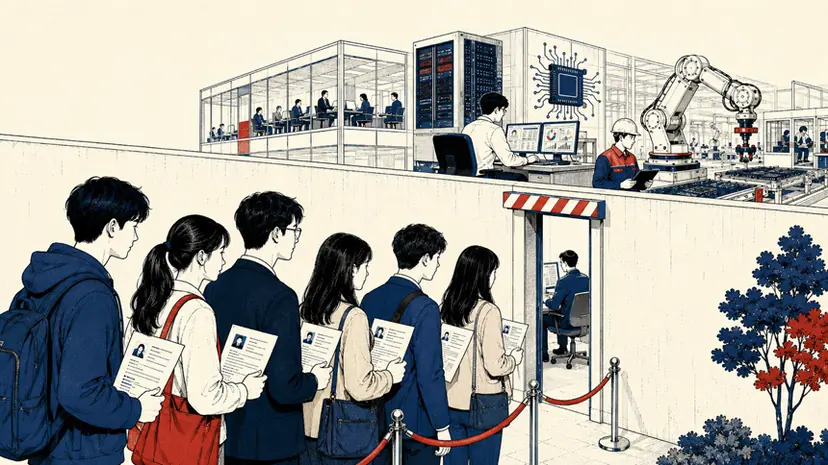
[비즈한국] Concerns are growing that the youth employment crisis, already dire, could worsen further as the dispute over "N% performance bonuses," triggered by Samsung Electronics005930 and SK Hynix005930, shows signs of spreading to other domestic firms. This is because major companies are accelerating the adoption of artificial intelligence (AI) and robotics in their internal operations and manufacturing sites.
With the adoption of AI and robots gaining speed, the threshold for hiring young people is bound to narrow further, especially as the unemployment rate for the youth (aged 15-29) hit a five-year high in the first quarter of this year. In particular, experts point out that since the number of young people who have never experienced employment saw its largest increase in eight years and three months during the first quarter, youth could be entirely excluded from a labor market that is increasingly favoring experienced workers.
Jensen Huang, CEO of NVIDIA, who arrived in Korea on the 5th, plans to explore cooperation plans with leading domestic robotics companies. NVIDIA is currently expanding cooperation in physical AI fields, including robotics, with companies such as Samsung Electronics, SK Hynix, Hyundai Motor005380, LG Electronics066570, and Doosan000150. It is reported that that evening, CEO Huang is scheduled to meet with Hyundai Motor Group Chairman Euisun Chung, SK Group Chairman Tae-won Chey, LG Group Chairman Kwang-mo Koo, and Naver Board Chair Hae-jin Lee at a Korean BBQ restaurant called 'Hyungnim Jeoyo' near Hongik University in Mapo-gu, Seoul. He is also reportedly meeting with Doosan Group Chairman Jeong-won Park to discuss cooperation on robotics technology.
Previously, during the 'Korea Partner Night' event held in Taiwan on the 1st, CEO Huang emphasized to reporters, "I believe robotics is very important for Korea." He explained, "Korea has great imagination, creativity, and ambition, but is facing a shortage of labor, which serves as its hands and feet," adding, "AI and robots will maximize Korea's potential."
The close ties between NVIDIA and major companies are interpreted as a signal that firms have begun to seriously consider replacing human labor with AI and robots to lower personnel costs amid intensifying demands for performance bonuses from labor unions. If major companies begin full-scale adoption of AI and robots, the already poor youth employment situation is expected to worsen.
Contrary to the recent improvement in the overall job market, youth employment conditions are deteriorating. According to the National Data Agency, the overall employment rate for all age groups in the first quarter of this year was 61.8%, unchanged from the same period last year. Despite various negative factors such as high oil prices, high inflation, and high exchange rates, the overall job market is showing a positive trend.
In contrast, the youth employment rate in the first quarter of this year was 43.5%, a 1 percentage point drop from the same period last year (44.5%). This is the lowest level since the first quarter of 2021 (42.1%). The youth employment rate, which stood at 45.3% in the fourth quarter of 2024, fell to 44.5% in the first quarter of 2025 as the economy was shaken by martial law and impeachment. Although it rose to 45.7% in the second quarter once political instability subsided, it fell again to 45.3% in the third quarter, dropped to 44.4% in the fourth quarter, and continued its downward trend in the first quarter of this year. Although President Lee Jae-myung has emphasized youth job creation since his presidential campaign, no results have emerged.
As the youth employment rate declines, the number of young people who have never even managed to cross the threshold of corporate hiring is increasing rapidly. In the first quarter of this year, the number of unemployed youth with no previous work experience was 52,000, an increase of 7,000 (15.8%) from the same period last year (45,000). This scale and rate of increase represent the highest levels in 99 months, since the fourth quarter of 2017 (13,000 people, 24.9%).
The problem is that youth who spend their early adulthood as unemployed find it difficult to properly enter the labor market later. This is because the domestic labor market has recently been moving toward a preference for experienced hires rather than new recruits. In fact, compared to the past, the number of young people who remain unemployed for more than a year is on the rise.
According to the National Data Agency, in a 2019 survey on youth, 52.3% of unemployed youth had been out of work for less than 6 months, but that figure decreased to 43.5% in the 2025 survey. In contrast, the proportion of unemployed youth who had not found work for more than a year increased from 22.6% to 30.0% during the same period. Youth who remain unemployed for long periods also face lower probabilities of landing permanent positions.
According to a report by the Bank of Korea titled 'Impact of Delayed Labor Market Entry and Housing Costs on the Life Cycles of the Youth Generation,' as the period of unemployment extends, the probability of being employed in a regular full-time position subsequently decreases. In particular, for every additional year of unemployment, real wages are reduced by 6.7%.