

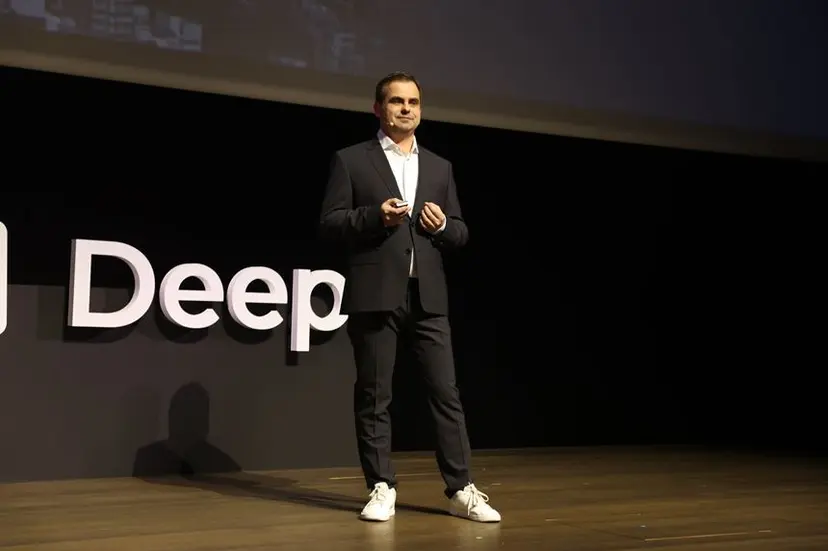
[비즈한국] Born in Cologne, Germany, in 2017, the AI translation startup DeepL has long been a source of pride for the European tech ecosystem. Founded by Polish-born computer scientist Jaroslaw Kutylowski, the company developed its neural machine translation technology based on the datasets of the multilingual dictionary service Linguee. From the start, it positioned itself as a challenger to Google Translate, and in several independent accuracy assessments, it actually outperformed Google. It gained word-of-mouth popularity by providing translations that preserved context and tone rather than simply substituting words.
In 2024, revenue grew 31% year-on-year to $185.2 million (approximately 280 billion KRW). Over the same period, its valuation doubled from $1 billion to $2 billion. Its user base was also noteworthy; more than half of the Fortune 500 companies, as well as government agencies and courts in various countries, entrusted DeepL with sensitive documents such as contracts, court rulings, and diplomatic records. Trust was built on their promise that “your data never leaves Europe,” keeping servers exclusively in Germany and Iceland.
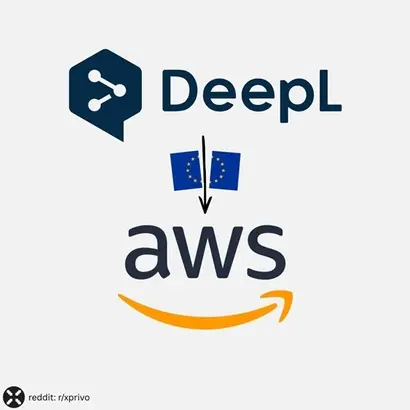
However, cracks in this belief began to appear early this year. DeepL sent an email to customers informing them that its terms and conditions would change starting May 20. The update stated that from then on, data would not only be processed on their own servers but would also be handled via Amazon Web Services (AWS). It was essentially a unilateral notification: silence was deemed consent, while objections would lead to contract termination effective December 31 of this year.
DeepL's 'Great Surrender'
Some in the German tech community are harshly criticizing this decision as 'DeepL's great surrender.' This is because DeepL built its growth on the narrative of being a 'European alternative to Google,' fighting against American big tech. Its core weapons were European servers and data sovereignty. By laying down those weapons, the company has effectively defected. This is why it is interpreted not merely as a business decision, but as a 'symbolic defeat for the entire European digital sovereignty discourse.'
As controversy grew, DeepL clarified that “data is encrypted, Amazon cannot view the content, and it is not used to train AI models.” The issue, however, remains that Amazon is an American company. According to the U.S. CLOUD Act introduced in 2018, the U.S. government can demand data stored on servers from cloud providers like Amazon. Even if servers are in Europe and data is encrypted, if the operator is an American company, it falls within the reach of this law.
For example, last year, Anton Carno, the Legal and Public Affairs Director at Microsoft France, was asked at a French Senate hearing whether he could guarantee that the data of French citizens would not fall into the hands of U.S. authorities. He replied, "No." He added, "Although there has never been a request from the U.S. government to date, no one knows how long the fact that it hasn't happened yet will remain valid."
The consequences of DeepL's change were immediate. According to Cybernews, a German-language tech media outlet, the Portuguese software company Maloojica Group decided to stop using DeepL immediately following the announcement. The company's CEO, Weisshaupt, stated bluntly, "The new terms are incompatible with the reasons we chose DeepL in the first place."
Exits are also expected in the public and legal sectors, which were DeepL's strongest allies. In Germany, there is speculation that government agencies and local municipalities, which must comply with strict data security guidelines from the Federal Office for Information Security (BSI), will look for alternatives that host their own servers within Europe.
The legal sector, where client confidentiality is paramount, is even more sensitive. Local German legal tech experts warn, "It would be difficult for law firms to bear the risk that litigation data or M&A secrets might fall into the potential jurisdiction of the U.S. CLOUD Act," adding that "the exodus of corporate accounts and internal bans could spread like dominoes."
DeepL's 'Dilemma'
Of course, this decision may have been inevitable from DeepL's perspective. To service 228 markets worldwide, fast response times and stable infrastructure are essential. Building such infrastructure independently costs astronomical sums. DeepL is reportedly preparing for a U.S. stock market listing, with a target valuation of $5 billion (7.7 trillion KRW). The logic that global infrastructure is necessary to stand before global investors is sound from a business standpoint.
This is not just DeepL's story. Any company trying to operate globally from Europe hits the same wall. Building cloud infrastructure on the level of Amazon, Google, or Microsoft costs trillions of won, and no European company can currently afford that cost. Europe already relies on non-European countries for more than 80% of its core digital products and services, including cloud, AI, and semiconductors. DeepL's choice is less of a betrayal by an individual company and more of a result forced by the structure. Ultimately, it wasn't that they made a bad choice, but that they had no good options.
“Upholding Data Sovereignty by Force”: The EU’s Final Stand
With even DeepL, once the pride of Europe, bowing down to American big tech's cloud infrastructure, the European Union (EU) has finally drawn its sword. On June 3, the European Commission announced the 'Cloud and AI Development Act (CADA).' The goal is to overturn the cloud and AI infrastructure landscape currently monopolized by the U.S. and to protect 'European data sovereignty' by force if necessary.
European Commission President Ursula von der Leyen emphasized the legitimacy of the bill in an official statement, saying, "We can no longer afford to depend on other countries for technologies that run hospitals, stabilize power grids, and protect services."
The most notable part of this bill is the '4-Tier Cloud Sovereignty Rating System.' The EU plans to mandate that only the highest tiers (Levels 3-4) of cloud services can be used in the public sector, which handles sensitive data related to national security, justice, health, and finance. To receive this rating, not only must the data be processed exclusively within EU territory, but the ownership and control of the corporate entity providing the cloud service must also reside with an EU company.
Henna Virkkunen, Executive Vice-President for Tech Sovereignty, stated during a media briefing, "No provider should have a 'kill switch' for European data," explicitly drawing a line by saying, "It will be difficult for U.S. companies to receive the highest sovereignty rating because of the U.S. CLOUD Act."
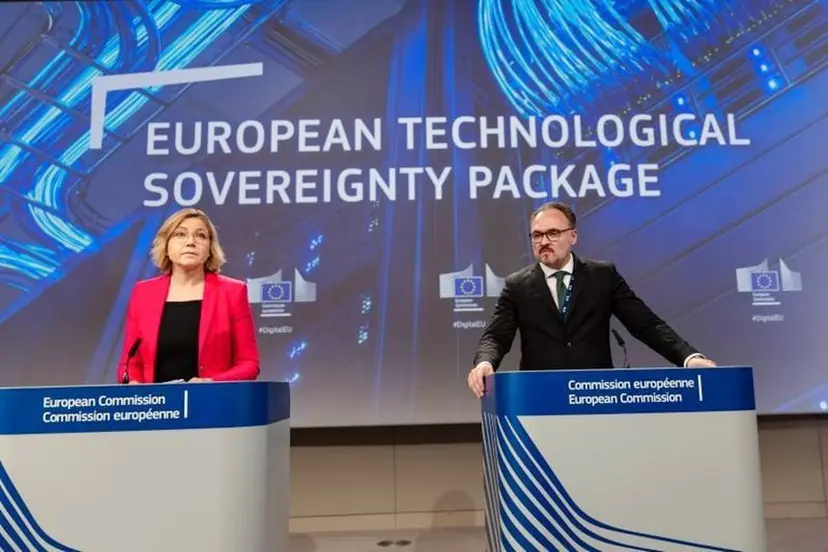
Along with this, the EU set a goal to expand its own data center capacity by more than three times the current level within the next 5 to 7 years. The strategy is to invest large-scale funds amounting to approximately 200 billion euros (around 340 trillion KRW) and drastically simplify licensing procedures to foster a 'Made-in-Europe cloud ecosystem.' However, Executive Vice-President Virkkunen acknowledged it as a 'long-term challenge,' stating, "Since 80% of our technology is imported from outside Europe, building capacity in the short term is impossible, and tangible results will appear by 2030 at the earliest."
The market is sharply divided between concern and anticipation. On the day the bill was announced, the European Digital SME Alliance, representing 40,000 tech SMEs in Europe, and French local cloud company OVHcloud welcomed it, stating, "A decisive foundation has been laid for European companies to escape infrastructure dependency on U.S. big tech and grow independently."
On the other hand, the Computer & Communications Industry Association (CCIA Europe) and the Software Alliance (BSA), which represent U.S. hyperscalers, immediately issued statements of opposition in Brussels and reacted strongly. They warned that this measure is "discriminatory protectionism that excludes global companies based on 'origin,' such as headquarters location and ownership structure, rather than technological performance," and will "ultimately lead to the technological isolation and reduced competitiveness of European companies." Some also fear that this bill could escalate into a serious trade conflict with the U.S. administration under Donald Trump.
Will the EU's drastic measure be the 'relief pitcher' that holds onto European AI companies that are departing for American infrastructure like DeepL, or will it be a 'self-defeating move' that isolates Europe from global standards? Time is running out to prove the validity of Europe's declared 'tech sovereignty.'
Author Lee Jung-woo has spent 17 years as a journalist covering various fields, including major industries such as automotive, secondary batteries, and heavy industry, as well as defense, diplomacy, environment, education, and health and welfare. He has specifically reported on-site on industrial structure changes centered on mobility, energy transition, and sustainability. Currently, he resides in Berlin, Germany, and works as a partner at the startup accelerator '123 Factory'.