

[비즈한국] CJ Bioscience311630, a leading South Korean microbiome drug developer, has overcome the biggest weaknesses of existing microbiome therapeutics—unclear mechanisms of action and failure of gut engraftment—by proposing a commercialization solution based on personalized medicine.
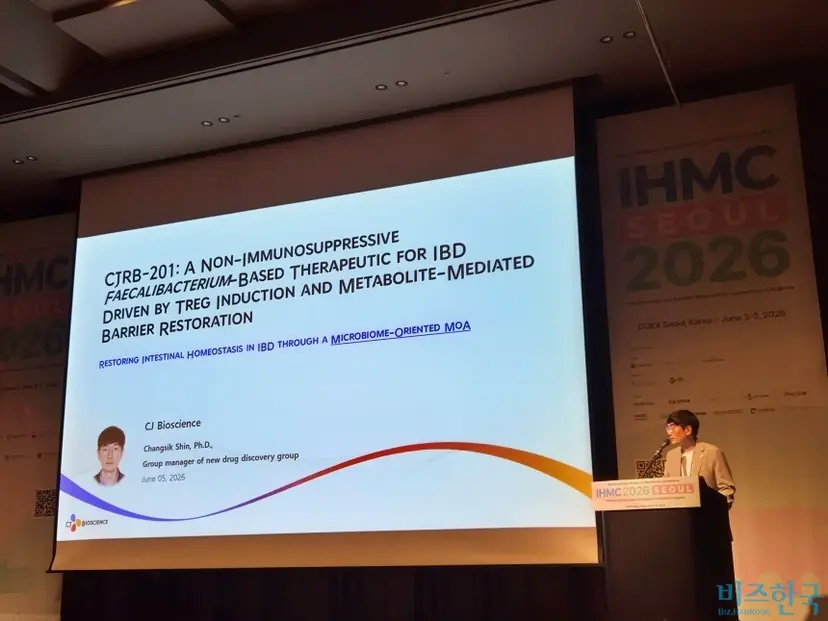
Kim Eun-ji, Head of the R&D division at CJ Bioscience, met with reporters at the 'IHMC (International Human Microbiome Consortium) 2026' held at COEX in Seoul on the 5th and stated, "We are focusing on diseases with the highest potential for success based on scientific evidence." While some in the market raised concerns that the recent suspension of clinical trials for the solid cancer treatment (CJRB-101) signaled a loss of momentum in drug development, this move is interpreted as a strategic decision to concentrate company-wide resources on 'CJRB-201,' which is currently in development as an inflammatory bowel disease (IBD) treatment.
Leader Kim serves as the head of R&D, leading the overall research. It has been about three years and six months since she joined CJ Bioscience after working at the Korea Drug Development Fund (KDDF), as a senior researcher in the healthcare division at LG Economic Research Institute, and as a director at Prescient Healthcare Group. Regarding the recent streamlining of the pipeline, she explained that it was a decision based on "selection and focus," determining that, due to the nature of the microbiome, clinical efficacy is more likely to be proven in immune diseases than in anti-cancer drugs. Leader Kim expressed strong confidence in the success potential of CJRB-201.
She stated, "Microbiomes influence numerous diseases, but we viewed immune and inflammatory regulation as their fundamental mechanism. We are focusing on IBD because we judged that immune factors are root causes of the disease, and that efficacy is easier to demonstrate when the physical location where the microbiome resides (the gut) is close to the lesion." The strategy is to compete in the IBD space, where a collapse of the gut ecosystem can directly lead to disease, rather than in cancer, where the organs may be far apart.
However, high scientific validity for a target disease does not fully guarantee commercial success. The current IBD treatment market is firmly dominated by biologics (antibody treatments) such as Humira that strongly block inflammation, so clear differentiation and competitiveness are required.
Regarding this, Leader Kim emphasized that CJRB-201 could become a true "fundamental treatment."
She pointed out, "Existing antibody treatments are drugs that control symptoms by powerfully and rapidly suppressing inflammatory reactions; however, they have significant side effects such as systemic immune suppression and limited ability to fix root causes, which eventually leads to recurrence or loss of efficacy." In contrast, she highlighted the differentiation, stating, "The root cause of IBD is the breakdown of the gut barrier, which causes harmful substances to pour in, leading to uncontrolled inflammation. CJRB-201 aims for fundamental treatment by not only acting as an anti-inflammatory but also physically restoring the compromised intestinal epithelial barrier to regain immune homeostasis."
Regarding future clinical development strategy, she explained that they are keeping both possibilities open: monotherapy with CJRB-201 and combination therapy with existing drugs. Leader Kim said, "We are thinking about monotherapy first, but because there are limitations where mild drugs are not sufficiently effective for early-stage patients before they are administered existing antibody treatments, we are also considering combination therapy with these drugs." She added, "While there is no confirmed plan, in the long term, maintenance therapy where a strong antibody treatment is used to rapidly suppress acute inflammation (flare) symptoms, followed by the administration of the microbiome treatment, could also be possible."
It is known that microbiome drugs face a high hurdle for approval by regulatory agencies such as the U.S. Food and Drug Administration (FDA) because large variations in gut ecosystems among individuals make it difficult to clearly prove the mechanism of action (MoA).
Regarding this, Leader Kim said, "Many existing live biotherapeutic products (LBPs) have struggled to identify the MoA because they often stop at explaining biological phenomena, such as 'patients got better after administering the bacteria' without knowing the specific cause. Our company is focused on identifying the mechanism of how strains interact with the human host at the molecular level, and even finding biomarkers that can clearly predict and understand clinical responses." She predicted, "If we can clearly explain why this drug works well for which patients, we can specify the patient population and dramatically increase the possibility of commercial success."
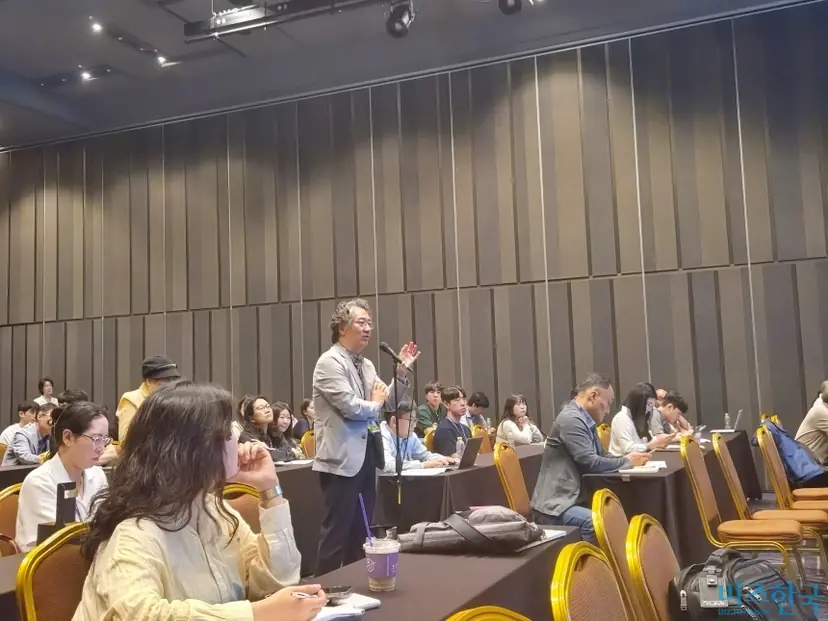
Shin Chang-sik, Head of the New Drug Research Group, supported the scientific mechanism identification emphasized by Leader Kim with concrete data. Taking the podium on this day with the topic of "Non-immunosuppressive Faecalibacterium-based treatment targeting IBD through the induction of regulatory T cells (Treg) and metabolite-mediated barrier restoration," Group Leader Shin introduced for the first time in a public setting the chain reaction mechanism of CJRB-201 and the strategy to overcome gut engraftment, which is considered the biggest hurdle for microbiome drugs. If beneficial bacteria administered externally cannot survive in the harsh intestinal mucosa and continuously secrete metabolites, but are instead excreted, the drug effect remains a one-time phenomenon and its efficacy as a new drug cannot be fully guaranteed; therefore, overcoming gut engraftment is considered a mandatory gateway for microbiome drug development.
Group Leader Shin explained, "When the carefully selected single Faecalibacterium strain, CJRB-201, is administered into the gut and secretes key metabolites such as butyric acid, it physically restores the loosened intestinal epithelial barrier and, at the same time, strongly induces 'regulatory T cells (Treg),' which are key to immune regulation, to block inflammatory signals such as neutrophil infiltration at the source." He then presented a helper microorganism, 'CJRB-203,' as the key to solving the engraftment challenge.
He emphasized, "Animal experiment results showed that when CJRB-203 was present in the gut environment, CJRB-201 was not excreted and successfully settled in the gut, producing excellent anti-inflammatory effects. Based on this, we will pursue commercialization as a personalized medicine model that pre-diagnoses the patient's gut environment to select and administer the treatment to the target patient group most suitable for CJRB-201 engraftment."
This means that the personalized wellness business based on gut microbiome testing, which CJ Bioscience announced would launch in the second half of the year, could serve as a foothold for a companion diagnostic (CDx) platform to identify future prescription targets for the new drug.
Group Leader Shin made it clear that the strategy to strengthen the wellness business is beyond simple expansion, but rather a matter of securing self-sustainability for new drug research. He stated, "It is realistically difficult to continue pouring in the enormous costs required for phase 1 and 2 clinical trials. As announced previously, we will implement a two-track strategy of rapidly creating a cash cow through the health and wellness business and using these profits to further advance new drugs."
In addition, he provided a firm countermeasure for the mass production (CMC) issue, which is considered the biggest entry barrier to microbiome commercialization. Group Leader Shin said, "We previously produced through a U.S. company, but we are currently cooperating with Chong Kun Dang Bio to proceed with the production of microbiome strains."