

[비즈한국] As some consumers turn to other coffee brands in the wake of the Starbucks controversy, price hikes across various coffee franchises continue. The industry maintains that these adjustments are inevitable due to burdens such as exchange rates and logistics costs stemming from the global situation.
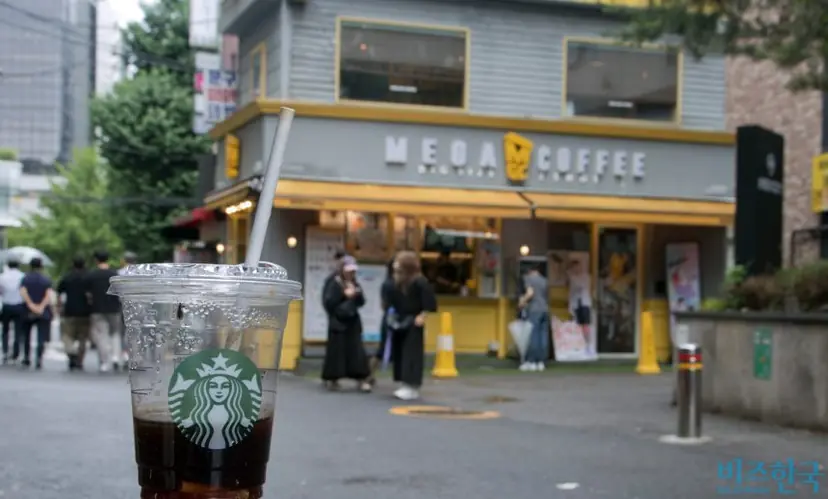
The number of consumers visiting Starbucks dropped noticeably right after the controversy. According to IGAWorks' Mobile Index, Starbucks' weekly payment volume from May 18 to 24, immediately following the 'Tank Day' controversy, was recorded at 23.69 billion KRW. This is a decrease of 8.47 billion KRW from the previous week's 32.16 billion KRW, representing a decline of approximately 26%. During the same period, new installations of the Starbucks app also fell by about 20%.
A trend of consumers seeking alternative coffee brands has emerged among those avoiding Starbucks. Recently, online communities and social media platforms have been filled with posts asking for coffee brand recommendations to replace Starbucks or sharing experiences at other franchises.
At a time when interest in choosing other coffee brands is high due to the Starbucks controversy, some coffee franchises are proceeding with price adjustments.
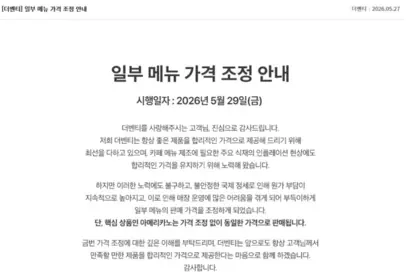
The Venti raised the prices of certain coffee and beverage items, excluding Americanos, by 100 to 500 KRW starting on the 29th of last month. The large size Vanilla Deep Latte increased from 3,500 to 3,700 KRW, while the jumbo size rose from 5,500 to 5,700 KRW. The Icheon Rice Latte was adjusted from 2,800 to 3,300 KRW.
Mega MGC Coffee also signaled a price hike. According to industry sources, Mega MGC Coffee plans to raise the prices of three items in its 'Hal-Mega Coffee' lineup by 200 KRW each, effective from the 19th. The Hal-Mega Coffee will be adjusted from 2,100 to 2,300 KRW, the King Hal-Mega Coffee from 3,200 to 3,400 KRW, and the Hal-Mega Misut-Coffee from 2,900 to 3,100 KRW.
In addition to in-store beverages, price increases have also appeared in coffee product lines. Coffee Bean Korea raised the prices of its vanilla latte stick products by 7.7–8.1% starting on the 1st.
A constant factor in explaining coffee prices is the cost of coffee beans. International coffee bean prices soared last year due to a combination of abnormal weather, poor harvests in major producing countries, and concerns over logistics disruptions resulting from instability in the Middle East. Recently, prices have entered a stabilization phase as supply conditions in major producing countries improved, falling from their peaks. International coffee futures prices, as tracked by global market data provider Trading Economics, hovered in the high 240-cent range per pound as of the 4th. This is about 14% lower than a month ago and about 30% lower than a year ago.
However, the industry explains that this current price adjustment cannot be explained solely by general coffee bean price trends. Some of the items with increased prices use ingredients like freeze-dried (FD) coffee rather than standard roasted beans. They argue that external factors such as war and exchange rates continue to exert pressure on the prices of FD coffee and other raw materials, and that burdens in labor and logistics costs have also influenced these adjustments.
A representative from Mega MGC Coffee stated, "This price adjustment was an inevitable choice to preserve franchise profits and maintain quality amid continued upward pressure on raw material costs due to external factors like war and exchange rates." They added, "The price of FD coffee, which is a key ingredient for Hal-Mega Coffee, is continuously rising, and prices for mix coffee products using similar ingredients are also on the rise. Recent price hikes should be viewed in a different context than fluctuations in general coffee bean prices."
Meanwhile, the industry maintains that these price increases are unrelated to the Starbucks situation. When asked about the connection between the price adjustments and the Starbucks incident, a representative from Mega MGC Coffee firmly stated, "They are unrelated."
Experts also believe it is difficult to view these price adjustments as a direct consequence of the Starbucks controversy. Lee Eun-hee, professor emeritus of the Department of Consumer Science at Inha University, said, "Budget coffee brands like Mega MGC Coffee or Compose Coffee would have carefully considered whether consumers would leave if they raised prices slightly, or if there were sufficient alternative choices in similar price ranges." She added, "It is more natural to see this price adjustment as a decision based on each brand's own assessment rather than the influence of the Starbucks controversy."
However, even if the price adjustments are not directly related to the Starbucks controversy, the burden felt by consumers is a separate issue. Professor Lee noted, "Because coffee is an item consumers purchase frequently, they can be sensitive even if the increase per cup is not large," adding, "For daily consumers, even a 500 KRW difference can feel like a burden."