

[비즈한국] The '2026 Joint Firepower Exercise,' held at the Seungjin Training Center in Pocheon on May 28th, was the largest of its kind in Korea in a long time. It served as a showcase for the future of the South Korean military, meticulously prepared to demonstrate the excellence of the K-Defense industry.
With 1,400 personnel from 27 units across the Army, Navy, Air Force, and Marine Corps, and a staggering 457 pieces of equipment mobilized, this firepower demonstration went beyond simple live-fire drills. It carried an ambitious plan to convey the government's commitment to self-reliant defense, the construction of a high-tech science and technology military, and, above all, to promote the practical combat superiority of K-Defense weapon systems to the world.
In fact, the footage shared from the field and on social media was nothing short of 'spectacular.' The earth-shaking bombings, artillery fire, and shooting sequences truly demonstrated the power of the South Korean military and the achievements of our defense industry.
However, it is difficult to consider this joint firepower exercise a complete success for several reasons. Above all, it lacked the realism and effectiveness required to truly showcase the future of our battlefield as an AI-powered high-tech military.
While the exercise displayed target acquisition through AI-based command decisions and reconnaissance during a scenario involving a counterattack following a defensive operation—similar to past exercises—it was difficult to argue that anything had changed from conventional command systems in terms of actual troop deployment or firepower utilization. Simply displaying reconnaissance footage on a large screen is not enough. The situation is comparable to calling a taxi via an AI-optimized route versus hailing one manually; there is no major physical difference, and it is difficult to convey how much faster or improved the AI-assisted command decision process actually is. For the current South Korean military, the understanding of how AI changes the command decision process seems to remain largely superficial.
A more persuasive 'video' explaining why AI allows for troop reductions, how it can respond rapidly to enemy threats, and how it detects camouflage or deception should have been presented on the big screen, but instead, an announcer simply narrated the virtual war situation at the venue.
Drones presented even greater problems. Although numerous unmanned aerial vehicles—including quantum drones, battalion-level drones, small reconnaissance drones, loitering munitions, and corps-level drones—appeared in this training, they were merely launched for show. Because they were difficult to see, the drone maneuvers and operations felt unrealistic, failing to convey how well drones can locate enemies or protect friendly forces.
Consequently, the joint firepower exercise felt little different from those in the past, with only an increased number of drones visible around the venue. Furthermore, in terms of aviation assets, apart from the FA-50, other key equipment like the LAH light armed helicopter or the KF-21 did not participate in the actual firepower demonstration, remaining limited to ground displays or simple fly-pasts, which was a disappointment.
There was also a lack of sophistication in the Ministry of National Defense's event concept. While it clearly functioned as an event to promote K-Defense achievements, the promotional effect was halved by the failure to invite foreign media and overseas military photographers, excluding the standard VIPs like embassy defense attachés and select media outlets. While managing the visiting groups to show the excellence of our military to the public is important, the complete lack of consideration or invitations for foreign media related to defense exports remains a regrettable oversight.
The problem is that while our joint firepower exercise struggled to find the right answers for showcasing the vision of future warfare—such as AI and drones—and for effectively promoting K-Defense abroad, competitors in the international defense market delivered terrifyingly polished events.
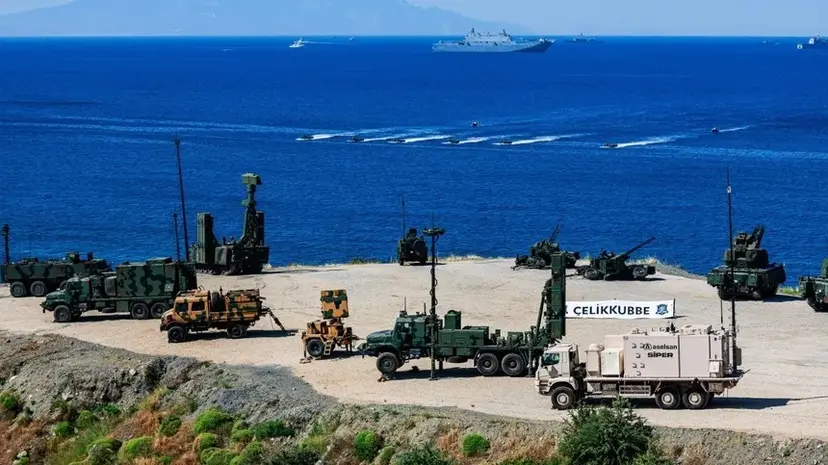
That event is 'EFES-2026,' which Turkey held from April 20 to May 21. EFES is quite similar to our joint firepower exercise in that it involves joint drills by Turkey's Army, Navy, and Air Force, demonstrates new domestic weapons with live-fire sessions, and, most importantly, serves as a major sales venue for the defense industry.
The differences lie in operation, scale, and timing. Unlike our joint firepower exercise, which consists of a few rehearsals and a main event, EFES is held continuously over a month, with professional observers invited on specific dates. Additionally, because the training site is located along a coast with access to both the sea and hills, it allowed for multi-dimensional operations, such as launching drones from naval vessels and conducting amphibious landings, along with separate nighttime live-fire drills. In other words, it is not an event staged merely for guests, but a real military exercise where observers are invited for a few days, fundamentally different from our 'exercise' in name only.
As a result, Turkey successfully demonstrated a variety of capabilities during EFES. They showcased the 'Steel Dome' integrated missile defense system currently under development and displayed live-fire sequences of around 20 KARGU drones using AI swarm functions. They were more successful than us in demonstrating AI and drone weapon systems because they did not try to show everything on a single day for VIPs, but rather distributed the demonstration programs to suit specific purposes, while still maintaining VIP invitations for defense and government promotion.
In terms of defense sales, there is much to learn from Turkey's EFES. During the final two days, Turkey invited overseas defense industry officials and attachés. While showing demonstration fire, they also set up a defense industry exhibition on-site, allowing over 50 Turkish defense companies to conduct direct consultations with weapons procurement officials from various countries.
Of course, there are clear disadvantages for Korea compared to Turkey. EFES spans a longer period, involves 10,000 personnel, and is an international joint exercise with over 1,000 foreign troops from 50 countries participating. Our training grounds also make it difficult to secure space for simultaneous amphibious operations and artillery fire. However, the Turkish approach of integrating defense industry promotion into long-term, genuine military training periods and closely linking it with overseas defense sales programs is a firepower demonstration model that we clearly need to learn from.