

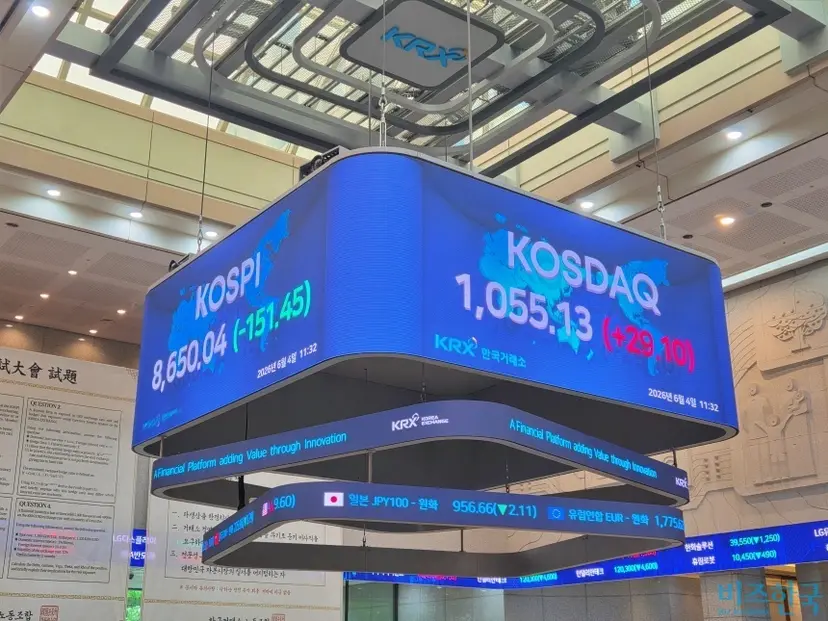
[비즈한국] The protagonists of the recently surging stock market are undoubtedly semiconductors and AI. While the overall index is rising, the reality is that pharmaceutical and biotech stocks have struggled to keep pace. With overlapping issues such as clinical delays, a drought in licensing deals, and the burden of interest rates, investors have focused more on 'risk' than 'expectation' in the biotech sector. Amidst this, Hanmi Pharmaceutical and Oscotec have recently secured back-to-back trillion-won licensing deals, which are being evaluated as a catalyst for a turnaround. Attention is focused on whether these achievements can act as a signal to revive sentiment across the stagnant K-biotech sector.
Autoimmune Disease Treatment 'Cebidoplenib' Licensing Deal Worth 1 Trillion Won Signed
Yoon Tae-young, CEO of Oscotec, stated at the 'Cebidoplenib Licensing Explanation Session' held at the Korea Exchange in Yeongdeungpo-gu, Seoul, on the morning of the 4th, "We will invest significant funds into Cebidoplenib to cultivate it as our next pipeline." On the 1st, Oscotec achieved a milestone by signing a licensing agreement for the autoimmune disease treatment 'Cebidoplenib' with U.S.-based biotech company Agios Pharmaceuticals (Agios), worth a total of $665 million (approximately 999.5 billion won), including an upfront payment of $25 million (37.5 billion won). This follows their success last December in licensing the Alzheimer's treatment 'ADEL-Y01' to Sanofi for up to $1.04 billion (1.53 trillion won).
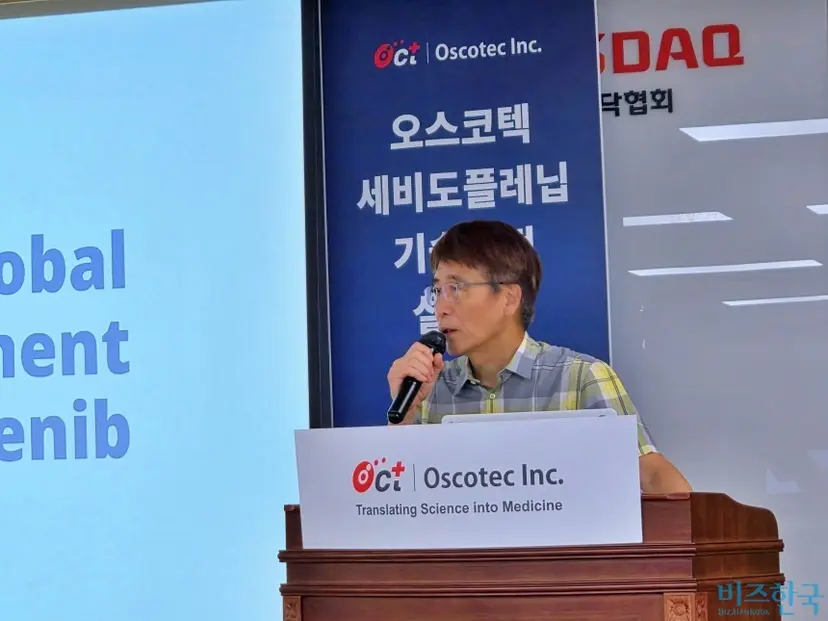
Regarding Cebidoplenib's market competitiveness, CEO Yoon noted, "It is far superior in terms of tolerability and safety, such as fewer gastrointestinal side effects, compared to competing drugs," and pointed to its potential to expand beyond ITP to other indications like warm autoimmune hemolytic anemia (WAIHA) as a key strength. Regarding the use of the large cash inflow from this contract, he added, "We will not only focus on our existing oncology pipeline but also aggressively expand our pipeline through open innovation and co-development to prepare for our next growth engine."
Through an R&D roadmap up to 2030, CEO Yoon presented a vision of achieving two or more additional licensing deals around 2027-2028, naming anti-resistance oncology drugs and fibrotic disease treatments as the next growth engines following Cebidoplenib. He emphasized, "As the legacy pipelines that have led the company have been successfully transferred, we plan to focus entirely on anti-resistance oncology drugs and related fibrosis pipelines for the next 3 to 4 years." Accordingly, Oscotec plans to accelerate the clinical development of its proprietary pipelines, 'OCT-598' and 'OCT-648.' Furthermore, the long-term strategy is to go beyond research focused on existing small-molecule compounds and push for expansion into new modalities and disease areas.
Regarding their partner, Agios, CEO Yoon expressed confidence in the commercial success of Cebidoplenib, stating, "They are a highly capable partner that sold off their oncology division to pivot entirely toward rare blood diseases, successfully taking drugs from Phase 1 clinical trials to approval on their own." Agios is a Nasdaq-listed company that has been focusing its capabilities on rare blood diseases since selling its oncology business unit to France's Servier for $2 billion in 2021. Agios plans to conduct Phase 3 clinical studies for Cebidoplenib, focusing on immune thrombocytopenia (ITP), and continue Phase 2 proof-of-concept studies for indication expansion.
Short Bowel Syndrome Treatment 'Sonepeglutide' Hits 1.9 Trillion Won Licensing Jackpot
Hanmi Pharmaceutical also kept the K-biotech winning streak alive by hitting a massive jackpot with its own platform technology. On the 31st of last month, Hanmi Pharmaceutical signed a licensing agreement with global pharmaceutical company Eli Lilly for the short bowel syndrome treatment 'Sonepeglutide.' It is a large-scale contract totaling $1.26 billion (1.8973 trillion won), including an upfront payment of $75 million (112.9 billion won), making it the second-largest licensing deal in Hanmi Pharmaceutical's history, following the 'Quantum Project' licensed to Sanofi in 2015 for 3.9 billion euros (approximately 4.8 trillion won). Simultaneously, this achievement comes about six years after licensing the metabolic dysfunction-associated steatohepatitis (MASH) treatment 'Efinopegdutide' to MSD in 2020 for a total of $870 million (approximately 1 trillion won).
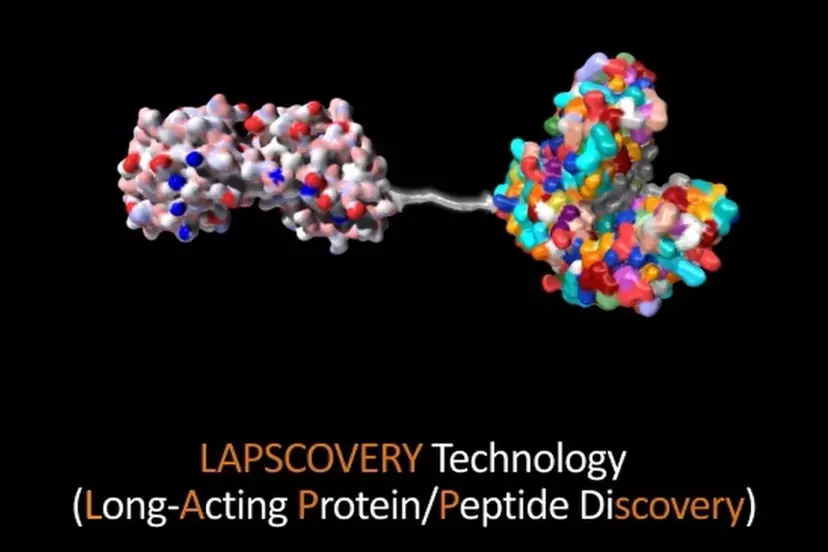
Sonepeglutide is characterized by drastically increasing the duration of drug efficacy in the body based on 'LAPSCOVERY,' Hanmi Pharmaceutical's proprietary long-acting platform technology. It targets patients with short bowel syndrome, a rare disease where nutrient absorption is difficult due to a shortened small intestine caused by congenital abnormalities or bowel resection surgery. In particular, unlike existing treatments that require daily administration, it is being developed as a 'once-monthly' injection, which is considered competitive because it significantly improves the convenience and compliance of patients who require long-term treatment. It has not only been designated as a 'fast track' by the U.S. FDA but has also been designated as an orphan drug by regulatory authorities both domestically and internationally. It is currently in the global Phase 2 clinical stage.
Maeng Ji-woong, Executive Director of the L&D Strategy Team at Hanmi Science, the holding company of Hanmi Pharmaceutical, evaluated, "This licensing deal has special significance in that it goes beyond the success of a single pipeline and proves once again that the platform-centered R&D capabilities Hanmi has accumulated are recognized in the global market." He added, "With five new drug candidates, including the obesity drug 'Efpeglenatide' and the neutropenia treatment 'Rolontis' which apply the LAPSCOVERY technology, in the global clinical stage, we expect this achievement will further expand interest in Hanmi's overall new drug pipeline." Executive Director Maeng is reported to have led this contract.
He added, "Sonepeglutide was highly evaluated for the reliable scientific data accumulated through global conference presentations and clinical data, while simultaneously conducting various indication studies based on its mechanism of action. It is a turning point that created structural synergy where research achievements are connected to business value through organic cooperation between the holding company and the business unit."
The industry expects this achievement to serve as a catalyst to revive investment sentiment in the pharmaceutical and biotech sector. Jeong Yoon-taek, President of the Pharmaceutical Industry Institute, evaluated, "As large-scale licensing deals have acted as a starting point for a joint rise across the sector in the past, I believe this series of good news can turn the stagnant market flow around."
He continued, "At some point, it could lead to a 'gap-filling' market trend for KOSDAQ biotech stocks that have been relatively neglected compared to KOSPI large-cap stocks," and forecasted, "As biotechnology is a future industry as promising as semiconductors, this achievement will become a powerful momentum for market funds to flow back into the biotech sector and emerge as a leading industry."