

[비즈한국] Gen Z is embracing the 'Yajang' (outdoor street dining) culture as hip. Foreigners also perceive Korean Yajang as spaces where they can experience the 'K-vibe.' It is sometimes even interpreted within the context of traditional Korean culture. In fact, our ancestors often went out to mountains and fields, laid down mats, and enjoyed food. 'Yayuchoe' (field excursion) refers to a gathering enjoyed in the open fields. Typically, in spring or autumn when the weather was pleasant, people would go out into nature in groups to share food and play games. As recently as the early 2000s, it was a very common scene for families, friends, and couples to grill pork belly (samgyeopsal) in outdoor parks. (Now, grilling pork belly in parks or on mountains is illegal.) Such outdoor culture remains in the form of urban Yajang.
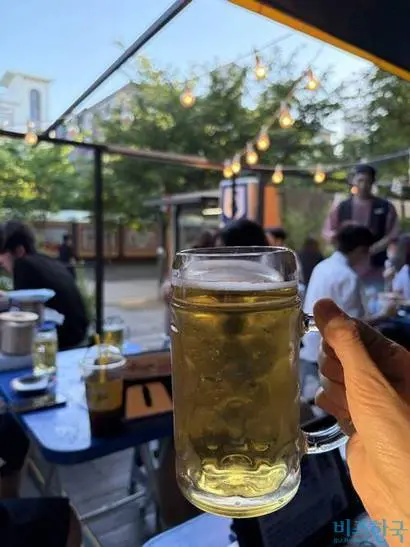
Yajang can be thought of as a night market, an outdoor marketplace, or an abbreviation for an outdoor nighttime establishment. It is also defined as a street culture in Seoul, mainly enjoyed at night, where tables and chairs are set up outdoors to welcome guests. Euljiro and Jongno are the centers, but it is not non-existent in the provinces. It can be found in places like Busan, Yeosu, and Ansan as well. Since it is popular, a 'Yajang map' has even been created. There are several types: roadside tables, folding-door/open-window pochas (street stalls), rooftops, and outdoor spaces (gardens, riverside, courtyards). In particular, the type where tables are set up outside of a business or store at night—often called 'laying out a Yajang'—is the classic form.
Then why is Yajang receiving attention? From a classic perspective, the 'third place' aspect stands out. American sociologist Ray Oldenburg mentioned the 'third place' theory in his book, 'The Great Good Place' (1999). He argued that people need three types of places to live: the first place is the home, the second place is the workplace, and the third place is a local communal space. He highlighted the importance of a third place where diverse people mingle without a specific purpose.
A third place is an informal public space for relieving stress and interacting comfortably with others, characterized by several traits. It is not a flashy, decorated space but one with a comfortable, unpretentious atmosphere; it maintains a fun and pleasant vibe; and it is a free space where one can stay or leave at any time. Furthermore, it is a level playing field where anyone is welcomed as a visitor regardless of social status or background, and it is a space that is close, easily accessible, and always open. Local pubs also fall into this category. However, this is not just a pub; it is a Yajang. The open-air nature of Yajang allows for easy coming and going, its urban location makes it accessible, the bustling atmosphere lifts the mood, and it fosters a sense of participation by mingling with others.
Additionally, the psychology of 'space appropriation' is at work. In 1991, Henri Lefebvre spoke of the phenomenon of "free appropriation of space for personal and social purposes." 'Appropriation' means utilizing space in one's own way. The stronger the control of space through power, the more satisfaction the appropriation of that space provides; Yajang can be said to be a way of providing a sense of liberation in these controlled and compartmentalized urban spaces. Restaurants or pubs that are normally closed or restricted to interiors during the day open their doors wide at night or place tables outside, allowing for the experience of expanding into streets or plazas. Moreover, when enjoying oneself with many people, even the noise feels emotional.
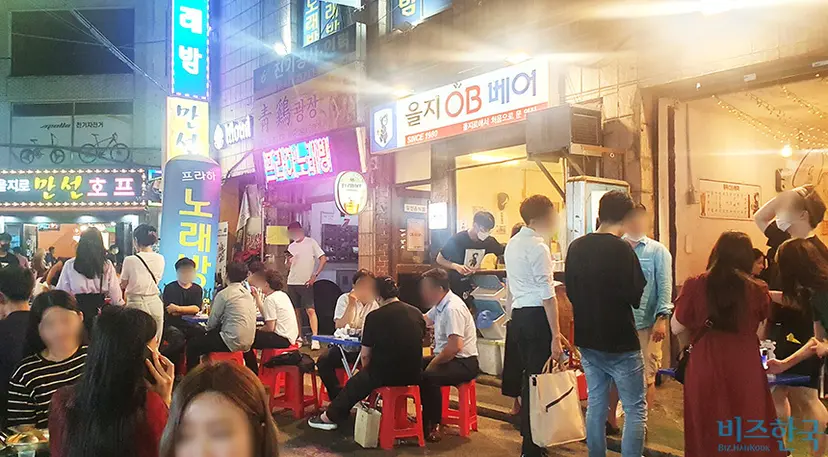
This psychology existed in the past as well. We must consider what makes it appealing to people in their 20s today. First, we can talk about the emotional and aesthetic experience. A space where one can feel the gentle breeze, chat to one's heart's content with acquaintances under urban lights as dusk falls, makes one feel truly alive.
Most of Gen Z was born and raised in dense residential spaces. They even live in more crowded spaces like dormitories or 'goshiwons' (study rooms), and spend their days working in concrete buildings. At work, they are trapped in non-face-to-face content or tasks. Since the COVID-19 pandemic, non-face-to-face interactions have strengthened, and human relationships have been restricted. While individual privacy and rights are guaranteed, the desire to connect cannot be ignored. However, they dislike forced gatherings that feel like an obligation. As seen in 'Gamtwi (Fries) Gatherings' or 'Gyeongdo Play,' socializing through loose solidarity is comfortable and important to them. Unlike the regulated and controlled urban spaces during the day, they can taste a sense of liberation in the Yajang at night.
This aspect is not limited to Korea. The same can be said for young people in their 20s overseas. Nightlife is relatively less developed in Korea, and foreign visitors cannot just participate in night programs at royal palaces. Yajang can be a classic example of 'dailycation' (daily vacation)—a travel style where one enjoys and shares the lives of Koreans in urban spaces, experiences the daily life of Koreans exactly as it is, and follows local trends. Staying-type tourism through overnight stays is also important for local regions because it boosts consumption.
Of course, there are cases where Yajang is illegal. Sometimes it can be a nuisance. In fact, the 'illegal' aspect also provided a sense of strange, deviant pleasure. Recently, local governments like Jung-gu and Jongno-gu in Seoul have been improving Yajang in a legal direction. Merchants, customers, local governments, and the nation as a whole must find ways to coexist, and that must be based entirely on the hearts of the people. There is a need to more carefully consider what the young generation and the future generation want.
The author, Kim Heon-sik, has been walking through or navigating the forests of popular culture phenomena since his 20s, with the expectation that there is a way to make the world better through culture. Even in the 21st century, where AI and quantum computers are active, he continues to walk the same path with the same belief.