

[비즈한국] As the scale of domestic pharmaceutical production grows, the volume of waste medication collected from households is also on the rise. However, there is no system in place that requires the pharmaceutical companies that produce and sell these drugs to bear the costs of their recovery and disposal. This is why some are pointing out that we need to discuss a structure where the pharmaceutical industry also shares in the costs and responsibilities, moving beyond just expanding government and local authority-led collection networks.
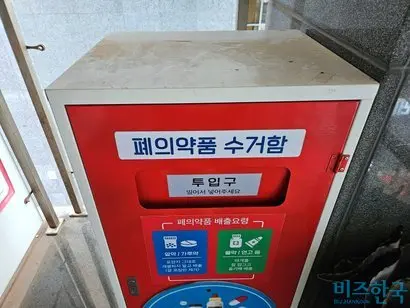
Waste medication is not just ordinary household waste. If discarded as general trash or flushed down the drain, pharmaceutical ingredients can leach into soil and streams. This raises concerns about potential impacts on ecosystems and long-term harm to the environment and human health. This is precisely why the government and local authorities collect and incinerate waste medication separately.
According to the Ministry of Food and Drug Safety, domestic pharmaceutical production reached 32.8629 trillion won in 2024, the highest figure since statistics were first compiled in 1998. As production and consumption grow, the amount of waste medication collected has also increased. Based on data from the Ministry of Climate, Energy and Environment, the national collection volume rose from approximately 487 tons in 2021 to 713 tons in 2022 and 772 tons in 2023. While the burden of collection, transportation, and incineration grows with the volume, there is no obligation under the current system for the pharmaceutical companies that produced and sold these products to cover these costs.
The collection system for household waste medication did not start out as a purely local government-led initiative. When the recovery and disposal system was first established through a public-private partnership led by the Ministry of Environment in 2009, the government, the Korean Pharmaceutical Association, the pharmaceutical industry, and pharmaceutical wholesalers all shared responsibilities. The pharmaceutical industry was responsible for infrastructure support, such as producing and distributing collection boxes, while pharmaceutical wholesalers took on the role of transporting waste medication gathered at pharmacies to public health centers and other facilities.
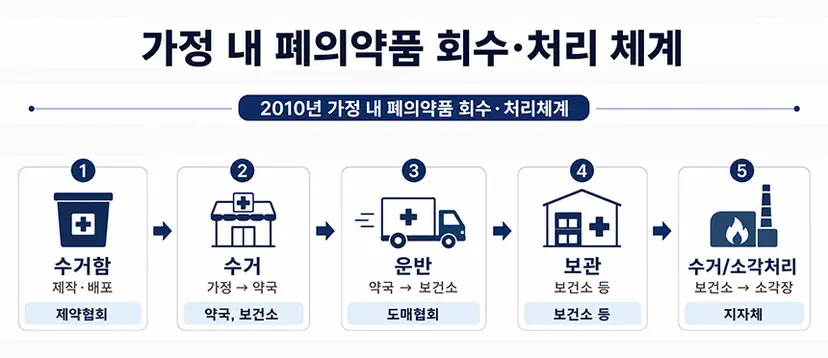
Since then, the focus of system reforms has shifted toward expanding public collection networks rather than strengthening the responsibilities of the pharmaceutical industry. The "Improvement Plan for Waste Medication Recovery and Disposal Systems" released by the government in 2023 focused primarily on collection boxes at community centers and apartment complexes, post boxes, and regional disposal plans. The roles of pharmaceutical companies and wholesalers, which were prominent in the initial system, have faded. While the collection network has widened, the responsibility of the producers and sellers—the pharmaceutical companies—remains outside the institutional framework.
It is not that the government has never considered the responsibilities of the pharmaceutical industry. When the Ministry of Environment (now the Ministry of Climate, Energy and Environment) expanded the waste medication recovery and disposal project nationwide in 2010, it announced plans to grant recovery and disposal responsibilities to pharmaceutical companies through amendments to relevant laws in the second half of 2011. However, this plan has yet to be institutionalized.
The pharmaceutical industry is not entirely inactive. Some pharmaceutical companies are participating directly in waste medication collection or conducting related campaigns. In 2021, Dong-A Pharmaceutical signed a waste medication collection agreement with the Korean Pharmaceutical Association and Yongma Logis to provide collection boxes and related supplies. Bayer Korea also conducted a campaign on June 1st to educate the public on the correct way to dispose of waste medication. The problem is that these activities are not mandatory. Participation and methods vary by company. Many are one-off projects, such as providing collection boxes, distributing promotional materials, or running employee campaigns. These fall short of a structure where the entire industry consistently shares the costs of collection, transport, and incineration.
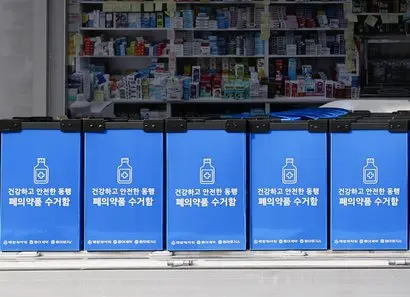
Overseas, there are cases where the cost of waste medication disposal is not left solely to the public sector. According to the OECD, France has included pharmaceuticals in its Extended Producer Responsibility (EPR) system since 2009, requiring pharmaceutical companies to bear the costs of collecting and disposing of unused medication from households. The recovery and disposal of unused drugs returned by individuals to pharmacies are handled by a non-profit producer responsibility organization called Cyclamed, with participation from pharmaceutical companies, wholesalers, and pharmacies. Given that the volume of waste medication is continuously rising, it seems necessary for South Korea to move beyond just expanding collection networks and discuss plans for the pharmaceutical industry to cover a portion of the costs.
Pharmaceutical organizations are calling for similar institutional improvements. 'Pharmacists for Healthy Society' has argued that pharmaceutical manufacturers and distributors must participate in the recovery and disposal system to reduce the environmental impact of waste medication. They also suggested considering methods such as paying contributions proportional to sales volume or operating a producer responsibility organization.
Meanwhile, the pharmaceutical industry remains cautious about institutionalizing responsibility for household waste medication recovery and disposal. They argue that because waste medication is often discharged as a mix of products from various companies, the criteria for cost-sharing and fairness must be carefully designed. A representative from the pharmaceutical industry noted, "Waste medication covers a broad scope, and it is difficult to identify which company's product is which. If institutionalization is necessary, we believe a method based on metrics like sales proportion per pharmaceutical company would be more realistic."