

[비즈한국] On the subway on your way home. As you mindlessly scroll through your smartphone, a sudden thought occurs: 'I want to create something, too.' Watching someone else's feed that looks like a magazine, or receiving a stylish newsletter, gives you a tickle in the corner of your heart. But the moment you try to start, the same words always hold you back: 'What could someone like me possibly do?' The three great lies of modern people: "I need to go on a diet," "I need to study English," and "I need to start a YouTube channel." Somewhere around that periphery, the desire is always pushed to the next day.
'Miracle Editing' is a book that beckons precisely toward that deferred heart. It was written by three editors who founded 'The Edit' and have been running a content company for over 10 years. Starting as a taste-based online magazine, The Edit has expanded into Instagram, newsletters, and YouTube, with a combined following of 1.3 million across various channels. The company, which began with 5 million won in capital and a single idea, has exceeded 3 billion won in annual revenue. What makes this book interesting is that it doesn't boast about those numbers like a success story. Instead, it quite honestly lays out the hesitation, trial and error, anxiety, money talk, platform fickleness, and the breath of people who must continue to create to survive.
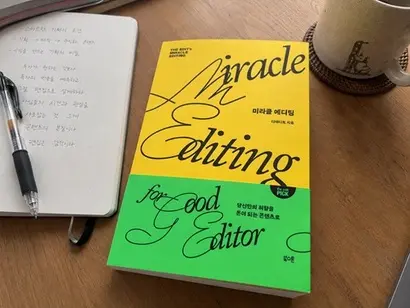
The book's title is bold. 'Miracle,' no less. There are so many books in bookstores these days that claim to change your life, and usually, once you finish reading them, only your mood changes, not your life. The authors are aware of this embarrassment. In the appendix, they jokingly refer to the title 'Miracle Editing' and ask, "Doesn't it sound too much like a practical guide?" But they soon reach a conclusion: "If you write about what AI cannot do, it is practical." The strength of this book lies exactly here. Instead of grandiose success formulas, they share what they actually tried, failed at, and corrected. So, the miracle mentioned in this book is not a miracle that strikes like lightning. It is a literally miraculous 'result' that is only occasionally granted to those who upload, edit, observe reactions, and create again every single day.
Above all, this book expands 'editing' from a professional skill to a life skill. It doesn't just talk about how to write good sentences. It talks about how to decide what to keep and what to discard, how to translate your experiences into the language of others, and how to make what you love something others want to see as well. The authors write, "Editing is fundamentally the act of selecting and refining something to make it better." That is why they say there is no magic without the raw material. Don't hide behind perfectionism; "It's okay if it looks sloppy, just write it, film it, and post it." This sentence is the most realistic piece of advice that runs through the entire book. What people who want to create content lack most is usually not talent, but a first draft. The world is more forgiving of a slightly clumsy first post than a perfect plan that doesn't yet exist.
The book follows four major flows: Discovery, Attempt, Growth, Expansion, and Sustainability. It begins by describing how the three editors entered the world of content, and subsequently covers how to imagine the consumer, how to start by imitating, how to create a character, how to handle algorithms and thumbnails, and how to connect good content to profitable content. While it wears the outer shell of a practical guide, it is closer to an essay, and while it reads like an essay, the content is quite practical. That's why you feel a strange sense of relief while reading it—the relief that creating content is not a task for geniuses, but for people who keep putting it out there even while feeling embarrassed.
A particularly impressive part is the advice to keep 'yourself' at the center, but not be trapped by 'yourself.' The authors say that while it is true that content starts from you, it doesn't mean the destination has to be just you. "Readers might seem like they are coming to see your world, but in reality, they want to take away the pieces they need for themselves." Misconceptions surrounding content often arise here. We want to show how special we are, but readers ask what they are left with. Bridging this gap is what editing is all about. It is the act of balancing between self-expression and delivery, between taste and marketability, and between what you want to say and what needs to be heard.
This book feels more realistic because it doesn't shy away from talking about money. Many books on content soothe readers with the phrase, "If you make it well, people will recognize it eventually." It's a nice sentiment. However, you can't pay your rent with nice sentiments. 'Miracle Editing' does not treat good content and profitable content as opposites. "Good content and profitable content are not mutually exclusive. Only those who believe that a design that makes both possible can succeed will be able to do this work for a long time." This sentence may well be the most expensive lesson The Edit has learned over the last 10 years. This book contains neither the romanticism that one must avoid money to keep content pure, nor the cynicism that anything goes as long as it makes money. Instead, it argues that to make good things for a long time, you must even edit for a sustainable structure.
The perspective on the AI era is also interesting. The authors don't try to scare readers by saying AI will replace all writers. Yet, they don't romantically urge us to hold out against it either. Instead, they view that what AI has eliminated is the 'fear of writing,' and what it has left for humans is the more essential time for trial and error. What will be more important going forward is not the ability to produce sentences, but the ability to judge what to ask, what to choose, what context to bundle it in, and to whom and in what language to deliver it. The authors' belief that the editing human will not disappear even if the tools change comes from here.
Of course, this book won't turn everyone into a content entrepreneur. Reading one book won't suddenly increase your followers, sell your newsletter, or bring in advertising offers. The authors know that, too. So, rather than a book that promises miracles, this is a record of people who, even while feeling embarrassed by the word 'miracle,' refuse to give up on it. In the epilogue, the authors confess that they chose the title 'Miracle Editing' "armed with the determination to sell the book, using a confident and arrogant title as a shield." I like this honesty. Because creating content is, in the end, the work of enduring between self-confidence and self-doubt.
'Miracle Editing' is not just for people who want to become editors. It is better suited for those who want to create something under their own name outside of the office, those who want to run their Instagram account a bit more elegantly, those who want to start a newsletter but can't get past the first sentence, or those who create content every day but are sometimes confused about what they are actually doing. This book says: your daily life is already material. The important thing is how you choose, trim, arrange, and change it into a form that can reach others.
Ultimately, editing is an attitude toward life. It is the act of deciding what to grasp from the information, experiences, and emotions that pour out every day. It is about having your own taste, but changing it into a shape that can fit into the time of others. So, after closing this book, you'll want to open a small account rather than a grandiose business plan. It's fine if it's not perfect yet. No, it is because it is not perfect that you can start. Miracles usually arrive with that very face: a clumsy first post, a first sentence you want to delete, a first awkward attempt. And to the person who makes another one the next day.