

[비즈한국] It has been confirmed that before the collapse at the Seosomun Overpass demolition site in Seoul, the Korea Authority of Land & Infrastructure Safety (KALIS) had requested the Seoul Metropolitan Government to establish a reinforcement plan, including the installation of temporary supports. The Seoul Metropolitan Government had previously explained that, according to the design, the stability of the girders was sufficient, making temporary supports unnecessary. However, with the revelation that a reinforcement plan based on the demolition sequence was suggested as a corrective requirement during the safety management plan review phase before construction began, the key issue has become whether this recommendation was actually reflected in the safety measures at the site.
According to documents obtained by Bizhankook from the office of National Assembly member Moon Jin-seok, KALIS proposed "confirmation of structural safety review, including reinforcement plans during dismantling" as a corrective requirement during the review of the Seosomun Overpass demolition safety management plan submitted by the Seoul Metropolitan Government in October last year and January this year. Specifically, it demanded: △preparation of a dismantling sequence chart based on structural safety reviews, △verification of the adequacy of load analysis (checking load analysis data for dismantling equipment), △verification of structural safety review results for major members based on equipment movement paths and dismantling sequences, and △establishment of reinforcement plans based on dismantling sequences, such as temporary supports.
A safety management plan is a plan established by contractors and others to prevent safety accidents during construction prior to the start of work. Under the Construction Technology Promotion Act, contractors must establish a safety management plan before starting construction and receive approval from the project owner. To ensure construction safety, KALIS reviews the safety management plans submitted by the project owner and can issue corrective orders or take other necessary measures. The Seosomun Overpass demolition, ordered by the Seoul Metropolitan Government, is classified as a Category 2 facility project, making it subject to the establishment and review of a safety management plan.
The notable point is the request from KALIS to establish reinforcement plans such as temporary supports. It appears that no temporary supports were installed to reinforce structural safety during the Seosomun Overpass demolition process. The Seoul Metropolitan Government's stance had been that temporary supports were unnecessary because the girders (beams connecting columns) were well-supported by the overpass structure. However, it has been confirmed that the relevant authorities had requested the establishment of reinforcement plans, including temporary supports, twice during the review of the safety management plan before the project began.
Lim Chun-geun, Head of the Seoul Metropolitan Government's Infrastructure Headquarters, addressed the lack of safety devices in a briefing on the 27th regarding the accident. In response to a reporter's question, he stated, "When looking at the design details at the time the demolition plan was initially established, it was determined that there were no major issues with the safety of the girders. Therefore, it was planned to cut and lift [the overpass deck] as it was. Because of this, I speculate that it might have been difficult to anticipate a collapse of the girders themselves at the site.”
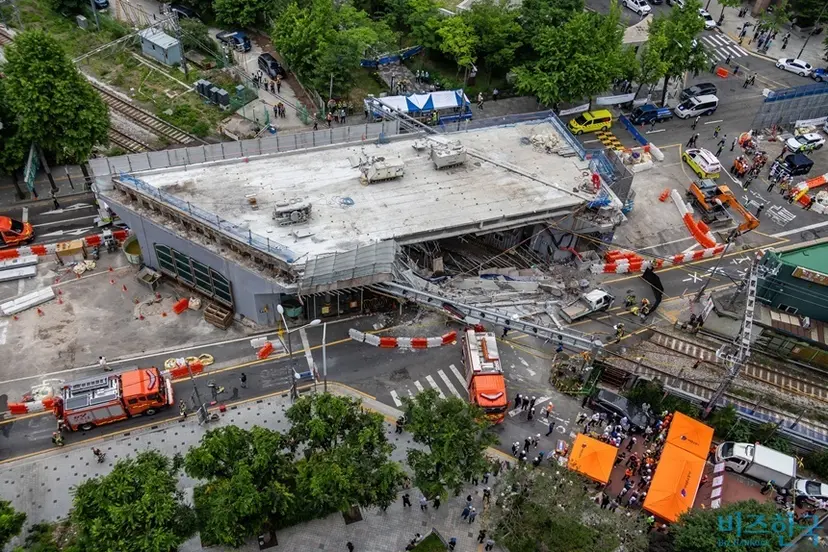
Meanwhile, the Seosomun Overpass collapse resulted in 6 casualties. The accident occurred at approximately 2:33 PM on the 26th at the railway crossing section of the Seosomun Overpass in Seodaemun-gu, Seoul. According to the Seoul Metropolitan Government, abnormal signs, such as a portion of a girder sagging, were identified during deck cutting work on the morning of the accident, and the structure subsequently collapsed during an inspection. Three people, including the site manager, the head of the construction supervision team, and an outside expert, were killed, and three others, including officials from the Seoul Metropolitan Government and Seodaemun-gu, sustained serious injuries.
The Seosomun Overpass is an aging structure approaching its 60th anniversary. Completed in 1966 with a length of 493m, it has served to connect traffic between Seoul Station and the Chungjeong-ro area. However, the decision to demolish it was made due to recurring defects such as concrete shedding from piers and damage to the deck and beams, as well as a 'D' grade received in a recent precise safety diagnosis. The demolition was ordered by the Seoul Metropolitan Government's Infrastructure Headquarters. Heunghwa was responsible for construction, while Soosung Engineering handled the supervision. The construction period was from April of last year to July of this year, and the progress rate was 88% at the time of the accident.
Choi Myung-ki, a professor with the Korea Industrial Site Professors Association, stated, "The fact that KALIS requested a structural safety review and the establishment of reinforcement plans like temporary supports means they identified risks in the dismantling process." He added, "If the structural review determined that temporary supports were not needed, there must be supporting data. If not, reinforcement measures such as installing supports or securing the structure with cranes should have been implemented." He pointed out, "If these suggestions were not reflected in the actual safety management plan and site measures, they can be seen as factors that increased the risk of an accident."