

[비즈한국] Following its Express business division, Homeplus has embarked on the sale of its remaining business units, including hypermarkets and its online mall. Homeplus emphasizes that any acquirer could immediately become the third-largest player in the industry. However, market observers predict that the sale will not be easy due to weakened online competitiveness and the ongoing downturn in the hypermarket sector.

Will the “Third in the Industry” Selling Point Work?
Following the sale of its Express division, Homeplus is now moving to sell its headquarters, hypermarkets, and online mall. Homeplus announced on the 25th that it is officially starting pre-rehabilitation M&A procedures for its remaining business units, excluding Homeplus Express. It is reported that the company has begun the sales process by sending teaser letters to potential buyers through its lead manager, Samil PwC.
This sale is notable for being conducted through a public bidding process rather than the 'stalking horse' method pursued last year. A stalking horse is a method where a conditional contract is signed with a lead bidder in advance, followed by a competitive bidding process. In contrast, a public bidding process is structured to solicit interest from the broader market without pre-selecting a candidate.
Industry experts believe Homeplus chose public bidding over the stalking horse method—which involves long-term negotiation of conditions with a specific candidate—because it allows for a quicker assessment of market interest as the deadline for the rehabilitation plan approval approaches. The deadline for Homeplus's rehabilitation plan is July 3rd, leaving only about a month.
Homeplus is highlighting its nationwide store network and online business infrastructure as its core strengths. The company is emphasizing the appeal of the acquisition, stating, "If a company that does not currently own a hypermarket chain acquires us, it can immediately rise to become the third-largest player in the domestic hypermarket industry.”
However, market sentiment remains cautious. There is significant skepticism about the actual appeal of the remaining Homeplus businesses due to the cooling hypermarket sector and intensifying e-commerce competition. Lee Jong-woo, a professor of Distribution and Marketing at Namseoul University, stated, “11st also pursued a sale for a long time but failed to find a buyer. Homeplus's online mall lacks distinct competitiveness,” adding, “It won’t be easy to put the hypermarket business back on track in a short time, as it has already lost a considerable portion of its potential customer base.”
Some suggest paying attention to the individual value of core store assets. While the hypermarket business is struggling, some argue that key stores in the metropolitan area could attract interest as real estate assets. Seo Yong-gu, a professor of Business Administration at Sookmyung Women’s University, said, “If Homeplus proceeds with a piecemeal sale focusing on key metropolitan locations, there is a possibility that buyers focused on real estate value rather than operational value might show interest.”
Meritz's Additional Support is the Key
Homeplus previously moved to secure liquidity by selling its Express division, considered a core asset, to NS Home Shopping, an affiliate of Harim Group. NS Home Shopping signed a business transfer agreement with Homeplus on the 7th. The expected acquisition date is June 22nd, when the payment is also expected to be made.
The market evaluates that this sale alone is insufficient to resolve Homeplus's financial difficulties. The sale price of the Express division is reported to be around 120.6 billion KRW, which analysts say falls short of market expectations.
On the 10th, Homeplus effectively began a desperate struggle for survival by temporarily suspending operations at 37 stores nationwide. The strategy is to stop running stores with low sales contributions and focus product supply on the remaining stores to facilitate a revenue recovery.
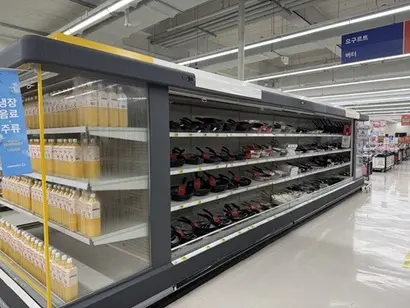
However, the situation at the remaining stores has not improved significantly even after the store optimization efforts. A Homeplus store visited on the 28th still showed continued disruptions in product supply. Most shelves were filled primarily with Homeplus private brand (PB) items, and the refrigerated and processed food sections were filled with household goods due to a lack of sellable stock. A store employee said, “Product supply has not yet normalized, and it is difficult to know when deliveries will become smooth again.”
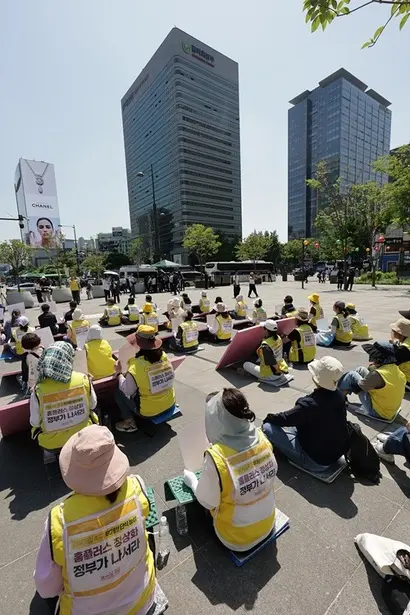
The Homeplus branch of the Mart Industry Union held a press conference on the 28th, appealing, “We have not been paid properly for two months, and the shelves are increasingly becoming empty. If this continues, the lives of hundreds of thousands of workers and small business owners will collapse, and the local economy will fall with them.” They added, “The government must stop neglecting Homeplus and make a decision. Please prepare normalization measures through the selection of a UAMCO manager and the injection of public funds.”
In the industry, it is predicted that since Homeplus's self-liquidity 확보 (securing of liquidity) is at its limit, Meritz's support will determine the company's fate. According to Homeplus, Meritz recently conveyed that it could review the possibility of providing a bridge loan (a 2-3 month short-term operating fund loan) of approximately 100 billion KRW. However, it is reported that conditions include early repayment upon the inflow of the Express sale proceeds, interest rates similar to existing DIP loans, and joint guarantees from major shareholders and management.
The point of contention is the scope of the joint guarantee. While Meritz requested a performance guarantee from MBK Chairman Kim Byung-ju to avoid controversy over breach of trust, Homeplus maintains that it can only accept a joint guarantee from Kim Kwang-il, Vice Chairman of MBK and co-CEO of Homeplus. Homeplus stated, “The benefits of this loan also extend to Meritz Financial Group, Homeplus's largest creditor,” adding, “We believe that providing necessary help for Homeplus's normalization does not constitute a breach of trust for Meritz, as they agree to recovering their claims through normalization rather than bankruptcy.”