

[비즈한국] Fake news is no longer just a 'matter of words.' It destroys reputations, fuels hatred against specific groups, destabilizes elections and public discourse, and sometimes leads to actual violence and social conflict. In the past, there was a strong tendency to treat misinformation as an issue of media ethics or individual defamation. However, now that digital platforms and generative AI are combined, fake news spreads much faster, more precisely, and sometimes in forms so complex they are impossible to verify.
Recently, Kim Se-ui, representative of the YouTube channel Garo Sero Institute, was taken into court custody. He faced charges including the dissemination of false information and defamation surrounding actors Kim Sae-ron and Kim Soo-hyun, and the court issued an arrest warrant citing the risk of destroying evidence and fleeing. Can this incident be viewed simply as the misconduct of a single YouTuber? From a European perspective, the core questions are as follows: It is not just about what an individual said, but through what platform structure that speech was amplified, and within what algorithms and profit structures it was repeatedly consumed.
In its 2018 Action Plan against Disinformation, the EU defined misinformation as a threat to democracy. This is based on the recognition that misinformation undermines trust in the public sphere, distorts elections, and fuels social division. Therefore, the European approach does not stop at 'who created the fake news.' It moves on to 'who amplified it,' 'which recommendation system pushed it to more people,' and 'did the platform leave it unchecked despite knowing the risk?'
The 'DSA,' the Front Line Preventing the Spread of Fake News via Platforms

At the center of this is the European Union's Digital Services Act (DSA). The DSA imposes a responsibility on online platforms to reduce illegal content and social risks. To comply with the DSA, Very Large Online Platforms (VLOPs) such as YouTube, X, Facebook, Instagram, and TikTok must regularly assess and mitigate systemic risks such as misinformation, election manipulation, hate speech, child protection, and consumer harm.
An important point is that the DSA is not a censorship model where the state deletes all problematic content directly. The core of the European approach is the systemic responsibility of the platform. It focuses on what algorithms show more of, what political and commercial messages advertising systems propagate, and whether researchers and civil society can verify platform data.
The European Union has already begun to enforce this law. On December 5, 2025, X was fined 120 million euros (approximately 209.4 billion KRW) for violating the DSA's transparency obligations. This is a symbolic event. It is a signal that platforms can no longer easily avoid responsibility by citing freedom of speech. For DSA violations, fines of up to 6% of global annual turnover can be imposed. For Big Tech, this has become a critical event where European regulations can no longer be treated merely as 'reputational risk.' It has now become a legal and financial risk.
AI Finds Risk Signals, Humans Make the Judgment
An interesting point here is the role of technology. Europe does not try to solve the fake news problem solely through law. Instead, it is creating a structure where law, technology, civil society, media, and research institutions work together. Technology for responding to fake news now goes beyond simple content filtering. It must track AI-generated images and audio, deepfake videos, manipulated screenshots, malicious editing, bot networks, and even repetitive narrative manipulation. The problem is that human fact-checkers cannot keep up with this speed alone. Therefore, the European technological response is evolving into a human-AI collaboration model: 'AI finds the risk signals, and human experts make the judgment.'
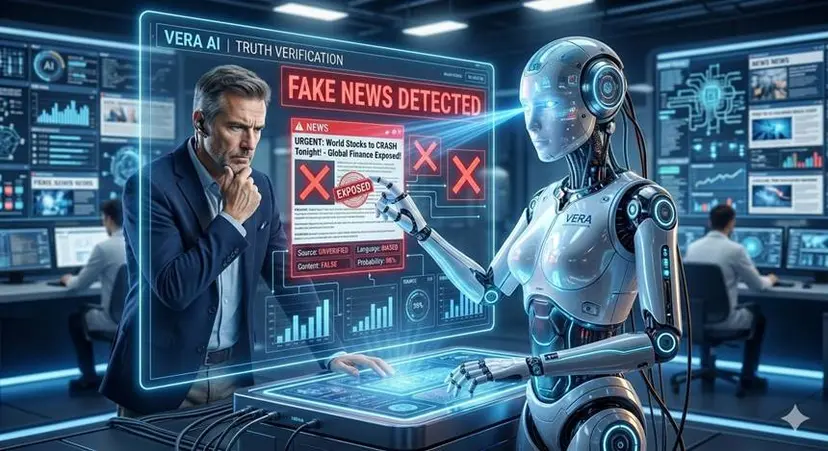
A representative project is vera.ai. vera.ai is an EU-funded research and development project to detect online misinformation and manipulated content. This project aims to analyze various forms of content, including text, images, video, and audio, and targets deepfake detection and multilingual verification. Crucially, this technology is designed not to replace journalists and fact-checkers, but to assist in their verification tasks. AI quickly captures suspicious content, and human verifiers judge the context and intent. Although this project officially ended on October 31, 2025, its results have provided important benchmarks for each European country.
AI4TRUST follows a similar direction. This project develops a system that monitors social media and news media in near real-time, selects content with a high probability of misinformation, and connects it to expert review. Misinformation is not created at a human pace. When bots, automated accounts, generative AI, and organized campaigns combine, it spreads at a speed impossible for humans to verify manually. What AI4TRUST aims at is precisely this 'speed gap.' If humans cannot verify all information, a system is needed where AI filters the signals first and humans make the final judgment.
TITAN shows yet another direction. TITAN is not a service that provides fact-check results like a correct answer, but an AI-based Socratic coaching tool that helps users develop the ability to question, doubt, and judge for themselves. This well illustrates the European philosophy on responding to fake news. The problem of misinformation cannot be solved by deletion alone. Once deleted, content reappears on other platforms, and conspiracy theories sometimes harden into stronger beliefs the more they are refuted. Ultimately, the problem will repeat unless the way citizens receive information itself is changed. This is why TITAN connects with education, civil society, and public institutions.
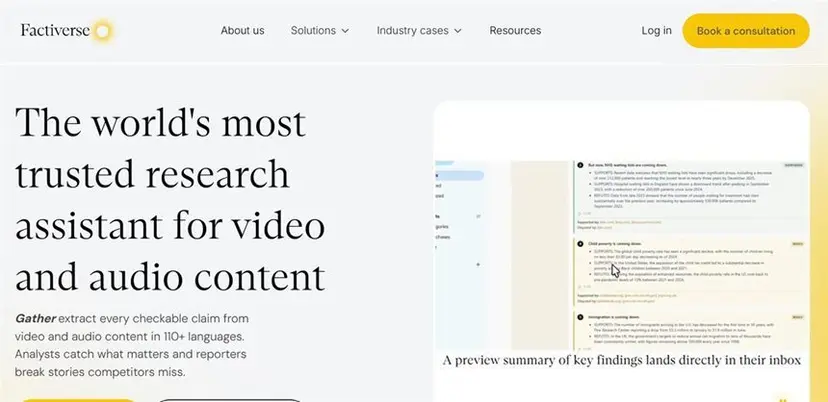
This trend is also appearing in the startup market. Norway's Factiverse is a startup providing AI-based fact-checking and information verification solutions. Nordic public broadcasters and media companies are utilizing Factiverse's technology in situations where it is impossible for humans to verify vast amounts of content such as elections, political debates, and YouTube videos. For example, when dozens or hundreds of hours of politically related YouTube videos are produced every day, the AI extracts statements, separates them into claims, and links them to verifiable sentences and sources. For media companies, instead of watching every video, they can focus on statements that are high-risk or require verification.
Italy's IdentifAI is a startup focused on detecting deepfakes and generative AI content. It develops technology to determine whether images, videos, and audio recordings created by generative AI are made by actual humans or are manipulated. It was reported that in 2025, it secured 5 million euros (8.7 billion KRW) in investment and is pursuing expansion into European and American markets. This shows that the market for responding to fake news is no longer limited to public projects or civil society activities, but is expanding into the cybersecurity and media trust infrastructure market.
The reasons why this field is emerging as a startup opportunity in Europe are clear. First, regulations are creating the market. The DSA requires very large online platforms and search engines to go beyond the mere obligation to delete content; it demands systemic risk assessments, algorithmic transparency, disclosure of ad repositories, data access for researchers, and the establishment of content reporting/action systems. This creates a structure where platforms find it difficult to claim they 'didn't know' about misinformation or that it was 'uploaded by users.' As seen in the European Commission's case of fining X, responding to misinformation is no longer an ethical recommendation but a matter of regulatory compliance and financial risk. In this process, new markets are forming for compliance solutions, risk monitoring, algorithmic auditing, ad transparency management, content provenance authentication, deepfake detection, and fact-checking automation.
Second, demand from media and public institutions is growing. The higher the social conflict—such as elections, war, health crises, immigration, and climate change—the faster misinformation spreads. In particular, Russia's invasion of Ukraine, the COVID-19 pandemic, European Parliament elections, and debates over refugees and immigrants have shown that misinformation can lead beyond online rumors to issues of security, public health, election credibility, and social integration. This is why organizations like the European Digital Media Observatory (EDMO) connect fact-checkers, researchers, journalists, and media literacy experts. Media companies find it difficult to manually verify all the vast social media content, and public institutions must quickly identify the spread patterns and impact scope of misinformation during crisis situations. Therefore, technical demand for automated monitoring, multilingual fact-checking support, misinformation network analysis, and election/crisis response dashboards is bound to grow.
Third, companies are also becoming direct victims of misinformation. False rumors, manipulated videos, fake reviews, brand impersonation, and information manipulation targeting competitors directly damage corporate reputation and consumer trust. With the proliferation of generative AI, fake audio of CEOs, manipulated interview videos, fake press releases, and fake customer reviews can all be created at low cost, making corporate communication risks much greater. For companies, responding to misinformation is becoming an area of risk management linked to brand protection, cybersecurity, investor relations, and consumer trust management, rather than just post-factum clarification work by the PR team. Because of this, demand for technology such as reputation monitoring, deepfake detection, fake review analysis, brand impersonation detection, and crisis communication support is also increasing.
Truth Needs 'Infrastructure for Trust'
There are significant implications for Korea as well. Debates on fake news in Korea are often narrowed to the framework of 'whether to punish or not.' In contrast, European discussions are somewhat more structural. It is a structure where not only the individual speaker but also misinformation becomes profitable, anger becomes clicks, and algorithms repeatedly recommend provocative content. If so, the solution cannot stop at individual punishment. The platform's recommendation system, monetization structure, ad transparency, research access, citizen education, and technology-based verification systems must be discussed together.
When looking at the arrest of Kim Se-ui from a European perspective, the question ultimately converges on one point. Will Korean society treat misinformation only as a problem of ex-post punishment, or as a structural risk of the information ecosystem? Europe is already moving in the latter direction. It is a way of holding platforms accountable, tracking the spread paths with technology, and helping citizens judge information for themselves.
In the age of fake news, the truth does not survive on its own. Truth also needs infrastructure. I mean an infrastructure of trust created by law, technology, media, civil society, education, and startups together. This is precisely what Europe's fake news response startups are showing. Future democracy will not be protected by good journalism alone. A new technology ecosystem is needed to monitor, verify, and explain the entire process of how misinformation is created, amplified, and consumed.
It is time for Korea to change the question as well. We must go one step further from asking who told the lie. Why did that lie spread so quickly? Who made money from it? What platform structure made it possible? And how will we change that structure? In the place where these questions are answered, new markets for fake news response technology and startups will also open.
The author, Eun-seo Lee, majored in law in Korea and studied theater in Berlin. Based in Berlin, a city of art and a European startup hub, she leads 123Factory, which connects the startup ecosystems of Korea and Germany while growing along with the city.