

[비즈한국] Cartoonist Lee Jong-cheol said his mother loves mulhoe (cold raw fish soup). It is Pohang-style mulhoe, where you mix raw fish with gochujang (red chili paste) and vegetables without adding broth, eat it partially, and then pour water (or ice) into it later. In his book 'Typhoon Hinnamnor No. 11,' there is a scene where his mother strengthens her resolve to recover from flood damage while sharing a bottle of soju with a bowl of mulhoe. We wanted to meet the author's mother. On a hot spring day when beads of sweat were forming, the author chose kimchi jjigae (kimchi stew) as his soul food.
The Power of Kimchi Jjigae That Brings Everyone Together
I had suspected that the author would like kimchi jjigae. It appears throughout his works, including 'Jecheol-dong People' and 'Typhoon Hinnamnor No. 11.' Above all, he is the "son of a restaurant owner" specializing in kimchi jjigae (hot pot). His parents' restaurant, which has been running for over thirty years in Jecheol-dong, Nam-gu, Pohang, North Gyeongsang Province, had its name changed twice in his works to 'Sangju Restaurant' and 'Haneul Restaurant,' but kimchi jjigae has never been absent from the menu.
His mother, 'Soon-i,' is said to make her kimchi jjigae by boiling pork in a homemade broth with kimchi and seasoning. I looked at the author's mouth, secretly hoping he might reveal the secret recipe that she "doesn't even tell her daughter-in-law," but it seems the son doesn't know anything special either. Ramen refills are unlimited, and the price is an affordable 8,000 won per serving, so perhaps this generous hospitality is the secret to the taste.
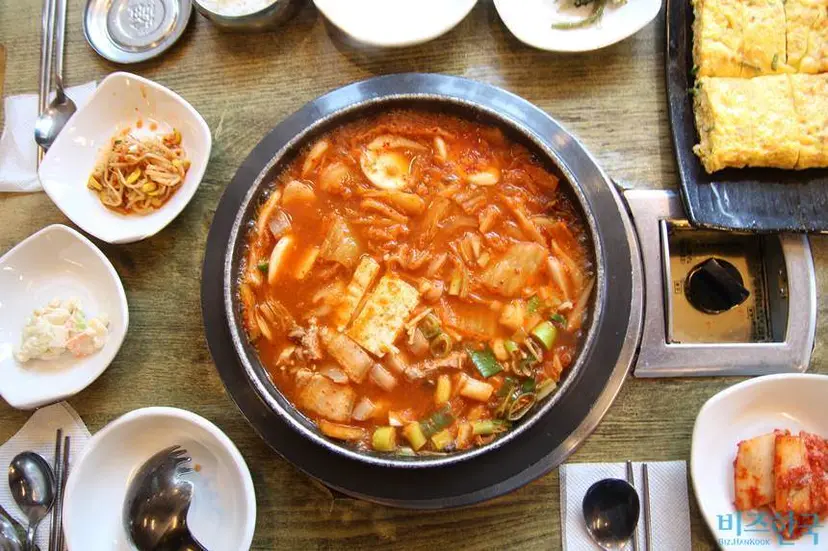
Even when flood recovery was in full swing, people would come and say, "I don't know how much I wanted to eat this kimchi jjigae," or "Seeing Haneul Restaurant open makes me feel like the neighborhood is coming back to life. It gives me strength." Thus, the kimchi jjigae the author misses goes beyond his personal memories; it is a medium that connects the village and the community.
"A new employee who joins POSCO becomes a regular customer, visits later saying he was promoted to manager, and then comes back with his subordinates for a company dinner when he becomes a department head... (omitted) How could I close the restaurant? As long as my body holds up, I have to keep running the business." It is not just the author who grew up eating mother 'Soon-i's' kimchi jjigae. Sitting around the sizzling kimchi jjigae are the author, his parents, his younger sibling, the restaurant helpers, and people from the industrial complex and the village.
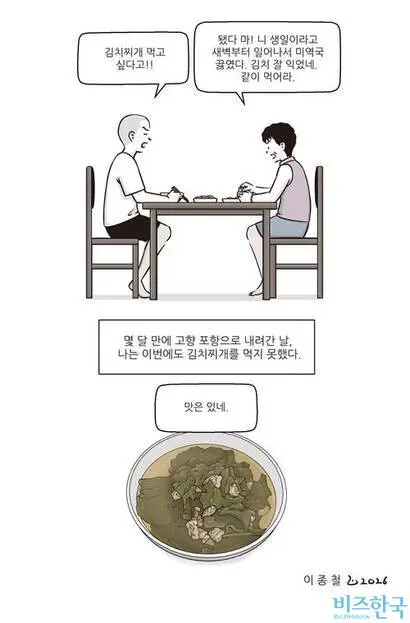
Every time the author visits Pohang a couple of times a year, he sings songs about kimchi jjigae, but his mother, wanting to feed her son who she hasn't seen in a while something special, serves him dishes like pork belly or mulhoe instead. Even on his birthday a few days ago, the author went to his hometown and kept asking for kimchi jjigae, but his mother served him seaweed soup instead. On this spring day that felt like midsummer, we added ramen noodles to the bubbling kimchi jjigae.
“Our Stories Become Comics”
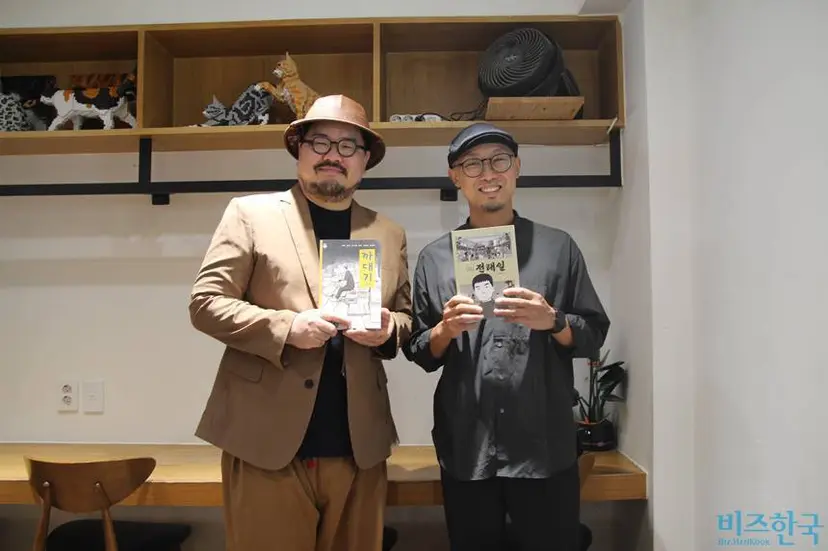
Cartoonist Lee Jong-cheol does not seek his subjects in distant places far removed from himself. The work, people, and relationships he has personally experienced, watched for a long time, and pondered deeply become his subjects. This applies to everything from 'Kkadegi,' which tells us that our bodies and minds are all 'fragile,' to 'Jecheol-dong People,' which highlights individuals growing within a village community, 'Typhoon Hinnamnor No. 11,' which realizes again that we are all 'connected' while experiencing disaster, and 'Again Jeon Tae-il,' which suggests that you and I are both Jeon Tae-il living together in our respective places.
The yesterday and today of those who work hard and live with difficulty become his comics. This is why every time I see his comics, I become curious about whether the real people who became characters in the story are doing well, and how they are living their lives.
Let's Not Whine
When someone who has lived with their nose to the grindstone suddenly looks to their sides and behind them, their perspective becomes filled with relationships and solidarity.
"When I had been working the 'Kkadegi' (package sorting) part-time job for about 6 months, I thought about making a webtoon out of it. Back then, it felt provocative, like 'a place you must never work' or a 'hellish part-time job.' But as I worked for about 6 years, I gained younger colleagues, and as I took on roles like the 'Kkadegi Captain,' I felt a sense of responsibility. As I built relationships with the delivery drivers who were always fussing about, I couldn't draw it lightly anymore. I came to understand many things from their perspective."
He talks about the things he has experienced like the summer heat of two years ago. The emotions that once surged with heat find their place as the years pass. He has already broken free from the obsessions of provocation, holiness, and tragedy. He vividly depicts things that can only be seen with the passage of time—the forest that becomes visible only after moving away from the trees. He reflects the way people live like a mirror, without exploding his emotions. Only those who have spent that summer hotly can add distance and depth to their gaze.
"I made the protagonist's name similar to my real name, which made me overly empathetic and made me start whining. Like I was the person having the hardest time in the world. But when I actually met my friends, they were on low wages and working overtime; they weren't much different. So I thought, let's not whine."
Lee Jong-cheol's Autobiographical Documentary That Doesn't Try to Preach
His recent work, 'Again Jeon Tae-il,' was a comic started at the suggestion of a publisher. The initial plan was to introduce martyr Jeon Tae-il to teenagers, including the story of his mother, the late Lee So-sun, but this did not satisfy the author's needs. Rather than stuffing Jeon Tae-il into the past, the author wanted to make him alive by connecting the past Jeon Tae-il with the present Jeon Tae-il, including 'myself.' The author's characteristic of drawing autobiographical comics gave three-dimensionality to the static figure of Jeon Tae-il and revived him for today.
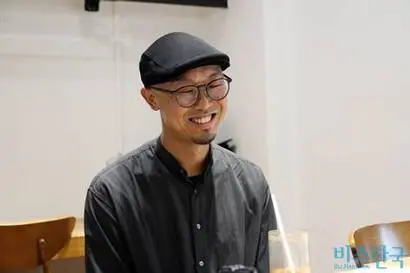
It is clear that in the process of becoming a cartoonist, he was influenced by works that dramatically highlight specific points as reportage or historical reenactment. However, he did not place his own comics behind them. By standing in the author's own place, rather than as an outsider observer or an omnipotent judge, he is creating a unique comic world. It is a way of revealing the essence without being trapped in duties or arguing, even while dealing with labor, human rights, disasters, and the alienation of victims. His perspective is the exquisite point.
Daumeotji*
At the cafe where we moved our seats, I asked him about his next steps. He replied that he has been contemplating for a long time about working on a comic regarding the political conservatism of TK (Daegu-Gyeongbuk) and its foundations. Having been born and raised in Pohang, Gyeongbuk, and attending university in Gunsan, Jeonbuk, experiencing the sentiments of both the Yeongnam and Honam regions, I was curious about how he would digest his experiences and depict them in a comic. Because it is a difficult topic that could easily hurt those close to him, including his family, I was worried, but I also hoped that with his writerly experience and capabilities, which he has diligently accumulated, he would be able to ruminate on the complex, tangled layers and unravel them delicately in each frame.
He has recently started to ponder as an educator while meeting students in the classroom. We offered our wishes to him as if they were the answer—worrying about how much his experience, as an author who has drawn themes that transcend the region, labor, and his own life in the form of printed comics—perhaps going against the current trends—could reach students who cannot find other paths besides serializing commercial comics or getting hired by studios. Like Scott McCloud, who explained comic theory through comics, why not draw his own creative method and process in the autobiographical comic style he is good at, from finding materials to publishing a book? As the cafe started to get busy, we ended the seat with a promise to draw makgeolli in the next frame (meeting).
*Daumeotji: A pure Korean word referring to comics.
Cartoonist Lee Jong-cheol was born in Pohang, Gyeongsangbuk-do, and grew up in the Pohang Steel Industrial Complex village. Between the quiet rural village and the industrial complex, he encountered various types of lives such as steel workers, laborers, restaurant employees, and farmers in the commercial area. He majored in Western painting at an art college in Gunsan, Jeollabuk-do, and began his career as an artist by drawing for 'The Sea Child Changdae' (2017). He moved to Seoul and started a part-time job doing package loading and unloading (Kkadegi) for a living. 'Kkadegi' (2019), which depicts his experiences at this time, was selected for the '2018 Diversity Comic Production Support' and won the 'Today's Our Comic Award' (2019).
He released 'Jecheol-dong People' (2022), which contains stories of steel workers and neighbors he saw while growing up near Pohang Steel, and 'Typhoon Hinnamnor No. 11' (2024), which depicts the solidarity of the people of Jecheol-dong village who were swept away by the typhoon. Recently, he drew 'Again Jeon Tae-il' (2026). Currently, he is working on comics and teaching students at Baekseok University of the Arts and Gumi University.
He says the calluses on his hands feel like his own identity as an author, and he is a writer who constantly uses his body to draw frames. Should we say he is closer to cartoonist Huh Young-man, who draws based on field research, rather than Lee Doo-ho, who draws comics while persistently holding his place? One interesting thing is the relationship between cartoonist Lee Jong-cheol and Lee Doo-ho. When he started attending art school in high school, the author submitted a four-panel comic to a competition held by the YWCA and won the silver prize, and the presenter at that time was Lee Doo-ho.
When he was a teenager and losing himself while watching fast-paced comics in weekly comic magazines, he said he nurtured his dream of becoming a cartoonist by watching classic short animations and Korean classic comic animation introduction programs broadcast on Tooniverse. After entering university, he read Korean reportage comics such as 'Where I Lived, Yongsan' (2010), in which Kim Sung-hee, Kim Subak, Kim Hong-mo, Shin Sung-sik, Angko, and Yoo Seung-ha participated, and thought, "I can also create a work with my own story." While the Korean reportage comic genre, which once formed a trend, is catching its breath these days, cartoonist Lee Jong-cheol's comics are pioneering that flow with his own narrative.
The author, Seo Chan-hwi, is a comic columnist who has explored and organized the flows and links between comics and surrounding cultures in a historical context. Since 1998, he has operated the comic information community 'Manhwain' and has written for various media such as The Hankyoreh, Ilyo Shinmun, Incheon Ilbo, and Kookbang Ilbo. Author Song Ha-won is the CEO of the Public Culture Development Center UrArt and operates the alternative comic specialty bookstore 'Homtong.' She is a cultural planner and comic researcher, and serves as an adjunct professor in the Department of Media and Communication at Sungkonghoe University and as a director at the Geumcheon Cultural Foundation. In 'Cartoonist's Soul Food,' the two aim to take a look at the lives and works of Korean representative cartoonists through the food they love.
![[Cartoonist’s Soul Food] The Cream Bread of That Dawn, Sustained by Dreams](https://s.bizhankook.com/attachments_thumb/2026/05/98392_thumb.webp)
![[Cartoonist's Soul Food] Art is in the 'Hand-taste', Food is in the Joy of Eating Together](https://s.bizhankook.com/attachments_thumb/2026/05/98652_thumb.webp)
![[Cartoonist's Soul Food] 'Kkadegi' author Lee Jong-cheol's 'Mother's Kimchi Jjigae'](https://s.bizhankook.com/attachments_thumb/2026/06/106516_thumb_1a338228.webp)
![[Cartoonist's Soul Food] 'Ghost Teacher' Author Nam Dong-yoon: "Undoubtedly, Sundae-guk"](https://s.bizhankook.com/attachments/2026/07/e57a933e6fe0_36ef77a3.jpg)
![[Cartoonist's Soul Food] Artist Park Kun-woong, Whose Knife-Cut Noodles Soothe the Knots of History](https://s.bizhankook.com/attachments/2026/07/9f3485391c47_2d2281a7.jpg)
![[Cartoonist's Soul Food] "A Red Bean a Day": A Visit with Manga Writer and Film Director Lee Dong-eun](https://s.bizhankook.com/attachments_webp_no_wm/2026/07/134567_no_wm_0b8d2928.webp)