

[비즈한국] The conflict over performance-based bonuses at Samsung Electronics has reached a temporary resolution. With the tentative labor-management agreement passing the union members' vote, the risk of a general strike, which had been signaled for 18 days, has effectively vanished. The company avoided the worst-case scenario of production disruptions, while the union secured a new special management performance bonus system linked to semiconductor business results. On the surface, it is a compromise where both sides have taken a step back. However, this agreement is not an issue that ends within Samsung Electronics. As the demand for 'operating profit-linked bonuses,' which began at SK Hynix, has extended to Samsung Electronics, it has become a historic inflection point that changes the very standards of compensation across the Korean industry.
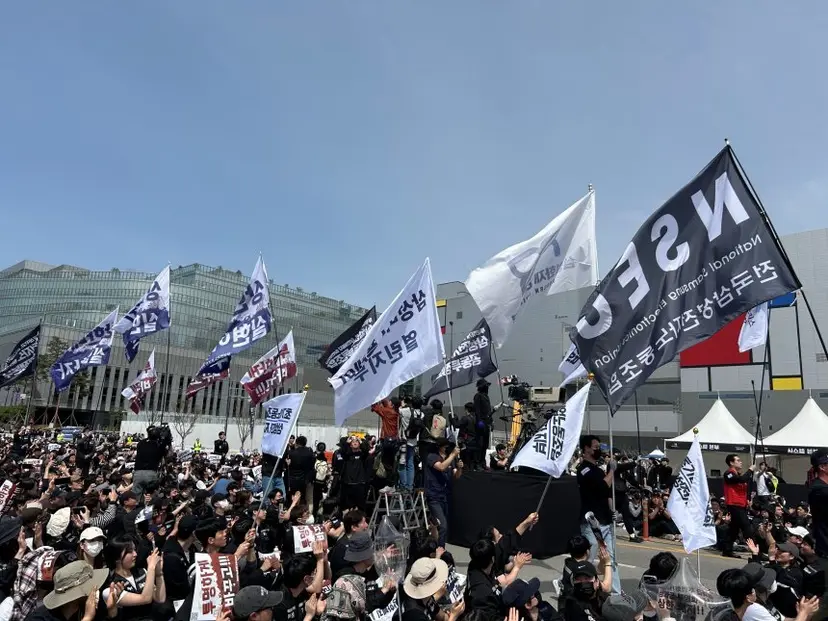
Tentative Agreement Passed with 73.7% Approval
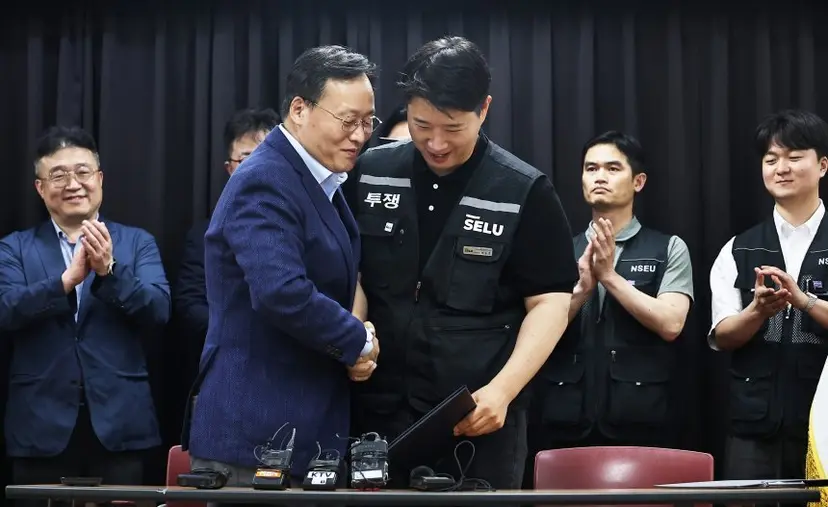
The joint bargaining group of Samsung Electronics unions announced on the 27th that the tentative 2026 wage agreement was passed with a 73.7% approval rate. The voter turnout reached 95.5%. Out of 65,593 eligible union members, 62,616 participated in the vote, with 46,142 voting in favor. Consequently, the general strike scheduled from May 21 to June 7 will not materialize. As there were significant concerns about production disruptions at a time when AI semiconductor demand is exploding and the memory market is recovering, this represents the removal of the biggest uncertainty for Samsung Electronics.
The core of this agreement is the performance bonus. Labor and management have decided to maintain the existing OPI system while establishing a separate special management performance bonus for the DS (Device Solutions) division. The funding for this special bonus is set at 10.5% of the business performance agreed upon by labor and management, with no cap on the payout rate. While the previous bonus system was calculated based on criteria set by the company, this structure directly links semiconductor business performance with employee compensation. The distribution of funds is allocated 40% to the division and 60% to the business unit. Common support organizations will receive a level equivalent to 70% of the Memory Business Unit's payout rate.
Compared to the union's initial demands, it is closer to a compromise. The union originally demanded the abolition of the bonus cap and the expansion of profit-linked compensation. Conversely, the company argued that a fixed profit-sharing structure could increase investment constraints and financial burdens. Eventually, just before the strike, both sides found common ground by creating a separate system for special management bonuses and settling on the figure of 10.5%. In effect, Samsung Electronics has partially changed the framework of its bonus system to prevent a strike.
Lingering Conflict Between Labor Factions
However, the passage of the agreement does not mean all conflict has disappeared. In fact, a new battle line has been drawn within Samsung Electronics. Voting sentiment was sharply divided by union and business unit. While the approval rate was high among the super-corporate union (representing many semiconductor personnel), it was significantly lower in the National Samsung Electronics Union, which has many members from the DX (Device eXperience) division. This is because the special management performance bonus was effectively designed around the DS division.
Compensation disparity is the most sensitive point. Estimates suggest that if the semiconductor business achieves record-breaking performance, employees in the Memory Business Unit could receive bonuses worth hundreds of millions of won on top of a 100 million won annual salary. Conversely, the DX division, which is excluded from the special management bonus, receives relatively much less compensation. It is a structure where, despite being fellow Samsung Electronics employees, the size of compensation varies completely depending on the business unit. The principle of 'reward where there is performance' is certainly persuasive. However, critics point out that if the gap becomes too wide, feelings of deprivation and internal division within the organization are inevitable.
Will Operating Profit-Linked Bonus Systems Become the 'New Normal'?
The starting point of this situation lay outside Samsung Electronics. As SK Hynix introduced a method of using a certain percentage of operating profit as a source for performance bonuses, the compensation standards in the semiconductor industry were shaken. The Samsung Electronics union could not ignore this. Especially with the intensifying competition for semiconductor talent, the question, "Why can't we receive as much as Hynix?" did not easily subside. For the company, the potential for talent leakage acted as a burden. Bonus negotiations became not just simple wage talks, but a part of the competition to retain semiconductor talent.
The problem is that this trend may not remain limited to the semiconductor industry. As Samsung Electronics and SK Hynix adopt operating profit-linked bonus systems, there is a climate of it spreading to unions at other large corporations such as Kakao, LG Uplus, Hyundai Motor, and HD Hyundai Heavy Industries. Furthermore, demands from some subcontracting unions to share the profits of the primary contractor are emerging. The repercussions have even reached overseas. Within Taiwan's TSMC, rumors of bonus cuts have led to arguments that "the Samsung Electronics union case should be referenced," casting a subtle tension across the Taiwanese industry that had been expecting indirect benefits.
Above all, the most acute point of conflict is 'consistency.' The business world is already voicing concerns. The reason is that if operating profit-linked bonuses become entrenched in industries with high market volatility like semiconductors, cost burdens could escalate during downturns. Conversely, the labor sector maintains that the rational distribution of excess profits generated by a company is now an inherent right that workers can demand, just like wages.
Although this negotiation has ended after many twists and turns, it remains to be seen how the operating profit-linked bonus system will affect wage and compensation negotiations across the entire Korean industrial sector.