

[비즈한국] "The first phase of AI was a technical breakthrough, and the second was the expansion of accessibility. We are now entering a third phase, where intelligence is becoming integrated into the core infrastructure of the economy and society."
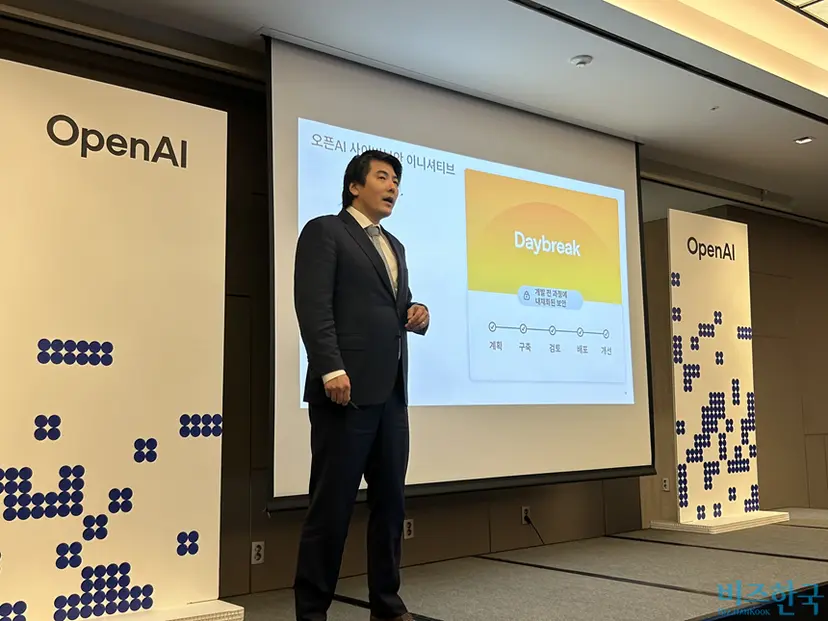
During a press conference held at the JW Marriott Hotel in Seocho-gu, Seoul, on the 27th, Jason Kwon, Chief Strategy Officer (CSO) of OpenAI, defined the inflection point of the AI industry in these terms. He explained that generative AI is no longer limited to personal productivity tools or enterprise software, but has entered a stage where it permeates national infrastructure, public systems, and industrial defense systems. The 'Korea Cyber Action Plan' announced by OpenAI on this day is an extension of this trend.
Government has GTAC, Companies have TAC... Doors Open Only to 'Verified Defenders'
On this day, OpenAI made official a plan to support the South Korean government, public institutions, and major domestic companies in accessing its advanced AI-based cyber defense capabilities. The core components are 'Daybreak,' an AI-based cyber defense capacity-building program, and the expansion of the Trusted Access for Cyber (TAC) program. The plan aims to provide access to the latest cyber-specialized models to verified defense entities through GTAC (Government & Institution Trusted Access for Cyber) for government and public organizations, and TAC (Trusted Access for Cyber) for companies in key national industries.
GTAC is intended for government ministries and public institutions such as the Ministry of Science and ICT and the Korea Internet & Security Agency (KISA), while TAC operates as a separate track for private companies in core national industries such as energy, finance, and telecommunications.
CSO Kwon stated, "The latest cyber AI capabilities should not remain in the hands of a few. Major defense entities in South Korea must be able to utilize them to strengthen collective security and public safety. Through the Korea Cyber Action Plan, we will work closely with the government, public institutions, and companies to support the strengthening of South Korea's cyber capabilities."
What OpenAI particularly emphasizes is a 'defender-first access' strategy. This means allowing trusted institutions and companies to utilize AI-based cyber technology before it can be abused as an attack tool. CSO Kwon explained, "The most critical use case is the capability to detect vulnerabilities within systems and automatically patch them. Since this capability can become a powerful attack tool if abused, we are operating an access control program that opens doors only to thoroughly verified and trusted defenders."
CSO Kwon added, "Because the pace of AI development is so rapid, it is important for trusted actors to secure these capabilities before malicious actors do. Defenders must be able to discover and patch vulnerabilities before hackers." He continued, "Cybersecurity should not begin after an attack. It must be internalized from the system design stage. AI helps security teams and developers understand risks faster and verify correction plans."
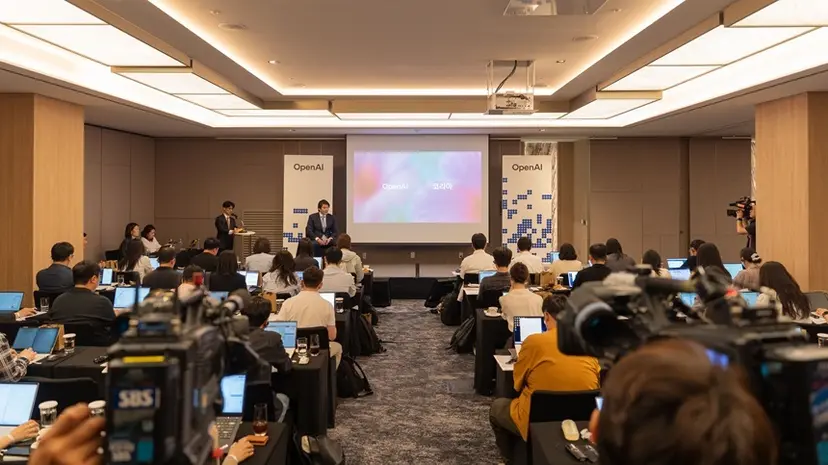
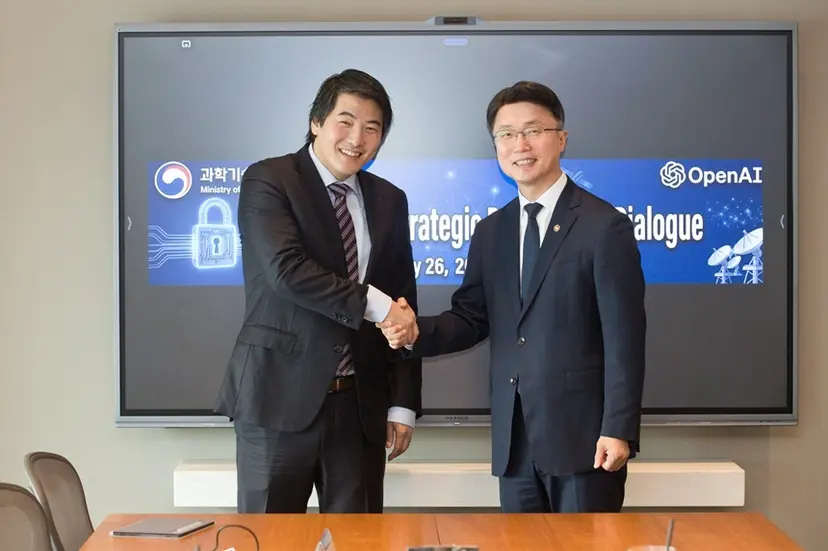
To prepare for this cooperation, Sasha Baker, OpenAI's Head of National Security Policy, visited South Korea on the 18th and demonstrated the latest cyber-specialized models to key public institutions, including the Ministry of Science and ICT, the Ministry of Foreign Affairs, the Ministry of the Interior and Safety, the Financial Services Commission, the Presidential Committee on the Age of AI, and KISA. Following this, CSO Kwon held a separate meeting on the 26th with Ryu Je-myung, 2nd Vice Minister of the Ministry of Science and ICT, to discuss the cooperation agenda.
With this participation in GTAC, South Korea has joined the group of countries participating in OpenAI's government security program, following the U.S. and Canada, alongside Japan. It is the first such case in Asia, shared with Japan. The Korea Internet & Security Agency (KISA) will be in charge of practical operations.
Regarding the expansion of TAC for private companies, OpenAI stated, "We are in discussions with several Korean companies," but did not disclose specific names.
Unlike its competitor Anthropic, which operates 'Project Glasswing,' a U.S.-centric closed security cooperative, OpenAI appears to have chosen to expand international cooperation. CSO Kwon said, "Because we have sufficient computing power, we can provide services to a wider range of defenders. We hope that as many people as possible can defend themselves as quickly as possible."
Regarding data security issues, he explained, "We already support data residency in South Korea (a system where data is stored and operated within domestic territory rather than on overseas servers), so data is processed domestically. We also provide methods for some customers where data is not stored on servers at all, thus meeting security requirements." Regarding discussions on 'Stargate' with Samsung Electronics and SK Hynix, he stated, "We are continuing productive conversations and the situation is positive."
"South Korea has a Full-Stack Economy"... Expanding AI Infrastructure Cooperation Across the Board
At the press conference, CSO Kwon also repeatedly emphasized the strategic importance of the South Korean market. He assessed, "AI transformation does not stop at individual productivity improvement. It is expanding into areas that impact society as a whole, such as public infrastructure, financial accessibility for innovative companies, and national resilience. South Korea is a country that can lead the next phase of AI transformation."
The perspective is that South Korea has secured talent, an industrial base, and the will of the public sector compared to other countries. Citing that South Korea, as a 'Digital First' society, has strengths in quickly adopting new technologies and integrating them into daily life, he called it a 'full-stack economy' equipped with semiconductor companies, strong infrastructure, a skilled developer community, and a startup ecosystem.
According to OpenAI data, the number of weekly active users of ChatGPT Codex in South Korea has increased tenfold since the beginning of the year. Furthermore, South Korea is one of the top 5 countries globally in terms of Codex utilization. OpenAI finds it significant that more than half of Codex requests in South Korea originate from non-development tasks such as document drafting, analysis, research, and operations, rather than coding.
OpenAI is recently continuing discussions on global AI infrastructure cooperation with Samsung Electronics and SK Hynix, while simultaneously broadening the scope of its cooperation in the public sector. The previous day, the company signed an agreement with the Korea Water Resources Corporation (K-water) to respond to climate change and water-related disasters, and entered into an MOU with the Korea Technology Finance Corporation to establish an AI-based technology evaluation system.
CSO Kwon emphasized, "For South Korean users, AI is becoming not just an interesting experimental technology, but a practical tool they rely on to get real work done. The purpose of this plan is to put powerful AI defense tools into the hands of trusted South Korean defenders and to more perfectly protect the institutions, infrastructure, companies, and ordinary citizens of South Korea who rely on secure digital systems."