

[비즈한국] When BTS released their 5th studio album 'Arirang,' there was some harsh criticism regarding the album as a whole, as well as individual tracks. Critics pointed out that there were no mainstream-friendly songs. However, considering the original experimental spirit of BTS, it wasn't actually a bad thing. The inclusion of more distinctly Korean elements was intended for the fandom of K-content and K-culture, as showcased by 'K-Pop Demon Hunters.'
In truth, focusing on or obsessing over individual albums or songs is a misunderstanding of K-pop music. This is because K-pop is a product of fan culture. Nothing is more foolish than applying rational analysis to the emotions of love. It is difficult to overlook the fact that the fandom economy has been further developed in a smart mobile environment. The music industry must adapt to this paradigm shift.
Are music awards shows adapting, though? Some are, but others remain stuck in a 20th-century analog mindset.
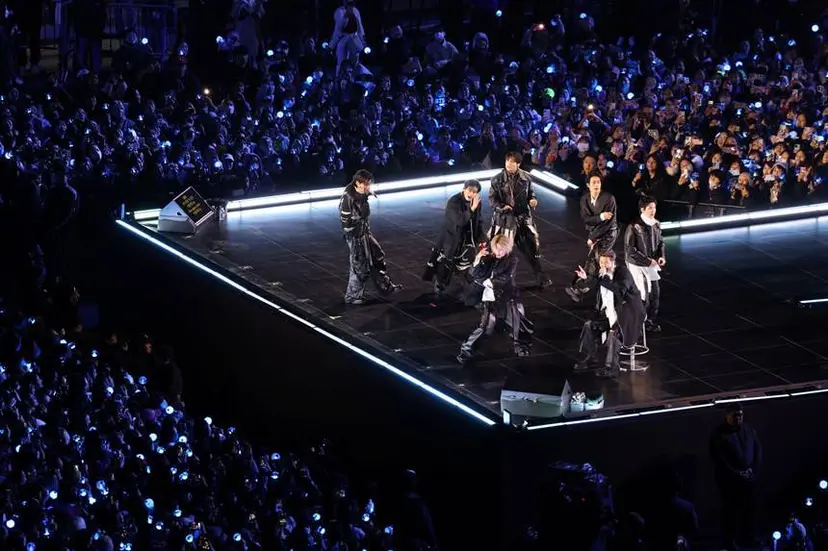
The three major American music awards, which are built upon the foundation of the market and the industry, mainly use three selection methods. First, there is the data-driven model, which the Billboard Music Awards uses. Music consumption data includes digital track and album sales, as well as streaming data, while broadcast performance data includes radio airplay and tour revenue. Social media participation and reaction are also significantly reflected.
At the opposite end of the spectrum is the Grammy Awards. This follows the classic method where the judgment of a panel of judges plays a crucial role. However, it is not limited to theorists or critics; it relies on the judgment of professionals active in the music industry. While it is evaluated as the most objective and rational, there are doubts about whether it reflects current music trends with agility. It is also criticized for being conservative or rigid. In any case, the subjective evaluation of the judges carries more weight than objective data.
The American Music Awards sits in the middle of these two models. It is based on objective data, but a panel of professional judges decides the final winner. Since 2006, the American Music Awards has based its final decisions on the will of the fans. Primarily, they refer to digital track/album sales, radio airplay, and social media engagement and mentions; in the final selection stage, expert judgment is excluded, and the outcome is determined 100% by the votes of music fans. Naturally, the artist with the largest fanbase will perform best, and BTS proved this by winning the 'Artist of the Year' award, the top honor, in 2026.
Over the past decade, Taylor Swift, Justin Bieber, One Direction, Ariana Grande, and Bruno Mars have won 'Artist of the Year' at the American Music Awards. These are artists active primarily in North America or the English-speaking world. Taylor Swift, who had won for three consecutive years, failed to win this time. Is this the limitation of a fandom restricted only to the English-speaking world? In contrast, BTS has a powerful fanbase spanning not only Asia but also North and South America, and Europe.
Moreover, this year, it wasn't just BTS; K-pop won across the board. The song 'Golden' from the 'K-Pop Demon Hunters' soundtrack took home three awards, including 'Song of the Year,' just like BTS, once again proving its massive mainstream popularity. 'Golden' previously became the first song by a female K-pop artist to top the US Billboard 'Hot 100' for 8 weeks. Additionally, it is significant that KATSEYE, a Korean-American joint group that was only nominated at the Grammy Awards, won 'New Artist of the Year' at the American Music Awards.
Now, what remains is the Grammy Awards, which operates on the 20th-century jury model. BTS has won 12 awards at the Billboard Music Awards since 2017, including three wins in 2022. The Grammy Awards cannot help but feel immense pressure. If BTS fails to win again, its credibility will be severely damaged. This is because the equation that claims the awards are authoritative because they are based on the objective and rational votes of industry professionals could crumble.
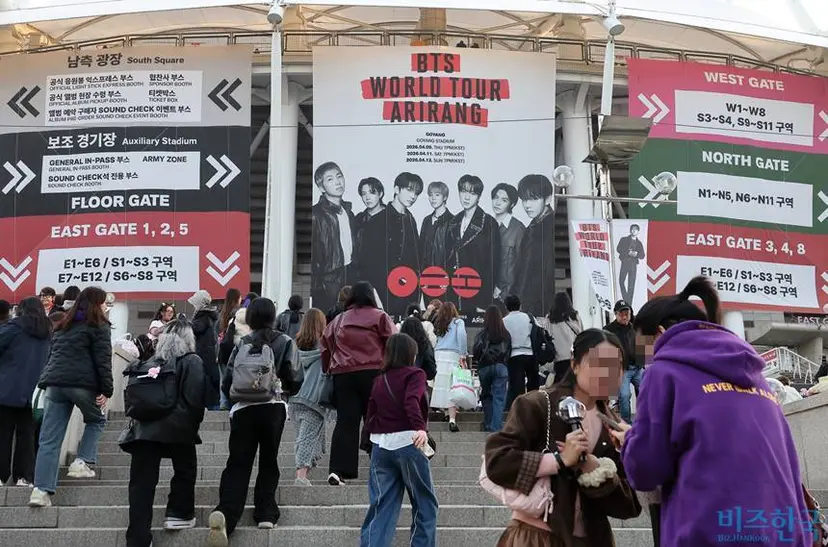
In February 2019, BTS became the first Korean artists to be officially invited to the Grammy Awards, appearing on stage as presenters for the 'Best R&B Album' category. In January 2020, they performed in the special 'Old Town Road All-Stars' stage, led by US rapper Lil Nas X, marking the first performance by Koreans at the event. They were nominated for 'Best Pop Duo/Group Performance' for three consecutive years: for 'Dynamite' in 2021, 'Butter' in 2022, and 'My Universe,' a collaboration with Coldplay, in 2023.
However, they never won. The backlash from fans, as well as local media outlets, was immense. If they use BTS only as performers or nominees again, they will face fierce resistance. If they continue to pass over K-pop, beyond just BTS, their credibility and authority will inevitably collapse.
For their Arirang album and individual tracks like 'Swim' and 'Body to Body,' BTS has significantly strengthened their team with LA-based production staff. The industry experts who judge the Grammy Awards cannot help but operate within these industrial networks and interests. Considering how much the K-pop fandom has spread and deepened in the US, they are also destined to become part of the K-pop industry. This is because the economic effects created by fan devotion and fandom cannot be ignored.
It is not just the International Federation of the Phonographic Industry (IFPI) but also the US music industry that must build business models through K-pop to survive. This is being proven not only by BTS, but also by Golden from K-pop Demon Hunters and KATSEYE. If the US rejects the music business model created by K-pop fan culture, there will be no future for them. We are in an era where music is consumed not just as music itself, but as a culture of solidarity and communication. Experts, too, are figures who represent this culture. It is in this same context that K-pop aspires to create idols that are both planned and autonomous.
The author, Kim Heon-sik, has walked and navigated the forest of popular culture phenomena since his 20s, driven by the hope that there is a way to make the world a better place through culture. He continues on the same path in the 21st century, where artificial intelligence and quantum computers are at play, with the same belief.