

[비즈한국] Unofficial merchandise that uses idols' faces and names without permission is being sold both online and offline, leveraging lower prices than official products. As products sold for profit—going beyond the small-scale production and sharing culture within fandoms—increase, concerns over the infringement of artists' rights and consumer confusion are growing.
The culture of fans creating, sharing, or selling small quantities of merchandise within their fandoms has existed for a long time. Birthday cafe perks, sharing at concerts, and small-batch photo cards have been consumed as voluntary fan activities. While legal issues can arise from using artists' portraits and names without permission, agencies have generally turned a blind eye to these fan activities.
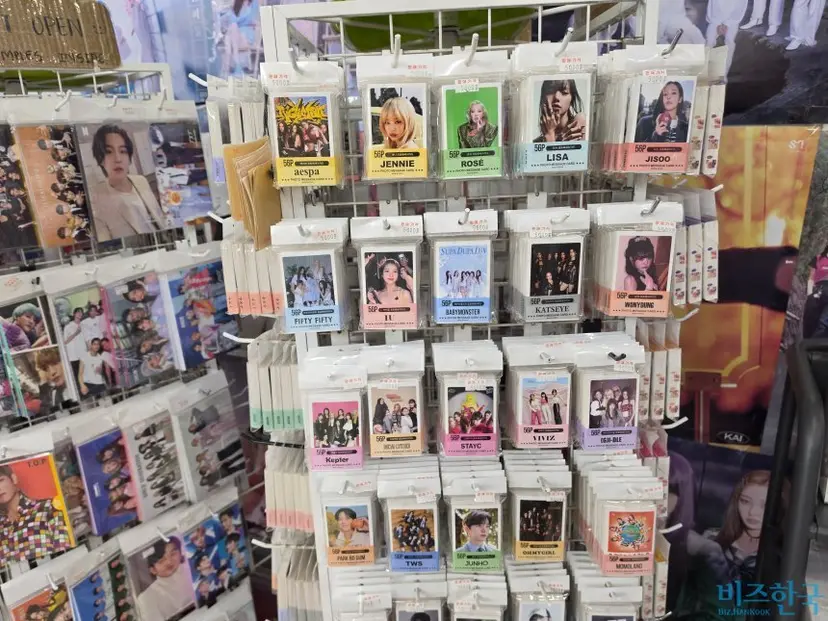
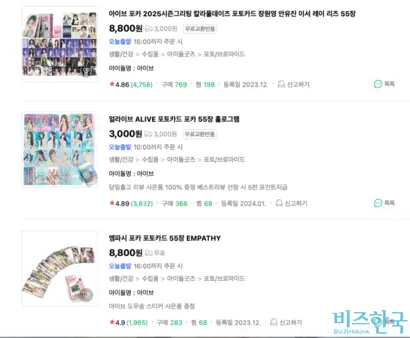
The problem is the increase in mass production and sales aimed at profit, which goes beyond small-scale production and sharing. Unofficial merchandise can be easily found on online shopping malls such as Naver Smart Store and Coupang. The variety is also vast; beyond just idol photos, photo cards, keyrings, and stickers using group names and logos are being sold.
Offline sales are also continuing. On the 26th, at a store in the Myeong-dong underground shopping center in Seoul, unofficial merchandise using idol photos was displayed on the shelves. Photo cards, keyrings, and calendars made with K-pop idol photos and logos were mostly being sold for under 10,000 won.
The reason unofficial merchandise is problematic is the potential for infringing on publicity rights. Publicity rights refer to the right to control the economic value of personal elements such as a celebrity's name, face, and stage name. However, unofficial merchandise is produced and sold as photo cards, keyrings, or stickers without the rights holder's permission. This is an act of unauthorized use of an artist's fame and market value.
Administrative measures have also been taken. In March, the Korean Intellectual Property Office issued its first corrective orders to four companies that produced and sold merchandise using the names and portraits of idol group members without authorization, applying the Unfair Competition Prevention Act. The target products included photo cards, student ID-style cards, and stickers. The corrective orders included the cessation of sales, disposal of existing inventory, a ban on similar sales methods, and mandatory anti-recurrence training.
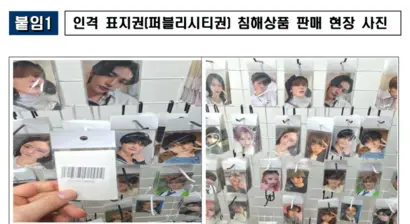
Unofficial merchandise also entails copyright and trademark issues. Using official photos or album images to create merchandise can lead to copyright infringement. Using group logos or official trademarks can lead to trademark disputes. Consumer confusion also occurs if the product type or sales method is mistaken for official merchandise.
It also extends to issues of consumer protection. The lower price compared to official products becomes an attractive option for younger fans with limited purchasing power. Parents who are unfamiliar with fandom culture may purchase these as gifts for their children without being able to verify if they are official products. In fact, online reviews often feature comments from those who bought them as gifts for their children or purchased them simply because of the low price.
Foreign tourists are exposed to the same problem. In tourist areas like Myeong-dong, products with idol photos and group names can be consumed as K-pop souvenirs. When unofficial merchandise is sold as if it were official to tourists who have difficulty distinguishing the two, consumer confusion only deepens. If unofficial merchandise of questionable quality and origin is consumed like official K-pop products, it can negatively impact the credibility of the K-pop market.
Vanessa, a visitor from Mexico who was browsing unofficial merchandise in Myeong-dong that day, said, "I thought they handled official products because the word 'K-Pop' was on the sign," adding, "If I had known, I wouldn't have come in."
The entertainment industry is increasing its response level to commercially sold unofficial merchandise. Ahead of the BTS tour in the U.S. in April, HYBE filed a lawsuit against unauthorized merchandise sellers in a U.S. court. HYBE also obtained temporary restraining orders and seizure orders through similar legal measures during BTS concerts in 2019 and 2021, seizing large quantities of counterfeit and infringing merchandise around concert venues. Major agencies are also strengthening monitoring of products that use their artists' intellectual property without authorization.
The sale of unofficial merchandise for commercial purposes is difficult to justify. However, fans' dissatisfaction with official merchandise is also cited as a backdrop for the growth of this market. High prices, short sales periods, and random configurations are problems that fans have repeatedly pointed out. It is also noted that as the structure makes it difficult to obtain merchandise of the desired member, demand shifts to unofficial merchandise that is cheaper and easier to buy.
Pop culture critic Kim Heon-sik said, "If official merchandise is priced high, limited in quantity, or sold in a random manner, fans are bound to feel a sense of thirst. There is an aspect where the structure of excessively monetizing fan sentiment leads to demand for unofficial merchandise," and added, "The K-pop industry should not repeat the practice of using fan sentiment solely as a sales tactic. The entertainment industry also needs to reflect on the situation where unofficial merchandise has been mass-produced."