

[비즈한국] The Sun is a very strange star. The strangest thing is that it is a loner with no one around it. Half of the stars in the universe have partners, and most form star clusters of at least thousands or tens of thousands of stars. But not the Sun. It shines lonely in the void, with not a single star within 4 light-years.
Surely, the Sun must have been born in the same way as other stars. It must have been created at a site where a massive molecular cloud contracted and numerous stars were born all at once. The Sun must have had hometown friends born alongside it. However, due to some circumstances, the Sun likely left its hometown and began a long, solitary life.
Can the Sun find its lost hometown? Where are the hometown friends who were born and raised in the same place as the Sun, and what kind of lives are they leading now? Surprisingly, a reunion for the Sun has recently been held after 5 billion years! The Sun holds an unexpected secret about its birth.
To find the Sun's lost friends, data from the Gaia space telescope, which until recently created the most vast and precise map of stars in our galaxy, was utilized. For over 11 years, nearly 2 billion stars were mapped. To find the Sun's hometown friends among all those stars, very strict criteria were applied.
We selected stars that had surface temperatures within 200 degrees of the Sun and perfectly matched the surface gravity and metallicity. Metallicity is especially important when considering a star's age and origin. This is because as the universe ages, more supernovae explode, and the universe gradually becomes contaminated with heavier elements. Therefore, how many heavy elements a star has is a key indicator to distinguish when that star was born.
Using these demanding conditions, 6,594 solar twin stars were filtered out. All are nearby stars within 1,000 light-years, not too far from the Sun. Previous studies could only find a few dozen solar twins at most, but thanks to Gaia's massive observational data, over 6,000 solar twins were discovered.
In fact, stellar evolution is quite complex. Having the same temperature does not necessarily mean the same brightness. It is determined by various factors such as the star's mass and metallicity. Therefore, to estimate the exact age of a star, it must be compared with stellar evolution models that apply various variables at once. This study used a stellar evolution model analysis called Parsec (PAdova TRieste Stellar Evolution Code). This way, the ages of over 6,000 stars were measured one by one. It was like issuing a birth certificate to each star. Among the stars suspected to be solar twins, some are young stars less than 1 billion years old, while others are very old, over 6 billion years old.
However, when the ages of these 6,000 twin stars are compared at once, a surprising result appears. There are stars particularly concentrated in two age groups. One has a narrow peak appearing at about 2 billion years, and the other is a broad bump spanning from about 4 billion to 6 billion years.
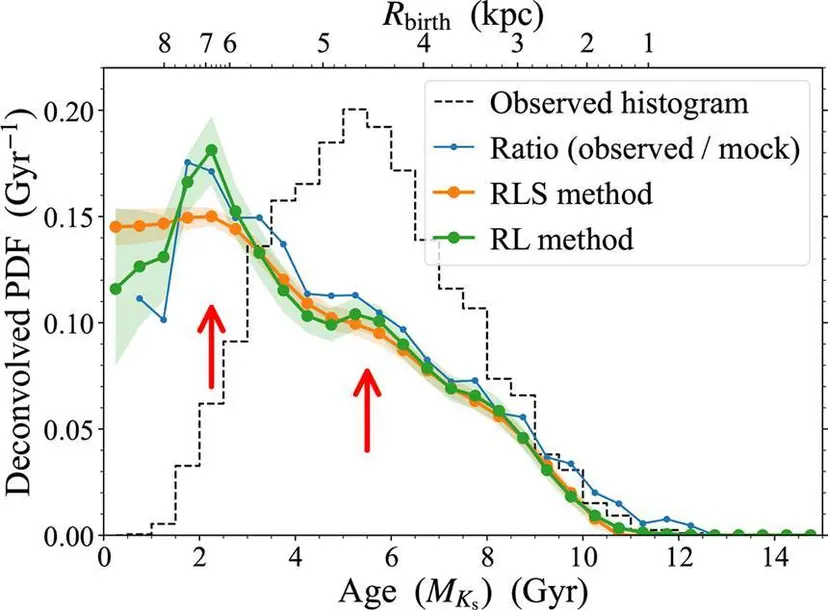
The first peak at 2 billion years is related to a powerful event that occurred relatively recently, about 2 billion years ago. Smaller galaxies, including the Sagittarius Dwarf Galaxy, are orbiting around our galaxy. Specifically, between 1 billion and 2.5 billion years ago, there was an event where these dwarf galaxies were pulled in by the Milky Way's gravity, providing a large amount of gas at once. The collision with the dwarf galaxy shook the surrounding gravitational field and caused more gas clouds to be compressed into stars. A kind of galactic-version baby boom era occurred, where star formation in the Milky Way exploded for a while. The peak at 2 billion years indicates the stars born during this baby boom era.
However, what we should focus on here is the second, gentle and wide bump. It is distributed in the age range of about 4 to 6 billion years. This exactly matches the age of the Sun. The Sun's exact age is currently estimated to be about 4.6 billion years. In other words, many of the stars in this bump were born at exactly the same time as our Sun, and are true solar twin stars that match all characteristics, including surface temperature, metallicity, and surface gravity. Moreover, these stars are not just clustered in the neighborhood very close to the Sun. They are scattered here and there across a 1,000 light-year area. This means that a large number of stars were born all at once in a chemical environment similar to the Sun at the very time the Sun was born.
However, looking at the Sun's current location is even more confusing. The Sun actually lives in a place where it doesn't fit at all. Metallicity varies depending on how far a star is from the galactic center. In the inner part of the Milky Way disk, close to the galactic center, there has been a long history of birth and death of numerous stars and supernova explosions, and thanks to this, it is rich in heavy elements like iron, magnesium, and silicon left behind by many generations of stars. Therefore, the inner part of the galaxy generally has high metallicity. Conversely, going to the outer part of the galaxy, the ratio of these heavy elements drops significantly.
Our Sun has a fairly high metallicity. Yet, the Sun currently lives in the suburbs, quite far from the galactic center. It is about 26,000 light-years away from the galactic center. This contradiction suggests the fact that although the Sun was born near the center of our galaxy, it left its hometown for some reason and came to the distant suburbs. If we estimate the true hometown location suitable for the Sun by substituting the Sun's metallicity and age, the Sun should have been born in the central region within at least 15,000 light-years from the center of our galaxy. This means that the Sun has traveled a staggering 10,000 light-years away from its hometown over the past 4.6 billion years. This is not just a slight expansion of its orbit, but a move from the capital of our galaxy to the distant suburbs.
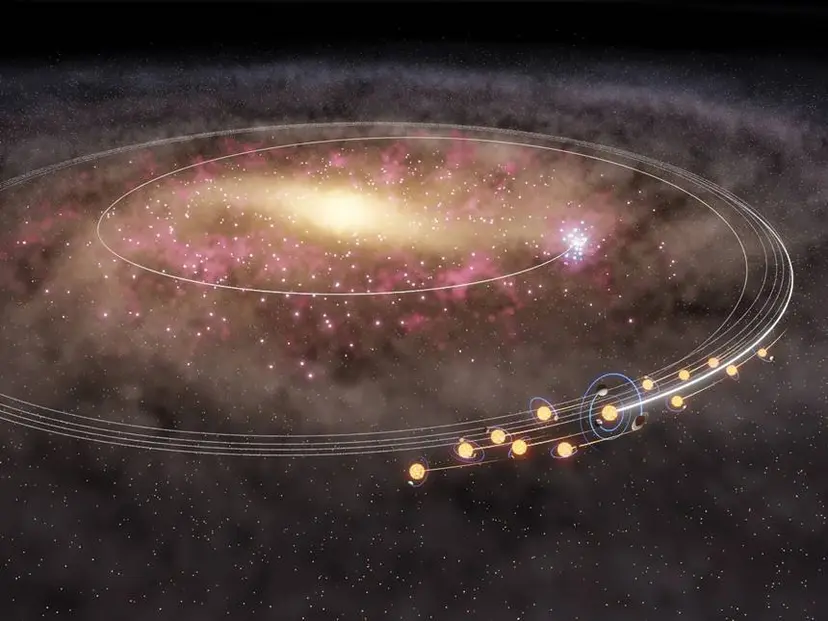
The phenomenon where a star's orbit changes significantly and it moves inside and outside the galactic center is called radial migration. It literally means migrating in and out along the radial direction. There are two main ways stars migrate. The case where a star naturally enters and exits the center of the galaxy while following the original elliptical orbit is called blurring. On the other hand, there is a method where the angular momentum of the star itself changes, changing the average radius of the orbit. This is called churning. If the Sun lived in the galactic center and arrived at its current position, it was likely churning, where the average size of the orbit itself moved outward, rather than simply having its orbit distorted and passing through its current position for a while.
This study analyzed the orbital characteristics of not only the Sun but all the newly revealed solar twin stars. We analyzed the size of the orbit, the degree of distortion into an elliptical shape, and how far they deviate perpendicular to the Milky Way disk plane according to the star's age. Interestingly, most of the solar twin stars are making a grand migration via churning. The Sun was living with its twins in its hometown near the center of our galaxy a long time ago, but at some point, it made a grand migration to the outskirts of the galaxy all at once.
There is a major obstacle in this scenario: the massive bar structure firmly planted in the center of our galaxy. This bar structure itself exerts strong gravity on the stars and gas that make up the galactic disk. In particular, if the speed at which the entire bar structure rotates (pattern speed) and the orbital speed of the stars in that area match perfectly, a kind of resonance occurs. Then, stars beyond that section cannot move in and out freely. This is because if a star trying to move from the galactic center to the outer part gets caught in the resonance radius section, it is trapped and maintains a stable orbit.
Looking at the scale of our galaxy's bar structure, a resonance barrier is formed at approximately 20,000 light-years from the galactic center. If so, the grand migration scenario of the Sun and its twin stars literally hits a big barrier. If the Sun was really born near the center of the galaxy inside the barrier and crossed over to the outer part of the galaxy beyond the barrier, we must explain how it could have broken through the barrier and come to this far-off place. There is only one way to solve this contradiction: that such a massive bar structure did not exist until the time the Sun was making its grand migration.
Surprisingly, the formation time of the bar structure is estimated to be between 4 billion and 7 billion years ago. This also overlaps with the period when it is estimated that the Sun and the twin stars made their grand migration together. It was during this period that a huge and distinct bar structure suddenly began to grow in our galaxy, disturbing the orbits of the stars in the inner disk and forcing them to move outward. As a result, the Sun and the twin stars likely made a grand migration efficiently all at once.
Now, this story connects to the problem of Earthly life. Perhaps the Sun's grand migration was one of the most important factors that allowed life to sprout on Earth. If the Sun had remained near the galactic center where it originally lived, Earthly life would likely have encountered a much more difficult environment. Stars are more densely packed inside the galaxy. Supernova explosions happen more frequently. Strong ultraviolet, X-ray, gamma-ray, and cosmic ray particles can damage planetary atmospheres or hinder the stable evolution of life. Of course, the supermassive black hole at the center of the galaxy, Sagittarius A*, is not always highly active, but the galactic center is likely to be exposed to more intense high-energy environments in the long term.
However, it would not have been good for the Sun to drift too far outside the galaxy either. The distant outskirts of the galaxy have relatively low metallicity. Here, "metal" to an astronomer does not mean just iron. It refers to all elements heavier than hydrogen and helium. Elements like carbon, oxygen, silicon, magnesium, and iron must be present for rocky planets to form, oceans to emerge, and for the chemistry of the crust, atmosphere, and living organisms to be possible. Going too far to the outskirts of the galaxy could mean a lack of these heavy element materials. Ultimately, the good place for life is not too close to the center of the galaxy and not too far outside the galaxy.
This perspective is called the galactic version of the Goldilocks zone, or the Galactic Habitable Zone. Just as the appropriate range where liquid water can exist around a planet is called the circumstellar habitable zone, the idea is that there may be a donut-shaped range within the galaxy where stars and planets suitable for life are highly likely to form. This concept considers factors such as metallicity, supernova frequency, star formation rate, and sufficient evolutionary time together. Classical studies have suggested the habitable zone of our galaxy as a ring-shaped region roughly 7-9kpc from the galactic center. Of course, this boundary is not an absolute line. Subsequent studies have criticized that the habitability of the entire galaxy should be viewed more flexibly. Nevertheless, the basic intuition that "too far inside is dangerous, and too far outside lacks materials" is still attractive.
Earth is right within the galactic Goldilocks zone. And the reason Earth got the optimal conditions might be because the Sun left its hometown early. Because the Sun was born in the inner disk, it could get materials sufficiently rich in heavy elements. Thanks to this, the rocky planet Earth was also created. However, the Sun did not stay in that dangerous inner environment. During the turbulent period related to the formation of the galactic bar, it moved outward and eventually reached its current, relatively quiet position in the galactic disk. Here, Earth gained billions of years of time. Oceans remained stable, the atmosphere was not completely stripped away, and life could endure multiple crises and evolve into complex forms.
From this point of view, the background of our existence is not just Earth. It is not just the Sun. The structural evolution of our entire galaxy is the background of Earthly life. The bar structure in the center of our galaxy, which seems to have nothing to do with the birth of life, might be the most important factor that gave life to Earth on a galactic scale. The bar structure shook the orbits of the stars, may have promoted star formation in the inner disk, and may have moved the Sun and solar twin stars outward. As a result, the Sun followed an exquisite path: born in a place where materials are abundant, and living a long life in a place where the risk is relatively low. If we want to find traces of extraterrestrial life even in external galaxies tens of millions or hundreds of millions of light-years away, we might need to pay attention first to spiral galaxies that retain a distinct bar structure.
This also gives new imagination to extraterrestrial life exploration. Until now, when we searched for life, we mainly looked for planets around stars, especially planets where water could exist as a liquid. But in a larger sense, the galactic environment to which the planet belongs can also be important. If we want to find traces of life even in external galaxies beyond our own, we might need to pay attention to galaxies that have a distinct bar structure at the center. Of course, we cannot say that life exists just because it is a barred galaxy. However, if the bar structure promotes the radial migration of stars and can move stars born in the metal-rich inner disk to more stable outer regions, a distinct bar could be a galactic device that increases the possibility of the emergence of planets favorable to life.
It is often said that it takes a whole village to raise a child. Perhaps for life to sprout on a planet, not only the intervention of the star or moon right next to it, but the efforts and coincidence of numerous stars on the scale of the entire Milky Way may have to help.
Reference
https://www.aanda.org/articles/aa/full_html/2026/03/aa58914-26/aa58914-26.html
Who is the author, Woong-Bae Ji? He loves cats and the universe. After watching 'Galaxy Express 999' as a child, he dreamed of making the beauty of the universe known. He is currently an assistant professor at the College of Interdisciplinary Studies at Sejong University, participating in various science communication activities such as lectures and writing. He has written books such as 'A Piece of the Universe Every Day', 'Scientists of the Starry Universe', 'Things You Can't Go To But Can Know', and 'Strange Questions That Come to Mind When Looking at the Universe', and translated books such as 'The Hitchhiker's Guide to the Real Universe', 'How I Killed Pluto', 'Quantum Life', and 'Cosmigraphics'.