

[비즈한국] NongHyup Chairman Kang Ho-dong has announced that he will accept the introduction of a direct election system. Currently, the NongHyup Chairman is elected by the votes of approximately 1,100 NongHyup cooperative heads. If the direct election system is introduced, all NongHyup members will participate in the vote. The total number of NongHyup members is reported to be around 1.87 million. The NongHyup National Agricultural Cooperative Federation stated, "We will actively accept the direct election system for members with an open mind and a sense of responsibility," adding, "We share the view that improvements are needed for a more democratic and accountable election system."
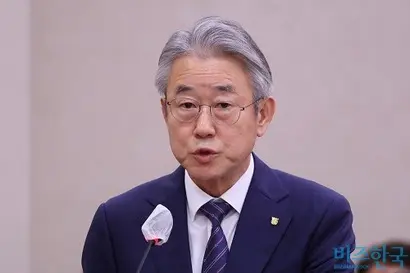
Recently, Chairman Kang Ho-dong has been embroiled in various controversies and has faced significant criticism from political circles and farmers' groups. Along with this, demands have emerged for the introduction of a completely direct election system for the NongHyup Chairman. The reason is that if the NongHyup Chairman is elected through votes by cooperative heads, there is a high possibility of various irregularities, such as bribery, emerging during the election process. Chairman Kang is also suspected of providing gifts worth 490 million won to individuals who helped his campaign through an executive at the NongHyup Foundation.
"The Farmers' Path with the People" held a press conference on May 8 and argued, "We must begin processing the amendment to the NongHyup Act, which focuses on the direct election system for farmer members and the independence of the Audit Committee." The Farmers' Path with the People is an organization formed by the solidarity of eight farmers' groups. President Lee Jae-myung also said at a senior secretaries meeting on May 14, "Please speed up institutional improvements such as a direct election system for members so that it can be reborn as a true NongHyup that takes the lead in improving the quality of life for farmers."
Strictly speaking, the NongHyup National Agricultural Cooperative Federation is a private entity, but because it is influenced by various policies and subsidies, it is difficult for it to be free from government influence. As Chairman Kang, he is in a position where he cannot simply ignore the direct election system that the President has directly mentioned.
To implement a direct election system, an amendment to the law is first required. However, the opposition party, the People Power Party, is opposed to it. Chung Jeom-sik, policy committee chair of the People Power Party, said at a floor countermeasures meeting in April, "NongHyup is not a government agency but a cooperative owned by farmers," and countered, "We must not force through unilateral legislation in a 'speed battle' style when there are significant concerns in the field regarding core issues such as the direct election of the chairman, expansion of government oversight, and separation of audit bodies."
There are also practical issues. It is estimated that up to 40 billion won will be spent on the NongHyup Chairman election if a direct election system is introduced. The NongHyup National Agricultural Cooperative Federation released a statement on May 21, saying, "There are tasks that must be solved, such as regional conflicts, the politicization of NongHyup, and the side effects of money-driven elections following the introduction of a direct election system," and added, "In particular, since the burden of excessive election costs leads to a decrease in support resources for members, institutional support such as the introduction of a public election system is desperate."
The public election system is a system in which all or part of the costs required for an election are borne by public entities such as the state or local governments. Since the introduction of a direct election for the NongHyup Chairman would expand the voting base to all members, potentially increasing election costs significantly, the need for a public election system is being raised within and outside NongHyup as a complementary measure to reduce cost burdens and concerns over money-driven elections. However, if government funds are injected into the election of a private company's chairman, further controversy may arise.
As the ruling Democratic Party of Korea holds a majority of seats in the National Assembly, it is possible to amend the NongHyup Act if they force the bill through. There is no problem under the current law if the government does not inject funds into the NongHyup Chairman election. However, it is difficult for the government or the Democratic Party of Korea to push ahead blindly. This is because there is a move in political circles to relocate the NongHyup headquarters to the Honam region, but the NongHyup labor union is currently strongly opposed to it. If the NongHyup executive team joins in, the relocation of the headquarters will become even more difficult.
It is possible to force the relocation of the NongHyup headquarters by amending the NongHyup Act. However, it is a significant political burden to explicitly specify a certain region in the bill while NongHyup employees are opposed. In a sense, the cooperation of the NongHyup executive team is necessary. It is assessed that HMM was able to relocate its headquarters to Busan without much noise recently because HMM CEO Choi Won-hyuk succeeded in persuading the labor union.
Perhaps for this reason, the government also seems to be showing a positive attitude toward the public election system. Kim Jong-gu, Vice Minister of Agriculture, Food and Rural Affairs, mentioned at a meeting on May 7, "We are reviewing alternatives at the government level, such as strengthening the eligibility for the chairman, introducing a public election system, holding concurrent elections for the chairman and cooperative heads, and cost-cutting measures through organizational efficiency upon the independence of the NongHyup Audit Committee."