

[비즈한국] On June 3rd, the 9th Nationwide Simultaneous Local Elections will be held. It is a large-scale election where we elect heads of metropolitan and local governments, local council members, and superintendents of education all at once. However, many voters perceive local elections as merely a 'scaled-down version of the presidential election' or a 'mini-version of the general election.' This means they look at the party logo before the candidate's name at the polling station.
As someone who has been observing the real estate market for nearly 30 years, I want to clarify this point. Local elections are fundamentally different from presidential or general elections. Their impact on your local real estate market is more direct and immediate than that of a presidential election. This is why distinguishing between candidates who will work for the region and its residents, rather than those who prioritize party interests, is no different from protecting your own assets.
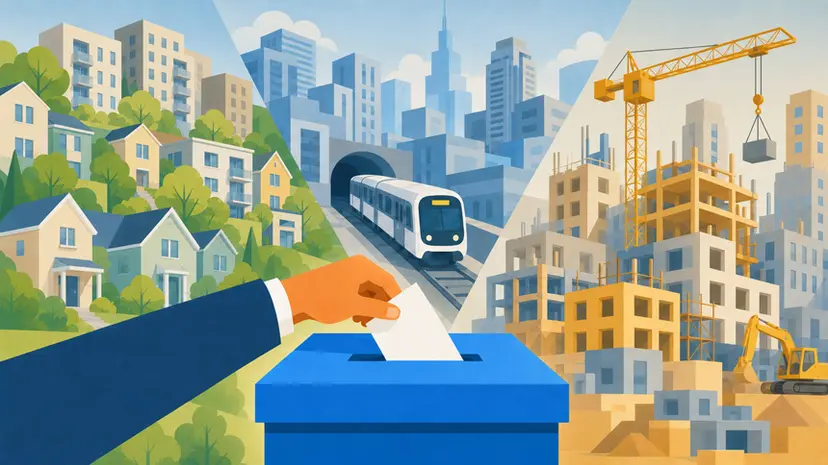
Why local elections are decisive for real estate
Policies determined by the President and the National Assembly are macroeconomic in nature. This includes the general framework of tax systems such as heavy capital gains taxes, financial regulations like LTV and DSR, and comprehensive real estate and property taxes. However, what gets built in your neighborhood, which roads are paved, what schools are established, and which zones are designated for redevelopment are almost entirely decided by heads of metropolitan and local governments and local councils.
Let's look at this more specifically.
· Urban master plans and urban management plans: These are under the authority of provincial governors, mayors, county governors, and district heads. This determines whether your neighborhood remains a residential area or converts to a commercial or business district, and how much floor area ratio (FAR) and building-to-land ratio are permitted.
· Designation and cancellation of redevelopment/reconstruction zones: The head of the local government holds the effective decision-making power. Depending on who is in charge, a project that could take 4 years might drag on for 10, or a stalled project might gain momentum as soon as their term begins.
· Cooperation on transportation networks like metropolitan and urban railways: In the process of establishing new GTX routes, light rail, BRT, and metropolitan bus routes, the head of the local government's negotiating power and authority to decide on cost-sharing become decisive variables.
· School districts and educational environment: The superintendent of education is responsible for the establishment, relocation, and consolidation of schools and the designation of school sites. Changes in school districts immediately impact apartment prices.
· Local finance and tax administration: Decisions related to local finance, such as adjusting flexible property tax rates, ordinances for acquisition tax exemptions, school site contributions, and urban planning taxes, are all within the realm of local government.
· Speed of licensing and predictability: Even under the same laws and projects, the speed of processing permits and administrative styles vary widely by local government. We have seen countless cases where, despite the project site remaining the same, progress accelerates or grinds to a halt after a change in leadership.
One more thing we must not forget is the local council. All ordinances, budgets, and permits pushed by the government head go through the scrutiny and approval of the local council. Even if the government head has a great plan, it won't proceed if the council blocks it; conversely, if the council fails to check the head, accidents happen if they push through unreasonable plans. Each and every member of the city/provincial or city/county/district council ultimately creates the real estate environment of your neighborhood. Surprisingly, many people only look at the government head and vote carelessly for local council members, which is a bad habit.
By now, you should realize that the saying “four years of real estate environment is decided in a single local election” is by no means an exaggeration.
Types of campaign pledges to watch out for from a real estate perspective
First, transportation pledges such as “I will open the ○○ subway station within my term.” The project period for metropolitan and urban railways is typically over 10 years. Promises to open new lines within a 4-year term are mostly cases of taking previous administrations' projects as one's own or are empty, unrealistic claims. You should be suspicious of transportation pledges that lack details such as which stage the route negotiation is in, whether the preliminary feasibility study has passed, and what the financial sharing ratio is.
Second, pledges like “I will lift regulations to raise housing prices.” This does not mean that deregulation itself is bad. However, a city is a system that is impossible to restore once it collapses. We have seen in many cities what happens to complexes where the floor area ratio is excessively relaxed and infrastructure fails to keep up, or what new complexes look like after 5 years when schools, roads, and parks are missing. Short-term stimulus ultimately forces someone to pay the price.
Third, industrial pledges to “attract ○○ company” should also be scrutinized. You need to look at whether there is a real possibility of attraction, whether it is only at the MOU stage, and how far land procurement, incentives, and licensing have progressed. Attracting companies is a pledge that is easy to use to stimulate votes because it has a large impact on real estate, but it is also an area with many empty promises.
Fourth, stances on issues where development and conservation collide. Issues like lifting Green Belts, lifting military protection zones, high-density development near stations, and improving old detached housing areas will inevitably have side effects if you only listen to one side. A candidate who meets all stakeholders and offers a balanced solution will, in the end, best protect the real estate value of that neighborhood.
Fifth, candidates with a dark history in previous terms. Candidates who have been involved in lawsuits due to unreasonable pushing of urban planning projects, have been involved in permit corruption allegations, or have a history where the timing of their or their family's real estate transactions suspiciously overlaps with urban planning decisions should be put on hold. Past actions speak more accurately than flashy new pledges.
Conclusion: The weight of one vote
Real estate is, ultimately, where people gather. What brings people together are jobs, transportation, schools, parks, and the administration that knows how to coordinate all of these. It is through local elections that we directly choose the top leader of that administration.
If you remove the party labels and look at the candidates one by one, you can see who has lived in the neighborhood their whole life and who is just passing through. You can see who prides themselves on knowing every alley and who gets the neighborhood name confused. You can see who speaks in concrete numbers and who speaks only in fancy slogans. You can see who has a history of keeping promises and who is just good at making them.
Four years of the real estate environment is decided on June 3rd. If we put it grandly, that is true. More accurately, the framework of a city that will affect not just the next 4 years but the next generation is decided that day. Urban planning is almost impossible to undo once it is drawn incorrectly. We have seen too many times how one wrongly placed road or one incorrectly designated zone leaves a 30-year scar.
Please cast your vote by looking at the person, not the party; the pledge, not the slogan; the numbers, not the flowery rhetoric. The discernment to recognize someone who will truly work for the region and its residents is essentially the same as the discernment to recognize good real estate. Don't be fooled by a flashy exterior; use the same eyes you use to pick real estate—those that evaluate location, fundamental strength, and future value—to pick your candidate.
※ Kim Hak-ryul, Director of the Smart Tube Real Estate Research Institute, known by the pen name 'Pashong', served as the team leader of the Real Estate Research Division at Gallup Korea. He operates and hosts the Naver blog 'Pashong’s World Exploration' and the YouTube channel 'Stew TV'. His books include '3040 Beginner's First Real Estate Investment (2026)', 'Rewriting the Republic of Korea Real Estate User Manual (2025)', 'The Power of Gyeonggi-do Real Estate (2024)', 'Absolute Principles of Seoul Real Estate (2023)', 'The Future of Incheon Real Estate (2022)', 'Kim Hak-ryul's Absolute Principles of Real Estate Investment (2022)', 'Future Map of Korean Real Estate (2021)', and 'From Now On, Only Places That Will Rise, Will Rise (2020)'.